
Comprehensive, coherent and collective action urgently needed

I am writing a paper on the disastrous turn in economic theory in which I explain that what is needed is a proper introduction of supply-side economic theory, which is really just classical economics with its modern name. Normally when I do this, I focus on John Stuart Mill since he finally brought it all together in his Principles, published 1848. Of late, I have also taken to using Henry Clay’s Economics: an Introduction for the General Reader which was published in 1916. There is such clarity there that I cannot believe how few of us there are anywhere who are even tuned into this stuff. But this time, partly just for a change, but also because he has more street creds even now, I have based my paper on Adam Smith and his Wealth of Nations. And what has amazed me is that it is all there, every last bit of it. The language is archaic, and being words without equations and numbers, few modern economists would make heads or tails of it. Too bad for us all, since this is what needs to be understood if we are ever to emerge from the mess our economies are in.

The reason I mention this is because of this news item at The Australian: OECD cuts forecasts, warns on growth. They are utterly bewildered, not just by how dead our economies are but by the refusal of governments to apply more of the same kinds of stimulus that created these problems in the first place.

The world’s economy is ensnared in weak growth and vulnerable to falling into another deep downturn unless governments take urgent action, the Organisation for Economic Cooperation and Development said on Wednesday.

Releasing its semiannual economic outlook, the Paris-based organisation amplified its call for governments to stimulate their economies by expanding investment and implementing policies that fuel competition, increase labour mobility and strengthen financial stability.

“The need is urgent,” OECD chief economist Catherine Mann said. “The longer the global economy remains in the low-growth trap, the more difficult it will be to break the negative feedback loops,” she added.

But there are signs of hope. Bad as our growth rates are – forecast 1.8% across the OECD! – no one any longer wants to take the same kinds of suicidal actions that created the problems in the first place.

The OECD called on governments in February to head off risks to the global economy by ramping up investment spending. The starker warning in the May economic outlook indicates little effective action has been taken and highlights the further dwindling of prospects for more sturdy growth.

In the most recent sign of reluctance among major economies to embark on fiscal stimulus, the Group of Seven leading industrialised nations stopped short of announcing coordinated action at a meeting last week. . . .

To lift the world’s gloomy economic prospects, the OECD laid the burden on governments rather than central banks because the room for expansionary monetary policies is reaching a limit.

They’re still Keynesians at the OECD in spite of everything. Such innocence, unfortunately combined with a deadly reluctance to investigate any other approach. I however completely agree with her about this:

“Policy-making is at an important juncture. Without comprehensive, coherent and collective action, disappointing and sluggish growth will persist,” Ms Mann said.

The dangerous part is that she has not a clue what the comprehensive, coherent and collective action needs to be.
Why haven’t they been able to do it?

Achieve recovery, that is. Because the overriding goal is to protect the status quo. At least he has noticed there is no doubt that the recovery programs have not worked. From Mike Campbell’s You won’t hear this anywhere which, oddly, is the case, except here, of course, but that doesn’t count. He doesn’t know why either, but at least he is willing to notice.

What’s wrong with the Venezuelan economy?

free market crayons

OK, Venezuela is a mess, but what’s the reason? Here are a few recent stories to remind us that there are at least some paying attention. But these are mostly about what is happening, not why it’s happening.

Venezuela Drifts Into New Territory: Hunger, Blackouts and Government Shutdown…

80% of basic products in short supply…

Venezuela Is Falling Apart

Venezuelans on the food and economic crisis blighting their daily lives

How Venezuela’s socialist dream collapsed into a nightmare

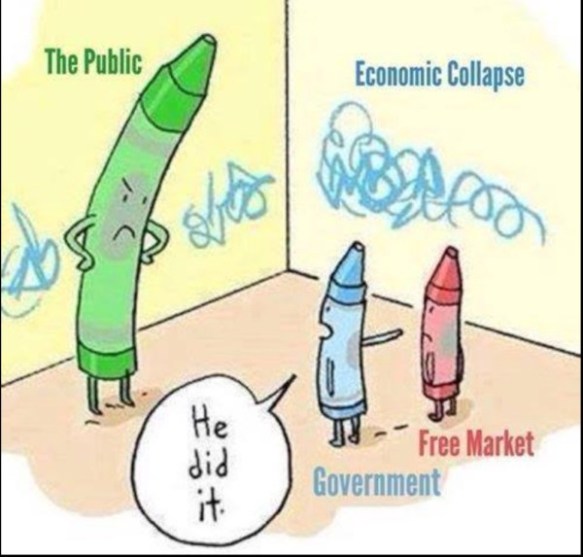
My question is, do people any longer even understand what the problem is and why things are working out this way? The country has more oil than Saudi Arabia and yet its economy is disintegrating. It seems to me that if you vote for the Greens, and possibly Labor, you are a prime candidate to take your country in a Venezuelan direction with not a clue in the world about what you are doing wrong.

BTW an extraordinarily clever cartoon.

Economics from bad to worse

I’m afraid I have now come upon the definitive evidence that economists have no idea how an economy works. It’s from The Economist last month, it’s titled, “Money from Heaven”, but it is the subtitle that provides all the evidence that economic theory is lost in the forest and is unlikely to find its way out any time soon: To get out of a slump, the world’s central banks consider handing out cash.

“HELICOPTER money” sounds like an item on an expense claim at a hedge fund. In fact, it is shorthand for a daring [!!!] approach to monetary policy: printing money to fund government spending or to give people cash. Some central bankers seem to be preparing their whirlybirds (and their printing presses). In March Mario Draghi, the president of the European Central Bank, described helicopter money as a “very interesting concept”. Ardent supporters see it as a foolproof way to perk up slumping economies.

The notion has as much potential to drive recovery as the NBN or Building the Education Revolution. It continues to believe that public sector waste in the form of fake versions of productive investment (green energy, crony capitalist enterprises, rail and roads) will make an economy grow. No modern economics text so far as I know even discusses the notion of value added outside of the national accounts, which means economists grow up without knowing the single most important part of what causes growth. It is never part of the equation. Seriously, how could any self-respecting economist endorse this?

Advocates of helicopter money do not really intend to throw money out of aircraft. Broadly speaking, they argue for fiscal stimulus—in the form of government spending, tax cuts or direct payments to citizens—financed with newly printed money rather than through borrowing or taxation. QE qualifies, so long as the central bank buying the government bonds promises to hold them to maturity, with interest payments and principal remitted back to the government like most central-bank profits. (The central banks now buying government bonds insist they will sell them at some point.) Bolder versions of the strategy make the central bank’s largesse more explicit. It could, for instance, hand newly printed money directly to citizens. Jeremy Corbyn, leader of Britain’s Labour Party, has proposed “people’s QE” of this sort.

The advantages of helicopter money are clear. Unlike changes to interest rates, stimulus paid for by the central bank does not rely on increased borrowing to work. This reduces the risk that central banks help inflate new bubbles, and adds to their potency when crisis or uncertainty make the banking system unreliable. Fiscal stimulus financed by borrowing provides similar benefits, but these could be blunted if consumers think taxes must eventually go up to pay off the accumulated debts—a problem helicopter money flies around.

Haven’t these people ever heard of Venezuela? Do they really not understand that growth comes from value adding production and can come from nothing else. Do they not understand that for a project to be value adding, the value of what is produced must be greater than value of the resources used up. Loss making enterprises cannot cause growth. If this is really what economist think, economics is beyond a pseudo-science and into the region of crackpot.

There is no such thing as a predictive theory of surprise, change and innovation

The argument is not new, which only means that it is a truth long known: The new astrology – By fetishising mathematical models, economists turned economics into a highly paid pseudoscience. But I have to say that this is a very long and tedious article, so long and tedious that no one will ever read it, at least among the economists. And this is point blank wrong:

After the Great Recession, the failure of economic science to protect our economy was once again impossible to ignore.

The failure of economic theory has been the least discussed issue among economists I have ever seen. If there has been a serious post mortem, I haven’t come across it. And the supposed issue, if any has arisen, has been the failure to predict the GFC which could never have been predicted. Even trying to trace it after it all happened has been near impossible. A crisis will almost inevitably seem to come from nowhere, although there will be some who can say afterwards that they could see it all before. The actual problem is with the theory itself, but let us go to the text to see what they have to say:

Ultimately, the problem is . . . with uncritical worship of the language used to model them, and nowhere is this more prevalent than in economics. The economist Paul Romer at New York University has recently begun calling attention to an issue he dubs ‘mathiness’ – first in the paper ‘Mathiness in the Theory of Economic Growth’ (2015) and then in a series of blog posts. Romer believes that macroeconomics, plagued by mathiness, is failing to progress as a true science should, and compares debates among economists to those between 16th-century advocates of heliocentrism and geocentrism. Mathematics, he acknowledges, can help economists to clarify their thinking and reasoning. But the ubiquity of mathematical theory in economics also has serious downsides: it creates a high barrier to entry for those who want to participate in the professional dialogue, and makes checking someone’s work excessively laborious. Worst of all, it imbues economic theory with unearned empirical authority. . . .

Romer is not the first to elaborate the mathiness critique. In 1886, an article in Science accused economics of misusing the language of the physical sciences to conceal ‘emptiness behind a breastwork of mathematical formulas’. More recently, Deirdre N McCloskey’s The Rhetoric of Economics (1998) and Robert H Nelson’s Economics as Religion (2001) both argued that mathematics in economic theory serves, in McCloskey’s words, primarily to deliver the message ‘Look at how very scientific I am.’

You cannot use maths because there is nothing to count, or at least nothing to count that really counts. That, and the fact that what was true last year is only the most imperfect guide to what will happen next. You cannot have a predictive theory of surprise, change and innovation. You can only have a theory of what conditions will lead to surprise, change and innovation, but that was done by the 1850s.

Why is Venezuela not at the top of the news every day?

Venezuela is the socialist nightmare of our time. It is kept out of the media in the same way that the famines in the Ukraine were kept out of The New York Times in the 1930s. The socialists who mis-report the news do not wish to see their dreams exposed no more than they would like to live in the countries they hide the details about.

Here’s the latest episode: SCENES FROM THE VENEZUELA APOCALYPSE: “COUNTLESS WOUNDED” AFTER 5,000 LOOT SUPERMARKET LOOKING FOR FOOD.

Capitalism works. Nothing else does. This is the lesson from Venezuela that none of the fools who follow Bernie Sanders or the Greens ever seem to understand.

There is this contrast with the United States, which is of course at the absolute opposite extreme, but is somehow disturbing in its own way. Yet if you asked Americans and Venezuelans (and Cubans and North Koreans) which they preferred, there is no doubt which of the two virtually everyone would prefer. It’s the ones who prefer the genuine austerity of Venezuela we have to worry about.

The epitaph for Keynesian economics: si monumentum requiris, circumspice

The article is titled, Obama Presides Over the Feeblest Post-WWII Recovery which doesn’t even get to how bad it has been. Modern statistical tools aren’t up to it, but then neither is the theory. This is how the article ends:

Deep recessions have traditionally been followed by fast recoveries, but Obama broke this mold. In so doing, he proved once again that a combination of chaotic monetary policy, rising taxes, and suffocating government regulation is not a formula for prosperity.

Where is even mention of a problem associated with higher public spending? Not there because no matter where you start from as an economist today, public spending is a positive. And it’s not that monetary policy has been “chaotic”. Stability has been the watchword over the past seven years, rates kept down by Federal Reserve decree. It is that interest rates have been kept artificially very low but where do they teach how disastrous such a policy is? As for regulation, it’s bad but nothing particularly new. No doubt somewhat worse than a decade ago, and should be reversed, but regulation is not the central problem.

Here, however is a different explanation: The United States of Insolvency.

Crises and business cycles are always with us. I merely observe that sound money and a balanced budget were two sides of the coin of American prosperity.

Then came magical thinking. Maybe you had a taste of modern economics in school. If so, you probably learned that the federal budget needn’t be balanced–it’s nothing like a family budget, the teacher would say–and that gold is a barbarous relic. To manage the business cycle, the argument went, a government must have the flexibility to print money, to muscle around interest rates and to spend more than it takes in–in short, to “stimulate.”

Oh, we have stimulated. Between the fiscal years 2008 and 2012 alone, federal deficits totaled $5.6 trillion. The public debt nearly doubled in the same span of years, to $11.2 trillion. The Federal Reserve tickled $1.6 trillion in new digital dollars into existence. True, our Great Recession proved no Great Depression, but the post-2008 recovery is the limpest on record.

It’s not, however, the debt per se. It is that government spending is never value adding. We teach that debt doesn’t matter and public spending is a stimulus. Keynes can truly say as we look across the world’s economies: “si monumentum requiris, circumspice“.

ADDING A BIT MORE: There’s probably not a day that goes by that I am not reminded of how disastrous Keynesian theory has been. There is nothing wrong in principle with doing things that will reduce unemployment and get recovery going. But there is a very great deal wrong in practice with public spending as the vehicle. So we can add this from today:

Middle class takes hit in most cities…
Incomes have fallen in four-fifths of all metro areas…
New American Home: Multi-Generational Living on Rise…

The ridiculous notion that we are falling into some kind of deflationary trap is being promoted because if you are a Keynesian you have virtually nothing else to say since you cannot blame it on the policies you believe must work.

Free trade is just another word for nothing left to lose

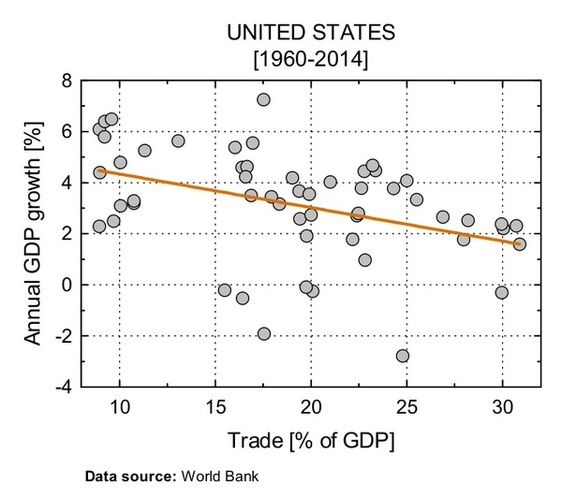
trade to gdp

Comparative advantage is obviously true: you can get more output if production is undertaken by producers who use fewer resources per unit of output. Can also be explained as recommending that production should be undertaken by the lowest cost producers if maximising production is the aim. And as with every statement such as this in economics, it comes with the proviso “all other things being equal”.

One of the bits about free trade I like to tease others with is that every trade negotiation is about concessions to reduce one’s own trade protection so that we can have the opportunity to sell more of our stuff to them. But they will only do that if we give them greater access to sell their stuff in our markets. No one, but absolutely no one, begins from the proposition that since free trade is so great, we will cut our tariffs and trade protection to zero and then cream all of the great advantages it will thereafter bring.

Which brings me to this article from which the above graph was taken: If trade made the US rich, explain this graph. Here’s the most specific para but do read the lot:

If your argument is founded on logical fallacies and theories that do not match reality, perhaps the belief is wrong. It goes without saying that the situation is complex, but to some extent, that is irrelevant. The result is what matters, and for as far as reliable records go back, the result is wrong.

Obviously, many, many, many other things are not equal but that is, of course, the point. Economic theory is looking like just so much hot air even here. The adjustment process is not instantaneous but requires immense restructuring that can take a generation. You know that business about there being no such thing as a free lunch. Maybe we should start thinking that maybe there’s no such thing as free trade either. No adjustment comes without costs. And when you add them in, free trade may be less of the bargain we traditionally think it is.

The arguments for free trade never envisaged a monstrous welfare and bureaucratic class either, where their level of demand was unrelated to the provision of value adding goods and services. And that’s just where criticism of the traditional theory might start.

Trump and economic policy

Most businesspeople don’t have the ability to convert their understanding of the corporate world into a coherent set of policies that will work across the economy and particularly on the supply side. They know what might work for them, but not necessarily across the board. I hadn’t even known Trump had even begun to develop a coherent approach to economic recovery, and it certainly does look to me as if he has had some very clued-in assistance in putting it together. It is in part outlined here: Beyond All the Bluster Trump’s Economic Plan Focuses on Growth, Jobs. This is the sort of thing that will work:

  • slash the corporate tax rate to 15%, down from the current 40%, the highest rate in the industrialized world
  • a one-time 10% repatriation tax on profits American companies made overseas and kept there to avoid the 40% rate
  • allow companies to write off the purchases the year they’re made, rather than over several years, as current law requires
  • the lower 15% rate business rate would also apply to small businesses that usually get taxed at individual income tax rates
  • his “make America rich” plan targets impoverished cities like Baltimore with incentives for companies to move there
  • convert the current State Department program that brings about 100,000 young foreigners into America to work in restaurants, camps, and seaside resorts under J-1 visas into a jobs bank for American inner city youth.

Meanwhile Hillary:

Compare Donald Trump’s blueprint with Secretary Clinton’s nightmare scenario: Higher taxes, more tax complexity, and an avalanche of new regulations. Over-regulation has depressed growth for the last fifteen years. The Obama administration suffocated business with 81,000 pages of new regulations in 2015 alone. Hillary Clinton is pushing for even more – with controls on hiring, pay, bonuses and overtime to promote “fairer growth.” Translation: gender and racial preferences, plus meddling in how much you get paid.

Remember President Obama’s statement, “You didn’t build that.” Well, Mrs. Clinton assumes “you don’t own that.” Government will run your business. Mrs. Clinton wants companies to stop maximizing quarterly earnings for shareholders – what she derides as “quarterly capitalism.” She wants “farsighted investments,” as defined by government, of course. Companies that can get out of the U.S. will rush for the exits. She’s even promising an end to “the boom and bust cycles on Wall Street.” As plausible as ending rainy days.

Infantile versions of fairness seldom mix well with sound economic policy. Trump has nevertheless put together a package that will work, although the cuts to spending and the scaling back of programs will also at some stage have to be included as well. But what we find above is very good, and about time.

And for what it’s worth, the article was written by Elizabeth “Betsy” McCaughey, who was Lieutenant Governor of New York from 1995 to 1998, during the first term of Governor George Pataki.

FURTHER REPORTS: It’s Reuters reporting on what CNBC is reporting, which is remarkable in itself: Trump wants to help U.S. businesses by lifting slew of regulations: CNBC.

U.S. Republican presidential candidate Donald Trump said on Thursday that if elected he would scrap a slew of federal regulations that he said are even more of a burden on American business owners than high taxes, and would try to refinance longer-term U.S. debt.

Not much detail in the story but you may be sure these are the kinds of things he means to do and will know which regulations ought to go.

Here is something governments don’t seem to know: corporate revenue funds capital accumulation, innovation, and economic growth

An interesting article by Stephen MacLean on Government Greed Axes the Golden Goose that got me thinking. The way you hear governments tell the story, there is a much larger amount of tax these corporates should pay than they actually do pay, which coincides with some fictitious number related to the amount of money they wish they could cream off for themselves.

But looked at another way, it may well be that the most socially beneficial outcome is for corporates to pay as little tax as possible so that their earnings can be ploughed back into their firms. The role of business is not as a means through which governments can raise money, but as a mechanism through which material welfare is provided to a community. The higher are the business taxes paid, the worse off the community ends up. As MacLean writes:

Middle-class Americans would be among those most hurt by Washington’s tax grab, as it is corporate revenue that funds capital accumulation, innovation, and economic growth. Tax away profit, and you tax away employment opportunities.

Thus, the most socially responsible approach to taxation by corporates may be to avoid paying taxes to the largest extent they are legally able. They are doing these governments a favour, but, as with so much, political greed far exceeds common sense.