Only one book written in the twenty-first century will explain the classical economics of the nineteenth

At Quora, this question: What are 25 economics books that you would recommend (preferably classical and neoclassical)? My answer:

If you are seriously interested in understanding economics you need to understand classical economic theory, the economics of the period from the publication of Adam Smith’s Wealth of Nations in 1776 until the marginal revolution began about a hundred years later in the 1870s. And if you are interested in understanding classical economic theory, you should read the third edition of my own Free Market Economics: an Introduction for the General Reader.

Modern economic theory has fallen into very hard times since its classical period, and is now incapable of explaining almost anything that matters. My FME third edition is entirely supply-side, explaining how classical economists understood the operation of an economy which is how an economy actually does work.

From the marginal revolution with its focus on marginal utility, through to the Keynesian Revolution of the 1930s with its introduction of aggregate demand, economic theory has looked at economies from the demand side. And while it has a superficial appeal, no economy is driven by demand. All economies are driven from its production side. People buy more where more is produced. If you want to understand what allows people to demand, you first have to understand what makes them capable of producing.

I will just add that if you try to read classical theory without some preparation for the changes in the terminology between economics today and economics then, you will miss the point. This is a paper you can find at SSRN which will help you get past what is a quite formidable barrier.

Classical Economics Explained: Understanding Economic Theory Before Keynes

Steven Kates

Abstract

Since the publication of The General Theory, pre-Keynesian economics has been labelled “classical,” but what that classical economics actually consisted of is now virtually an unknown. There is, instead, a straw-man caricature most economists absorb through a form of academic osmosis but which is never specifically taught, not even as part of a course in the history of economics. The paper outlines the crucial features that differentiate modern macroeconomics from classical theory, with the emphasis on what an economist would have understood as The General Theory was being published. Based on the differences outlined, a model of classical economic theory is presented which explains how pre-Keynesian economists understood the operation of the economy, the causes of recession and why a public-spending stimulus was universally rejected by mainstream economists before 1936. The classical model presented is an amalgam of the final edition of John Stuart Mill’s 1848 Principles of Political Economy published in his lifetime and Henry Clay’s influential 1916 Economics: an Introduction for the General Reader, a text which was itself built from the economics of Mill.

Here’s the link to the paper.

Classical Economics Explained: Understanding Economic Theory Before Keynes

Protection for Republican majorities in the House and Senate

I am a free trader by nature but not a big fan of economic forms of self-harm. And I am certainly for Trump basing his decisions on political calculation, since I am also against political forms of self harm. PDT is shifting towards a slight increase in protection for American products, as summed up in this article from The Wall Street Journal: ‘Every day is a new adventure’: Trump upends Washington and Wall Street with shifts on trade, guns. Pulling the various bits from the article, there are two sides to it, always bearing in mind that if it’s in the WSJ the story will be shaped by a free-trade ethos. So why, according to the story, would protection levels be increased. This is part of the Trump calculation:

  • foreign countries are stealing American jobs with cheap imports – tariffs are one of the only ways to punish other countries for practices that disadvantage U.S. manufacturers
  • impose tariffs on steel and aluminum in the name of national security – large amounts of cheap steel and aluminum posed a national security risk for the United States
  • Trump has also been keeping a close eye on the special election this month for a U.S. House seat in western Pennsylvania. Voters in places such as Pennsylvania’s 18th District are looking for more to be done by the administration. The president has noted that the Republican in the race is struggling in a district where he won by a large margin.

And why leave things alone. Again from the WSJ and part of the White House debate:

  • tariffs could spark a trade war – other countries would retaliate, imposing tariffs on U.S. exports, damaging an economy that Trump was trying to build up through his tax cuts
  • the stock market was doing well [as is the economy as a whole].

This is hardly a return to Smoot-Hawley, and if it protects Republican majorities in the House and Senate, the small ripple effects on the American and world economies will be worth the extra few cents Americans pay for the goods and services they buy. Meanwhile, this is the stated threat from Europe:

“We will put tariffs on Harley-Davidson, on bourbon and on blue jeans – Levi’s,” European Commission President Jean-Claude Juncker told German television.

Meanwhile public spending rises another trillion and no one says a word.

Coalition sense on IR

I imagine The Australian made this the first thing they told us about the new Deputy Prime Minister as a kind of negative point, but this is something that’s long been missing from the Coalition:

Mr McCormack upheld the importance of unfair dismissal laws to “protect workers”, ­reflecting on his decision to take action against the Riverina Media Group over his departure from The Daily Advertiser in Wagga Wagga — a rural paper that he ­edited for a decade between 1992 and 2002 — ­declaring that he had been “wronged” by his former ­employers.

See the quotes around “protect workers”. There must be some notion that workers being wronged by their employer is so farfetched that it has no place within a government that is pro-market. So let me point out that being shafted by one’s employer is not exactly an unknown phenomenon and it’s a pleasure to see someone back inside the leadership of the Coalition who understands this. I worked for a quarter of a century as the Chief Economist for Australia’s national employer association in the middle of our industrial relations system – even presented the National Wage Case on three occasions – but it never crossed my mind that in arguing on behalf of business that I was acting on behalf of people who were always guaranteed to do what was ethically and morally right. You have no idea what rotten sods there are running businesses, although now that I think about it, I imagine most of you do.

Our unique system of industrial tribunals is in my view a large part of what has made Australia so economically and socially stable. The blind spot in John Howard’s period as PM was his war on our tribunals which in the end led to his introduction of WorkChoices as the core industrial relations legislation. Remember this?

In May 2005, Prime Minister John Howard informed the Australian House of Representatives that the federal government intended to reform Australian industrial relations laws by introducing a unified national system. WorkChoices was ostensibly designed to improve employment levels and national economic performance by dispensing with unfair dismissal laws for companies under a certain size, removing the “no disadvantage test” which had sought to ensure workers were not left disadvantaged by changes in legislation, thereby promoting individual efficiency and requiring workers to submit their certified agreements directly to Workplace Authority rather than going through the Australian Industrial Relations Commission. It also made adjustments to a workforce’s ability to legally go on strike, enabling workers to bargain for conditions without collectivised representation, and significantly restricting trade union activity. . . .

WorkChoices was a major issue in the 2007 federal election, with the Australian Labor Party (ALP) led by Kevin Rudd vowing to abolish it. Labor won government at the 2007 election and repealed the whole of the WorkChoices legislation by the Fair Work Act 2009.

That’s not to say there are no improvements to be made, but a return to WorkChoices is not one of them. Perhaps for a change someone has learned something from history. Good to see Michael McCormack take up his place and good luck to him.

There are Keynesians in even the most unlikely places

This is from, of all places, Maurice Newman’s article in The Oz today on Trump’s news might be bad for his forgotten flock. So which is the absolutely wrong word in this passage?

Despite a decade of easy money, continued fiscal stimulus and a personal savings rate that has tumbled from 6.6 per cent to 2.4 per cent in just 12 years, the US economy during calendar 2017 grew at 2.5 per cent, hardly a number to write home about. Indeed, adjusted for the once-off hurricane rebuild effect, it managed just 1.5 per cent in the last quarter.

It is, of course, the first word, “despite”. If he had said instead, “because of …” then all would be clear. Artificially low rates of interest, high levels of unproductive public spending and falling savings are the very recipe for stagnation.

Ho hum; trillion dollar deficit

us fed debt

Here’s the US debt story with a bit of historical perspective. Here we find an example of Change You Can Believe In care of the blessedly departed Barack Obama. Consequences include slower growth, limited if not actually negligible increases in the real wage, additional upwards pressure on the price level and some additional increases in rates of interest. But really, where’s the constituency to do anything else? How many non-Keynesians are there, never mind anti-Keynesians?

Remember this? Remember how it ends?

What’s changed and how you gonna change it? Still, there are  regulations going and public spending is being better targeted. Large numbers are being peeled from the welfare rolls. Not good, but if the deficit is rising and you’re a Keynesian, what’s the problem? And if you’re not, what are you going to say to convince them otherwise?

Of course, there is then this from Drudge yesterday:

Then there’s this from today:

But then there’s this also from today.

Really, you only wish people knew how things worked, as in some business comes up with an idea, borrows some money to buy in some capital and labour, and then produces that are sold on the market for a profit. There is endless entrepreneurial drive in the US. With a President who is an entrepreneur, who knows what’s possible.

If you want to raise the minimum wage you need to raise productivity first

The video comes at an opportune time since this is a large part of where our next election will be fought: Business faces world’s highest minimum wage under Bill Shorten. I will also mention that the Card and Krueger study mentioned in the vid for many years played a large part in our own wage cases where I had to spend an inordinate amount of time demonstrating how inane the notion is that higher minimum wages do not cost jobs. They do. Unless productivity goes up, the only possible outcome of raising minimum wages is a fall in employment. The vid makes the case, while also establishing how out to lunch the economic establishment is in yet one more area. Thinking you can create jobs by raising the minimum wage is as stupid as believing you can increase employment through unproductive public spending. Modern economics has almost entirely lost its way, but if that’s the advice people want, there will be plenty of advisors to provide it.

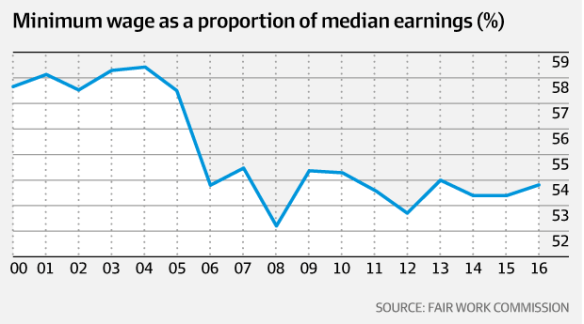
The chart below is from that same article, showing the drop in the minimum wage as a proportion of the median wage which coincided with the GFC and may even have preceded it. A very old sequence, a downturn that decimates industry changes the employment pattern along with the underlying wage structure. Using averages as a measurable reality that can be adjusted by some kind of administrative policy will never ever work. If you want to raise the real wage or the minimum wage you can only do it by raising the level of real value added per employed person. That’s called leaving things to the market, a very old idea that has always worked when it has been applied, but another one of those notions economists in general have long ignored and is now all but forgotten.

So far so good but this is only Year One

Here’s the question: Do economists understand what’s happening to the American economy? And here’s the answer: no, they don’t. So when I see the American economy picking up, I am excited to see how accurately classical economic theory explains what to do with the result right there before your eyes. I also don’t know if this is true – Economy to grow at 5.4% rate in first quarter, Atlanta Fed tracker shows – but no one will be surprised if things turn out that way. The question for the future, however, is different – whether our present growth rates can be sustained, and on whether you can depend on our current economic establishment not to muck things up.

Alas, economists learn not from experience, not from observing the world and what happens, but only via the theories they have been taught and passed examinations to demonstrate their knowledge of. I suppose there’s no other way, but it should make you cautious. Leaving economies in the hands of economists drenched in modern economic theory is not the best long-term strategy. A couple of examples of economic thinking from the very highest reaches of economic theory to help put things into perspective. First this via The Institute of International Monetary Research:

The accompanying video looks at a different topic. In an article in the current issue of The Oxford Review of Economic Policy, Professor Paul Krugman claims that economic theory and analysis have worked well over the last decade. He is a champion of the well-known Keynesian prescription, that an increase in the structural (i.e., cyclically-adjusted) budget deficit boosts aggregate demand and makes above-trend growth (with falling unemployment) more likely. According to Krugman, cheered on by Keynes’ biographer, Lord Skidelsky, in the Project Syndicate blog, these textbook ideas were translated into policy in the USA and went far to check the Great Recession. Krugman and Skidelsky believe that, in this sense, economics worked.

That is, it worked in the sense that the ridiculously exaggerated forecasts of doom never eventuated. But the recovery never occurred either, a recovery that is occurring now based on principles absolutely and completely antithetical to the policies adopted by those who applied a Keynesian stimulus.

So let me also mention this, Should We Reject the Natural Rate Hypothesis?, from the latest issue of the Journal of Economic Perspectives. This is the interim conclusion:

To summarize: I read the macroeconomic evidence as suggestive of persistent effects of monetary policy on the natural unemployment rate and potential output. But the evidence is not overwhelming. Moreover, looking just at recessions has its limits: It cannot answer whether there are symmetrical effects of booms and recessions, which is a crucial issue for the design of policy. In this context, a closer look at potential channels of persistence and more microeconomic evidence may help to assess potential nonlinearities or asymmetries between recessions and booms.

And this is the conclusion at the end:

Where does this leave us? . . . The general advice must be that central banks should keep the natural rate hypothesis as their baseline, but keep an open mind and put some weight on the alternatives. For example, given the evidence on labor force participation and on the stickiness of inflation expectations presented earlier, I believe that there is a strong case, although not an overwhelming case, to allow US output to exceed potential for some time, so as to reintegrate some of the workers who left the labor force during the last ten years.

That is, we should keep the theory intact but ignore the theory when it suits us because something else would be preferable even if the theory doesn’t tell you what that is. Indeed, if we are looking at the US economy and trying to explain its astonishing reversal over the past year, there is not a theory found in any modern text [except possibly mine] that will help you understand what is going on or why. These and their students are the people who run the show and make macro and monetary policy decisions while also regulating business. So far so good, but this is now before the economic establishment again gets their claws on the levers of power.

Do economists understand what’s happening to the American economy?

The answer is, of course, no, they don’t. A couple of examples from the very highest reaches of economic theory. First this from The Institute of International Monetary Research:

The accompanying video therefore looks at a different topic. In an article in the current issue of The Oxford Review of Economic Policy, Professor Paul Krugman claims that economic theory and analysis have worked well over the last decade. He is a champion of the well-known Keynesian prescription, that an increase in the structural (i.e., cyclically-adjusted) budget deficit boosts aggregate demand and makes above-trend growth (with falling unemployment) more likely. According to Krugman, cheered on by Keynes’ biographer, Lord Skidelsky, in the Project Syndicate blog, these textbook ideas were translated into policy in the USA and went far to check the Great Recession. Krugman and Skidelsky believe that, in this sense, economics worked.

That is, it worked in the sense that the ridiculously exaggerated forecasts of doom never eventuated. But the recovery never occurred either, a recovery that is occurring now based on principles absolutely and completely antithetical to the policies adopted by those who applied a Keynesian stimulus.

And while we’re at it, I might also mention this, Should We Reject the Natural Rate Hypothesis?, from the latest issue of the Journal of Economic Perspectives. This is the interim conclusion:

To summarize: I read the macroeconomic evidence as suggestive of persistent effects of monetary policy on the natural unemployment rate and potential output. But the evidence is not overwhelming. Moreover, looking just at recessions has its limits: It cannot answer whether there are symmetrical effects of booms and recessions, which is a crucial issue for the design of policy. In this context, a closer look at potential channels of persistence and more microeconomic evidence may help to assess potential nonlinearities or asymmetries between recessions and booms.

And this is the conclusion at the end:

Where does this leave us? . . . The general advice must be that central banks should keep the natural rate hypothesis as their baseline, but keep an open mind and put some weight on the alternatives. For example, given the evidence on labor force participation and on the stickiness of inflation expectations presented earlier, I believe that there is a strong case, although not an overwhelming case, to allow US output to exceed potential for some time, so as to reintegrate some of the workers who left the labor force during the last ten years.

That is, we should keep the theory intact but ignore the theory when it suits us because something else would be preferable. Indeed, if we are looking at the US economy and trying to explain its astonishing reversal over the past year, there is not a theory found in any modern text [except mine] that will help you understand what is going on or why it’s happening.

“Donald Trump is delivering on economic leadership, that’s for sure”

It’s from Miranda Devine’s radio show but I picked it up at Breitbart: Aussie PM Applauds Trump Leadership, Says Economic Reforms Benefiting the World.

U.S. President Donald Trump’s sweeping tax cuts combined with reforms in corporate regulation are benefiting the global economy, Australian Prime Minister Malcolm Turnbull said.

Mr. Turnbull pointed to the International Monetary Fund’s strong predictions of global economic growth in the wake of the Trump tax cuts as testament to his economic drive.

Speaking during a radio interview, Mr. Turnbull happily declared: “Donald Trump is delivering on economic leadership, that’s for sure” before outlining his own close personal relationship with the president.

“You’ve only got to look at the IMF to see they regard the American tax cuts as being very pro-growth,” he said. “And, of course, because the US is such a big part of the global economy, that has lifted global growth forecasts as well.

He then added something that must have included a bit of personal reflection as well.

“You get plenty of criticism in public life. You’ve got to expect it. I’m sure he expects it,” he said.

Well, at least Malcolm has now come over from the Dark Side or so he says. If only his policies were more like Trump’s it would be even better.