
Free trade and the modern left

From a note I wrote to a friend.
_____

I have had two articles of mine put up at Powerline Picks, one I have done on tariffs and the other on Jordan Peterson, which Peterson himself tweeted a link to. My reason for mentioning them is that by concentrating on all of this, I have had a penny drop that I discussed in a note I wrote to someone else, which might interest you since we are both forever trying to unravel the latest scams and tactics of the left. These were the articles: Economic theory is all right in theory which dealt with tariffs and my Quadrant review of Peterson’s 12 Rules for Life.

Mulling the issues over, thinking of tariffs in the context of Peterson, it has very strongly come to mind that oddly, but almost with certainty, the left are now the big free traders because it is the most certain means they have at their disposal to bring our economies down and Western Civilisation along with it. They are no more pro-market than they have ever been, and in no sense are supporters of entrepreneurial capitalism, but with open borders structured to allow Chinese goods to undermine American manufacturing, especially when accompanied by mass immigration from third world hordes lacking any marketable skills, there has never been a better opportunity to bring the West down, and to do it with the connivance of large elements of the right. I don’t think PDT will have seen things as a coordinated set of actions, and perhaps it is just an uncoordinated series of policies that in sum all end up working in the same direction. Perhaps for him it was merely intuitive, in the same way it has been for me, in recognising what must be done to beat back the left without appreciating what the left is up to. But wherever his approach has arisen from, his actions are all necessary as part of a program to maintain the American economic system and its historical constitutional form of government in place even in the face of the kinds of challenges not even the Soviet Union could mount.

There is no need for a central committee of the left to work this out, but once various elements fall into place and their destructive value is recognised, their aim is to keep them where they are. The madness is that these are parody versions of the traditional policies of the right, which has led to an ocean of opposition from those who would normally be expected to support him. Will need to think these things through some more.

I have had some flack on my shared right-of-centre blog over supporting PDT on tariffs, but the flack really comes from the alliance of the Wall Street Journal and the governments of China, Mexico, Canada and Australia. I don’t know whether Trump sees these things as I now do, or he is just working things through one policy at a time, but I don’t know how this can be fought off. The single most important personal characteristic in looking at Trump may be his personal wealth since he cannot be bribed in the way the entire American Congress is at constant risk of being. If classical economic theory – which he is applying although he may not know that either – were not so accurate in creating wealth and jobs, it would truly be the end of the game for us in the West. It may be anyway, but here we are at least being given something of a respite and an opportunity to fight again another day.
While the world reeled

I was going to keep away from this for a while, but having watched the above last night and then found this in The Oz today, I’m afraid that it’s once more unto the breach dear friends:

“While the world reeled after ­Donald Trump signed off on his trade tariffs …”

Meanwhile, on the editorial page of the very same edition of the very same paper we have: Steel tariffs show Australia isn’t fair dinkum when it comes to fair trade, where we find:

In January an anti-dumping investigation concerning steel ­reinforcing bars imported from Greece, Spain, Indonesia, Thailand and Taiwan concluded that anti-dumping duties ranging from 4 per cent to 42 per cent would be required. They came into effect last Wednesday.

I will leave it then with this. Is it at all conceivable that a country might do something so unfair that another country would then justifiably put on a tariff, or increase an existing tariff, as a means to limit some potential harm? No? OK. Yes? Then when might that be?

And just for added irony, in 1778, Adam Smith, yes that Adam Smith, was appointed as commissioner of customs in Scotland.

Pandering to ignorance

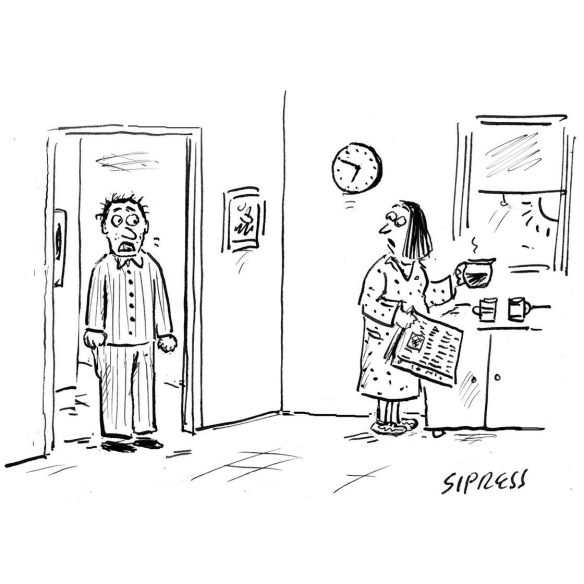
“Just woke up—anything bad happen yet?”

This is from the Financial Times, sent to me by my Porsche-driving California-based Silicon Valley high school friend who finds it his mission in life to complete my day with the worst of Donald Trump. The certainty is that if I returned the favour, my email account would be instantly blocked, but I let it continue for its interest. He is a perfect representation of the anti-Trump madness and is highly instructive. The cartoon is from him as well, and truly puts you in mind of the mindset. The story today is from the Financial Times in London, comes with the heading, “Trump, Kushner and the businessman fallacy” and this is how it starts.

When Warren Harding was 19, in 1884, he bought a small Ohio newspaper, probably for $450. By the time he ran for president in 1920, it had made him rich. Harding campaigned as an entrepreneur, promising “less government in business and more business in government”. He is often described as the worst US president, until now.

C’mon, we’ve had Carter and Obama since that time, but as with all media, for the past hundred years the best Republican is automatically ranked lower than the worse Democrat. But as it happens Harding was among the best, and it was his handling of the recession of 1920-21 for which he is best remembered, or by the likes of my mate and the Financial Times, best forgotten. Try this instead: How Government Inaction Ended the Depression of 1921.

Warren Harding was philosophically inclined to oppose government intervention and believed a downturn of this kind would work itself out if no obstacles were placed in its path. He declared in his acceptance speech at the 1920 Republican convention:

We will attempt intelligent and courageous deflation, and strike at government borrowing which enlarges the evil, and we will attack high cost of government with every energy and facility which attend Republican capacity. We promise that relief which will attend the halting of waste and extravagance, and the renewal of the practice of public economy, not alone because it will relieve tax burdens but because it will be an example to stimulate thrift and economy in private life.

Let us call to all the people for thrift and economy, for denial and sacrifice if need be, for a nationwide drive against extravagance and luxury, to a recommittal to simplicity of living, to that prudent and normal plan of life which is the health of the republic. There hasn’t been a recovery from the waste and abnormalities of war since the story of mankind was first written, except through work and saving, through industry and denial, while needless spending and heedless extravagance have marked every decay in the history of nations.

Harding, that least fashionable of American presidents, was likewise able to look at falling prices soberly and without today’s hysteria. He insisted that the commodity price deflation was unavoidable, and perhaps even salutary. “We hold that the shrinkage which has taken place is somewhat analogous to that which occurs when a balloon is punctured and the air escapes.” Moreover, said Harding, depressions followed inflation “just as surely as the tides ebb and flow,” but spending taxpayer money was no way to deal with the situation. “The excess of stimulation from that source is to be reckoned a cause of trouble rather than a source of cure.”

You know the Roaring Twenties. With PDT as president, we may end up with our own version. Harding died in 1923 so this period of prosperity is attributed to Coolidge, but it was Harding who set the prosperity in place. As for the Financial Times, like with my Californian mate, ignorance gives them peace of mind, but hopefully is not contagious.

A lesson in trade theory

“Every economic answer is a political question.”

Here then is a question for all you experts on international trade, taken directly from my Free Market Economics [pp. 248-249]. Picture two countries, A and C.

Suppose in Country A, in one hour it can produce either one car or 1000 shirts. [It’s also the same answer if Country A can produce ten cars and 10,000 shirts per hour!]

Meanwhile in Country C, in two hours it can produce either one car or 500 shirts.

According to the economic theory of comparative advantage, how many cars will Country A produce? OK, once you’ve worked that out, now tell me if you get the same answer using common sense. As chrisl said, “economic theory is all right in theory”. Personally, I’m not even sure of that, but you get the idea.

So here’s the thing. It is entirely possible that the US is tired of carrying most of the burden for the defence of the West and would like a bit of sharing the burden. It might also find some respite for itself in strengthening those parts of its economy which are more closely associated with its defence industries. And it might even wish for some kind of gratitude from others, supposedly on the same side, in trying to assist the US in resurrecting its strength. And then there are the straightforward economic issues, which are not the same as the political. So let us go to these.

And of course the issue economically is comparative advantage, and not pure let the most efficient producer produce each product. With comparative advantage, it is not always the most efficient low-cost producers who produce. If you don’t even understand that, you should keep right out of this debate.

Why encourage free trade:

  • competition is what drives improvement and growth – without competition most businesses would just coast along to the fullest extent they could
  • innovation is driven by competition – the way to take on an established business is to find a better way to do something
  • all other things being equal, free trade is best

Why “free trade” is not working for the US:

  • cheating is rife – try to sell an American car in Japan – not possible for all kinds of products in all kinds of countries
  • many countries subsidise exports while imposing non-tariff barriers to trade on imports along with tariffs themselves
  • currency manipulation – artificially holding exchange rate lower to discourage imports and encourage exports is not unknown
  • $US is world reserve currency it is unable to adjust to repair a balance of payments deficit
  • there are many forms of approved trade restrictions everywhere you look – the EU for example – such as:

Trading blocs

A regional trading bloc is a group of countries within a geographical region that protect themselves from imports from non-members. Trading blocs are a form of economic integration, and increasingly shape the pattern of world trade. There are several types of trading bloc:

Preferential Trade Area

Preferential Trade Areas (PTAs) exist when countries within a geographical region agree to reduce or eliminate tariff barriers on selected goods imported from other members of the area. This is often the first small step towards the creation of a trading bloc.

Free Trade Area

Free Trade Areas (FTAs) are created when two or more countries in a region agree to reduce or eliminate barriers to trade on all goods coming from other members.

Customs Union

A customs union involves the removal of tariff barriers between members, plus the acceptance of a common (unified) external tariff against non-members. This means that members may negotiate as a single bloc with 3rd parties, such as with other trading blocs, or with the WTO.

World Trade Organisation

There are then the WTO rules of trade engagement which are not designed to create a world where free trade is on the only answer. The rules were devised when the US economy was a lot more robust than it now is, and when the US was both willing and able to make sacrifices of all kinds to help others withstand the spread of communism. None of this is applicable today. The US is therefore no longer willing to watch others cheat their way into a stronger trade position, at the cost of its own national security, economic strength and domestic employment. Here is part of what the WTO is up to.

WTO Rules

1. Most-favoured-nation (MFN): treating other people equally Under the WTO agreements, countries cannot normally discriminate between their trading partners. Grant someone a special favour (such as a lower customs duty rate for one of their products) and you have to do the same for all other WTO members.

2. National treatment: Treating foreigners and locals equally Imported and locally-produced goods should be treated equally — at least after the foreign goods have entered the market. The same should apply to foreign and domestic services, and to foreign and local trademarks, copyrights and patents.

3. Developing countries have transition periods to adjust to the more unfamiliar and, perhaps, difficult WTO provisions — particularly so for the poorest, “least-developed” countries – so these basket case economies are allowed to whittle away at the economic strength of the developed world.

Meanwhile, economic ministers around the world increase unproductive public spending every chance they get, add new regulations on top of old, and increase business taxes at every turn, and then job on their chairs screaming, “Eek, a tariff!’

The quote at the top, by the way, is from Joan Robinson, who has quite a lot to say about free trade that ought to be read by the economic illiterates who populate the world, who are now found speaking on behalf of the status quo, as harmful as the status quo is to most of the lower half of the income distribution. Robinson was not just a Keynesian but also a big supporter of Mao, so I’d be very careful, but the above quote seems as accurate as anything else you are likely to hear about economics.

Is there such a thing as “free trade”?

“Every economic answer is a political question.”

It is entirely possible that the US is tired of carrying most of the burden for the defence of the West and would like a bit of sharing the burden. It might also find some respite for itself in strengthening those parts of its economy which are more closely associated with its defence industries. And it might even wish for some kind of gratitude from others supposedly on its own side in trying to assist the US in resurrecting its strength. And then there are the straightforward economic issues, which are not the same as the political. So let us go to these.

And of course the issue even economically is comparative advantage and not pure let the most efficient producer produce each product. With comparative advantage it is not always the most efficient low-cost producers who produce. If you don’t even understand that, you should keep right out of this debate.

Why encourage free trade:

  • competition is what drives improvement and growth – without competition most businesses would just coast along to the fullest extent they could
  • innovation is driven by competition – the way to take on an established business is to find a better way to do something

Why “free trade” is not working for the US:

  • cheating is rife – try to sell an American car in Japan – not possible for all kinds of products in all kinds of countries
  • many countries subsidise exports while imposing non-tariff barriers to trade
  • currency manipulation – artificially holding exchange rate lower to discourage imports and encourage export
  • $US is world reserve currency which will not adjust to repair a balance of payments deficit
  • approved forms of trade restriction – the EU for example – such as:

Trading blocs

A regional trading bloc is a group of countries within a geographical region that protect themselves from imports from non-members. Trading blocs are a form of economic integration, and increasingly shape the pattern of world trade. There are several types of trading bloc:

Preferential Trade Area

Preferential Trade Areas (PTAs) exist when countries within a geographical region agree to reduce or eliminate tariff barriers on selected goods imported from other members of the area. This is often the first small step towards the creation of a trading bloc.

Free Trade Area

Free Trade Areas (FTAs) are created when two or more countries in a region agree to reduce or eliminate barriers to trade on all goods coming from other members.

Customs Union

A customs union involves the removal of tariff barriers between members, plus the acceptance of a common (unified) external tariff against non-members. This means that members may negotiate as a single bloc with 3rd parties, such as with other trading blocs, or with the WTO.

World Trade Organisation

There are then the WTO rules of trade engagement which were devised when the US economy was a lot more robust than it now is and when the US was willing to make sacrifices of all kinds to help others withstand the spread of communism. None of this is applicable today. The US is therefore no longer willing to watch others cheat their way into a stronger trade position, at the cost of its own national security and economic strength. Here is part of what the WTO is up to.

WTO Rules

1. Most-favoured-nation (MFN): treating other people equally Under the WTO agreements, countries cannot normally discriminate between their trading partners. Grant someone a special favour (such as a lower customs duty rate for one of their products) and you have to do the same for all other WTO members.

2. National treatment: Treating foreigners and locals equally Imported and locally-produced goods should be treated equally — at least after the foreign goods have entered the market. The same should apply to foreign and domestic services, and to foreign and local trademarks, copyrights and patents.

3. Developing countries have transition periods to adjust to the more unfamiliar and, perhaps, difficult WTO provisions — particularly so for the poorest, “least-developed” countries – so these basket case economies are allowed to whittle away at the economic strength of the developed world.

The quote at the top, by the way, is from Joan Robinson, who has quite a lot to say about free trade that ought to be read by the economic illiterates who populate the world, who are now found speaking on behalf of the status quo, as harmful as the status quo is to most of the lower half of the income distribution. Robinson was not just a Keynesian but a Maoist, but she remains one of the clearest and most penetrating economic writers of the twentieth century.

Trump and trade

An introductory text on economic theory won’t get you very far in trying to make sense of what is going on in international trade. Here, therefore, are two bits of background on PDT’s policies on trade. The first via Conservative Treehouse:

Clearly, nobody was paying attention when Commerce Secretary Ross laid out at the Davos World Economic Forum exactly what the administration was intending to do in the coming months:

1. POTUS Trump is delivering an awakening to a generation who have never known trade policy as applied to a balanced U.S. economy.

2. America-First is a nationalistic approach to U.S. economic and trade policy that seeks to protect and elevate the standard of living for U.S. workers and specifically the American middle-class. Obviously the application of “economic nationalism” is adverse to the interests of multinational corporations who have been purchasing U.S. policy through DC politicians for decades with the last 30+ years seeing exceptionally high increases.

3. Both Democrats and Republicans have been selling out Main Street interests in favour of the financial interests of multinationals on Wall Street. The results have been exported jobs and manufacturing.

4. Resetting the economics to restore a thriving middle-class requires reversing policy and re-establishing priorities. Government cannot force investment and economic policy can only create the conditions for investment.

5. Creating the conditions for investment inside the U.S. means shifting policies that previously made investment outside the U.S. the “best play.” That’s where tax policy, trade policy, tariffs and renegotiated trade deals drive the action.

6. Trump assembled a specific set of economic policies to reverse the 30 year exfiltration of American wealth. Each policy move is connected to the prior policy move. Each initiative builds on the preceding initiative. Each current sequential step is established to deconstruct a historic policy step that might be decades old.

7. Opposition to America-First economic policy is from those who benefited from the prior policies, i.e., multinational corporations, multinational financials, Wall Street, purchased politicians and corporate media.

8. The implementation of the policy requires two elements: Tax and Trade. Inside the Trump administration there are economic policy advocates who agree on the tax element but disagree on the trade element. The combined Trump policy is part of the larger America-First initiative. The Wall Street crowd align with Trump on taxes but split with him on trade

9. Commerce Secretary Wilbur Ross is critical as he is the person creating the fulcrum in the balanced economy reset. Trump and Secretary Ross always knew they would need to jettison part of the administrations’ economic team once they accomplished and moved past tax reform. Their focus is now laser targeted policy toward Main Street.

10. This is phase #2 of the total policy execution. During a panel discussion at the Davos World Economic Forum, Secretary Ross outlined how the ‘America First’ economic policy and phase-2 platform engages with the global community, conveying to the larger multinational interests an explanation of the high-level shift in U.S. trade policy and reinforcing the Trump Doctrine of economic nationalism. He said: “The Chinese for quite a little while have been superb at free-trade rhetoric and even more superb at highly protectionist behaviour. Every time the U.S. does anything to deal with a problem we are called protectionist.” Cue the audio visual demonstrations over the past few days surrounding Steel and Aluminium tariffs.

11. At Davos, after three decades of Trump outlining his trade views, Secretary Ross also said President Trump has a forceful leadership style that some people don’t like but “While we don’t intend to abrogate leadership, leadership is different from being a sucker and being a patsy. We would like to be the leader in making the world trade system more fair and equitable to all participants.” He challenged all the panelists, including World Trade Organization Director-General Roberto Azevedo and Cargill Inc. CEO David MacLennan, to name a nation less protectionist than the U.S. He got no responses.

12. Secretary Ross then cited a study of more than 20 products that showed China had higher tariffs on all but two of the items on the list while Europe had higher tariffs on all but four. The panel sat agape at Ross’s delivery of irrefutable facts to the audience.

13. “Before we get into sticks and stones about free trade we ought first talk about whether there really is free trade or is it a unicorn in the garden,” said Ross. Again, there was no response from the panel. The Corporate and Financial media never reported on the severity of what Ross said at Davos – because the Main Street policy he was explaining is so directly against their interests.

14. Despite the tariffs Trump imposed in January on solar panels and washing machines and despite the proposition of Steel and Aluminum tariffs, according to their own Commerce Ministry, China is hoping for a “bumper year” for new trade deals.

15. For the past 30+ years, DC politicians have been selling out the U.S. economy to corporate interests, Wall Street and multinationals. POTUS Trump is simply saying “no more.” They hate him for it but he doesn’t care.

And then there is this from Forbes: China Is Not A Market Economy, And The WTO Won’t Survive Recognizing It As Such.

China’s status as a “market economy” is once again under dispute. Not, of course, by anyone who knows anything about the Chinese economy, but within the councils of the WTO, where the issue is being argued between the European Union and China. The U.S. Trade Representative Robert Lighthizer has notified the body that the U.S. also — in support of the EU’s case — opposes China’s recognition as a market economy.

China has reacted with predictable hostility, restating its longstanding view that market economy status would simply become a fact on the 15th anniversary of joining the WTO, almost exactly a year ago, when China first filed a complaint at the WTO about the refusal of the U.S. and the EU to grant this recognition. According to a strict reading of their accession treaty, they have at least an argument. In this agreement, a 15-year period was assumed to be enough time for China to implement its many provisions and emerge, more or less, as a functioning market economy. Had China made faster progress, they could have made their case and been granted this status earlier, according to the agreement.

There’s more after that, all worth reading to the end. And then there’s this.

“The greatest asset of our whole economic system is its effect upon commerce, agriculture, industry, the wage earner, and the farmer, and practically all our producers and distributors, is our incomparable home market. It has always been a fundamental principle of the Republican Party that this market should be reserved in the first instance for the consumption of our domestic products…Our only defense against the cheap production, low wages and low standard of living which exist abroad, and our only method of maintaining our own standards, is through a protective tariff. We need protection as a national policy, to be applied wherever it is required.” — Calvin Coolidge.

Beyond Economics 101

This post on Economics 101 reminds me yet again how useless modern economic theory is at working through almost any economic issue at all. It’s about the theory of comparative advantage, I think, and the role of free trade in creating a high standard of living. But let me go first to this question at Quora: What are 25 economics books that you would recommend (preferably classical and neoclassical)? My answer:

If you are seriously interested in understanding economics you need to understand classical economic theory, the economics of the period from the publication of Adam Smith’s Wealth of Nations in 1776 until the marginal revolution began about a hundred years later in the 1870s. And if you are interested in understanding classical economic theory, you should read the third edition of my own Free Market Economics: an Introduction for the General Reader.

Modern economic theory has fallen into very hard times since its classical period, and is now incapable of explaining almost anything that matters. My FME third edition is entirely supply-side, explaining how classical economists understood the operation of an economy which is how an economy actually does work.

From the marginal revolution with its focus on marginal utility, through to the Keynesian Revolution of the 1930s with its introduction of aggregate demand, economic theory has looked at economies from the demand side. And while it has a superficial appeal, no economy is driven by demand. All economies are driven from its production side. People buy more where more is produced. If you want to understand what allows people to demand, you first have to understand what makes them capable of producing.

I will just add that if you try to read classical theory without some preparation for the changes in the terminology between economics today and economics then, you will miss the point. This is a paper you can find at SSRN which will help you get past what is a quite formidable barrier.

Classical Economics Explained: Understanding Economic Theory Before Keynes

Steven Kates

Abstract

Since the publication of The General Theory, pre-Keynesian economics has been labelled “classical,” but what that classical economics actually consisted of is now virtually an unknown. There is, instead, a straw-man caricature most economists absorb through a form of academic osmosis but which is never specifically taught, not even as part of a course in the history of economics. The paper outlines the crucial features that differentiate modern macroeconomics from classical theory, with the emphasis on what an economist would have understood as The General Theory was being published. Based on the differences outlined, a model of classical economic theory is presented which explains how pre-Keynesian economists understood the operation of the economy, the causes of recession and why a public-spending stimulus was universally rejected by mainstream economists before 1936. The classical model presented is an amalgam of the final edition of John Stuart Mill’s 1848 Principles of Political Economy published in his lifetime and Henry Clay’s influential 1916 Economics: an Introduction for the General Reader, a text which was itself built from the economics of Mill.

Here’s the link to the paper.

Classical Economics Explained: Understanding Economic Theory Before Keynes

As for comparative advantage and free trade, if you’d like a very good explanation of its classical meaning, you won’t do better than my Free Market Economics, an analysis I have not changed a word of since the first edition. It is naturally taken from the economics of John Stuart Mill who had himself taken it from David Ricardo, who wrote it up in 1817. It’s a great first approximation for all those economic types who are actually addicted to mercantilism, whereby economies are driven from the demand side and economies grow by increasing their level of exports. I know, who could believe such a thing, but let us assume just for now that there really are morons who harbour such views. How did Mill and Ricardo explain what was wrong with such notions? By pointing out that the best way to improve one’s standard of living is to produce what one does best and exchange one’s own forms of supply for the goods and services produced by others. You know, goods buy goods. You know, Say’s Law. You know? Perhaps not.

But you know what was also current then? The gold standard. There are many ways this process of comparative advantage breaks down, but with the abandonment of the gold standard and fixed exchange rates, there are all kinds of ways to cheat in foreign trade relations that are not discussed as part of the basic theory. This is the definition of “currency manipulation” found at Google:

It occurs when a government or central bank buys or sells foreign currency in exchange for their own domestic currency, generally with the intention of influencing the exchange rate and trade policy outcomes.

“Influencing” as in making one’s own situation better at the expense of someone else. It can be done, and is done. And there’s more. For most economies, a devaluation occurs naturally with deficits but not with the $US which is the world’s reserve currency. And let me also add this, that there is no trade war imaginable unless others decide to retaliate. And why would they if the only damage of increased tariffs in the US is to its own economy? Let the US suffer for its actions, right? Why poke yourself in the eye if they want to poke themselves in the eye?

There is so much more that can be said but will leave it to some other time.