
Hayek and the market economy

My approach to the free market economy is probably closer to the political economy of Friedrich Hayek than to anyone else who had written during the twentieth century (other than the incomparable Henry Clay). Let me therefore draw your attention to this article, just published at the Claremont Review of Books, HAYEK’S TRAGIC CAPITALISM. The opening paras:

Best known for his anti-socialist polemic The Road to Serfdom (1944), the economist and political philosopher Friedrich A. Hayek is often thought by foe and friend alike to have offered a plain and striking argument for capitalism: the least deviation from laissez-faire is the first falling domino that will inevitably lead to totalitarianism. The foes and friends draw different lessons from the fact that decades of regulation and welfare policy have never actually had this result. For the foes, it shows that Hayek was obviously wrong and his analysis unserious. For the friends, it shows that the dreaded socialist dictatorship must now be imminent rather than far-off—no doubt finally to arrive with whoever the next Democratic president turns out to be.

But in fact, Hayek never gave so silly an argument. Nor will one find in his work the chirpy optimism with which many libertarians and Reaganite conservatives ritualistically defend the market economy. Hayek’s case for free enterprise doesn’t fit any of the usual simplistic stereotypes. He not only explicitly and persistently rejected laissez-faire, but could write as eloquently about the moral downside of capitalism and the emotional attractions of socialism as any left-winger. In an era in which—young socialist chic notwithstanding—global capitalism appears to have swept all before it, it is the triumphalist defenders of the free market rather than its critics who have the most to learn from Hayek’s cautious, nuanced apologia.

Classical economists were not laissez-faire. Economies must be meliorated by political judgement. Knowing how to do it right is the issue, not acting as if doing nothing at all is optimal. It is acting as if the free market is all one needs that plays into the hands of socialists and will ensure the end of free market economies. Read my text for a modern discussion not only about how a market economy works, but also the role of government policy in keeping an economy on course. It also explains what governments should never do as well, but that is only one part of the story, and not necessarily the most important part of the story.

Wicksell and William White

This is a comment from Sunni Bakchat dealing with monetary policy.

If the morons in the Reserve Bank had a broad education they’d know about Wicksell rather than just Keynes. Clearly Keynesian economics does not have the answer or it is being interpreted incorrectly. This idiocy from the Reserve Bank will continue until their hand is forced. For there is not an original thinker or courageous person to be found in the institution, or just about any other western reserve bank at present. For those seeking a little inspiration, William White, former chief economist at The Bank of International Settlements is all over the subject.

Alas, I had never heard of White. Now I have gone looking: INTERVIEW WITH DR WILLIAM WHITE, FORMER HEAD OF THE MONETARY AND ECONOMIC DEPARTMENT AT THE BIS. A sample:

I’m working on a piece for the G30 which basically deals with the future of central banking and the future of monetary policy. I sense from talking to many of the members, many of whom are previous central bankers, that they are very concerned about the direction this has taken, in particular the continued over reliance on stimulative monetary policy to get us out of the predicament we are in. It has turned into a kind of Pandora’s box. Swiss Re has recently published a paper called “Financial Repression: Quantifying the Cost” which looks at the cost of these unusually low interest rates for the insurance industry. Clearly, they are really, really worried about it and I don’t blame them.

I’ve written a lot about this stuff, not least of which a paper that was published by the Dallas Fed in 2012 . It was called “Ultra Easy Monetary Policy And The Law Of Unintended Consequences.” It contained page after page of all the things that might go wrong. Moreover, knowing that even my imagination might be inadequate, I treated that paper as a kind of work in progress. So every time I opened up The Financial Times or something else and I saw something unpleasant that wasn’t in my paper, I clipped it out and added it to the pile. Unfortunately, the pile is getting bigger and bigger. There is a possibility at least that this whole exercise could end very badly.

Larry Summers argues that the Wicksellian natural rate is now below zero, and the financial rate can’t go below zero, so therefore we have a real problem. Well, my reaction is to suggest we try through policy to get the natural rate back up again The way that you do that is to raise expected profit rates for viable companies that are being held down by all the zombie companies bring supported by banks or governments in one form or another. It will be painful, absolutely no question. There will be a lot of vested interests, which will be hurt. But the way out of this thing is to get rid of the excess capacity and give people an opportunity to make an honest dollar.

There is hope, as dim and faded as it might be.

Australia may have the world’s most incompetent central bank

Cannot be sure since I don’t watch them all, but it’s gotta be a contender. Look at this from today’s AFR: RBA’s Lowe flags ‘extended period’ of low rates.

Speaking at the annual Australian Business Economists Anika Foundation lunch in Sydney, Dr Lowe also said the RBA board “is prepared to provide additional support by easing monetary policy” if growth in economic demand “is not sufficient” to lift inflation “in a reasonable timeframe”….

“It is highly unlikely that we will be contemplating higher interest rates until we are confident that inflation will return to around the midpoint of the target range,” Dr Lowe said.

So they don’t know that low interest rates slow economic growth. They’re not alone, but it would be nice if they were at least aware this is potentially a genuine consequence of keeping rates artificially low. But that isn’t even the issue. Their problem is that the inflation rate is too low!

This is unreal. They are trying to get the level of money demand to rise to create more inflation. Go on, explain your reasoning, if you can. Real demand will never rise since real supply, the basis of demand, will never rise with such policies in place. Do these people know anything?

Keynesian economics: stealing from the poor to give to the rich

My major presentation at FreedomFest was on Keynesian economics, using the same title as this post. There was lots more than this quote below from Hutchison written when Keynesian theory was unchallengeable at the risk of one’s entire career as an economist, but he did repent – mostly – later on. Here he is quoting John Stuart Mill to show how absurd classical beliefs were. But this is also what every economist in the nineteenth century believed, and then right up until 1936. No one, except a handful of others today, now believe what was absolutely mainstream. Not only that, they cannot understand the reasoning, and it definitely was not because they thought recessions never occurred or they ended almost as soon as they began.

Say’s law is the proposition that recessions are never caused by a deficiency of demand and that recessions can neither be brought to an end or employment levels improved by an increase in aggregate demand. The typical way in which this conclusion was expressed was to state that overproduction is impossible, that demand deficiency is never a valid explanation for recession and mass unemployment. Although completely siding with Keynes, these issues are thoroughly discussed by Hutchison (1953), where the proposition is examined through the writings of John Stuart Mill who was writing in 1848.

“The idea [wrote Mill] ‘that produce in general may, by increasing faster than the demand for it, reduce all producers to distress,… strange to say, was almost a received doctrine as lately as thirty years ago; and the merit of those who have exploded it is much greater than might be inferred from the extreme obviousness of its absurdity when it is stated in its native simplicity’….

“Mill again agrees that in fact in commercial crises ‘there really is an excess of all commodities,’ which is a regular though transient phenomenon; but on the other hand, ‘it is a great error to suppose with Sismondi that a commercial crisis is the effect of a general excess of production’.” He goes on to denounce the latter notion (but not of course the former) as being (all in one paragraph) ‘ a chimerical supposition’, ‘ a confused idea’, ‘essentially self-contradictory’, ‘a fatal misconception’, ‘a fatal error’, and ‘a veil not suffering any one ray of light to penetrate’. Finally, he makes a pronouncement (later faithfully quoted by Fawcett) affecting the whole shape and task of political economy:

“The point is fundamental; any difference of opinion on it involves radically different conceptions of political economy, especially in is practical aspect. On the one view, we have only to consider how a sufficient production may be combined with the best possible distribution; but on the other hand there is a third thing to be considered – how a market can be created for produce, or how production can be limited to the capabilities of the market.”[Principles, Bk. III, Ch. XIV, para 4.]” (Hutchison 1953: 349-352)

This “chimerical proposition” is now mainstream and has been since 1936, with a major role for economic policy to determine “how a market can be created for produce”. I consider this as absurd as Mill had thought of it, but there is virtually not an economist alive today who agrees with Mill or myself.

Mill was right, and modern Keynesians are wrong, which really means that the whole of modern macro is wrong. It’s like believing that the earth is at the centre of the universe, but that is how it looks. Nevertheless utterly wrong, but you with certainty do not even know what a classical economist believed or how they thought the business cycle began and ended.

Income inequality

A report on income inequality from the UN that shows how far beyond any traditional notion of inequality we have come.This is what “poverty” now consists of and is measured by:

The 10 indicators, namely nutrition, sanitation, child mortality, drinking water, years of schooling, electricity, school attendance, housing, cooking fuel and assets.

Cannot deny that these all matter. Let me, however, point out that no economy managed along market-economy lines has any of these problems at all.

Art Laffer receives Presidential Medal of Freedom

Both of the following links were found at Powerline: Trump Gives World’s Worst Economist the Presidential Medal of Freedom and Trump is giving Arthur Laffer the Presidential Medal of Freedom. Economists aren’t smiling.

These sour economic vandals. It’s not even that they are incapable of understanding what he says, but they are even unwilling to listen. The belief that economies are driven from the demand side is so inane that I find it hard to see how anyone with any sense can take it seriously. Everything about how an economy is driven forward and jobs created is dependent on individuals making decisions to do things, then working out what needs to be done and then doing it. No economy in history has ever slowed because there was an unwillingness to buy things. The idea is so stupid it is hard to imagine how it could ever happen in the world as we know it.

The core issue is Say’s Law. If you don’t understand Say’s Law, let me impress on you that you are incapable of understanding how an economy works. If you are interested, however, you can find out from my Free Market Economics, Third Edition, An Introduction for the General Reader. This is what Art Laffer himself wrote about the book, which you can find on the back cover of the text:

‘This book presents the very embodiment of supply-side economics. At its very core is the entrepreneur trying to work out what to do in a world of deep uncertainty in which the future cannot be known. Crucially, the book is entirely un-Keynesian, restoring Say’s Law to the centre of economic theory, with its focus on value-adding production as the source of demand. If you would like to understand how an economy actually works, this is one of the few places I know of where you can find out.’

The American economy is the only economy that has fully recovered from the effects of the stimulus which followed the GFC. It is also the only economy in the world that is managed largely by the supply-side principles, which is why PDT is giving Art Laffer this award.

Me old china plate

Two stories, separate but thematically linked. The first about Chinese foreign policy starts with this.

Donald Trump’s former chief strategist Steve Bannon has warned that Australia will become “a tributary state” to China unless the Morrison government joins the US in forcefully challenging Chinese hegemony in the region.

And then this: from the Herald Sun.

Premier Daniel Andrews has made a big deal out of talking up the Australian content in Victoria’s huge $45 billion investment in infrastructure projects.

Local content should be a priority and, indeed, the government needs to keep construction unions inside the tent to contain costs and keep industrial peace.

Mr Andrews had pledged a minimum 92 per cent of Australian steel would be used in the $6.7 billion West Gate Tunnel project.

But as revealed Thursday by our state political editor Matt Johnston, contractors for the project have ordered a 33,000-tonne shipment of steel from the Chinese government-owned firm ZPMC.

There are serious questions about what agreements were touted by Mr Andrews to foreign investors during his trip to China last month. Mr Andrews, the only Premier to have signed on to China’s controversial Belt and Road Initiative, has previously said he would work to attract Chinese investment in Victoria’s infrastructure program.

No doubt imported Chinese steel would be a lot cheaper than Australian steel. But the decision may yet cost Mr Andrews much more in union fury and public faith.

The title, btw, is a bit of rhyming slang I learned when I first reached these shores those many years ago. Seems quite appropriate in the present context. And while I’m on it, if one is interested in free trade, this might be of interest: How does China cheat on trade? Let us count the ways.

China cheats by protecting its home market from American imports with high tariffs, tricky non-tariff barriers, and costly, constantly changing regulations.

China cheats by subsidizing the exports of government-owned “national champions” to crush its free market competitors and dominate global markets.

China cheats by preying on weak counties, locking up their natural resources with “debt traps” in an obvious effort to gain a global stranglehold on key resources like bauxite, copper, nickel, and rare earths. These monopolies are not only being used to fuel China’s industrial machine, but to punish those countries who would oppose its predatory policies.

China cheats by subsidizing manufacturing with cheap loans and cheap energy, and also by turning a blind eye to environment, health and safety standards. Because of its cheating, it already dominates industries ranging from ship production and refrigerators, to color TV sets, air conditioners, and computers.

Above all, China cheats by stealing key technologies and intellectual property from the United States and other countries. These activities range from cyberespionage and forced technology transfer down to massive open-source collection and plain-old physical theft.

Economics is and has always been a subset of politics. No economics text can ever tell you what ought to be done, only what the consequences of different decisions might turn out to be. And a modern text doesn’t even do that.

The aim is to replace capitalism with something else

I have been sent an article from a friend in New Zealand – Why Call it “Socialism”? – which opens in the following way.

I’ve been coming around to the belief that most modern arguments over “socialism” are a waste of time, because the content of the term has become so nebulous. When you drill down a bit, a lot of “socialists” are really just saying that they would like to have government play a more active role in providing various benefits to workers and the poor, along with additional environmental protection.

Socialism is thus a desire for better social welfare and a more egalitarian society. Well, maybe. This was my reply.

Thank you for that. Very interesting, and yet, and yet…. Socialism is a personal belief system that has no specific definition. Everyone makes up their own version so whenever some actually existing socialist economy is set up and then inevitably fails, everyone else can say that what they did was not what they had meant by socialism, that what was done was not what they had had in mind.

No one any longer describes what they believe in as “socialism” but I know it when I see it. It is ever and always a means to supplant the market through some kind of government direction in which individuals are not made responsible for their own personal welfare. Instead, governments manage and direct major economic entities; there are huge burdens placed on enterprises, through the taxes that are levied, the wages and benefits they are made to provide, and the regulations that they are made to follow; and there are huge amounts of public expenditures, almost inevitably more costly than the economic benefits they provide, that shape the direction in which an economy is made to follow. There are then large efforts to equalise incomes between those who provide more value than they are paid and those who either do not work or who are allowed to receive incomes well above the value added they have personally created. There are other features too, but you get the picture. The incentive structure is completely warped so that economic returns are very badly correlated with economic contribution.

And with every turn of the electoral cycle, we move further in a socialist direction. Scott Morrison is hardly a free-market capitalist, but he is well ahead of anyone on the Labor side. Your own PM is a complete economic dunce who will do you in if she is given half a chance. Everyone wants to be Mr, Miss, Ms and Mrs Niceperson. I only wish they had some prior understanding of how economies work before they bought in on it.

There you are. Interesting article, but economists turn out to have no political or philosophical sense whatsoever.

I would be placated to some extent if everyone before they waded in on the need for more regulation and re-distribution first explicitly stated that of course, free market capitalism is the only way to manage an economy so these suggestions are only intended to slightly alter the way we go about things. But no one ever says that. Replacing capitalism with something else is the underlying aim, or so it seems to me. There are so many gadgets around, from computers to widescreen television, that everyone will be easily lulled into disaster as in Venezuela with no way out at the end. And none of it will be mentioned by our media who are more into an apathetic torpor than anyone in Orwell’s time could ever possibly have imagined.

You cannot trust a party of the left with the management of an economy

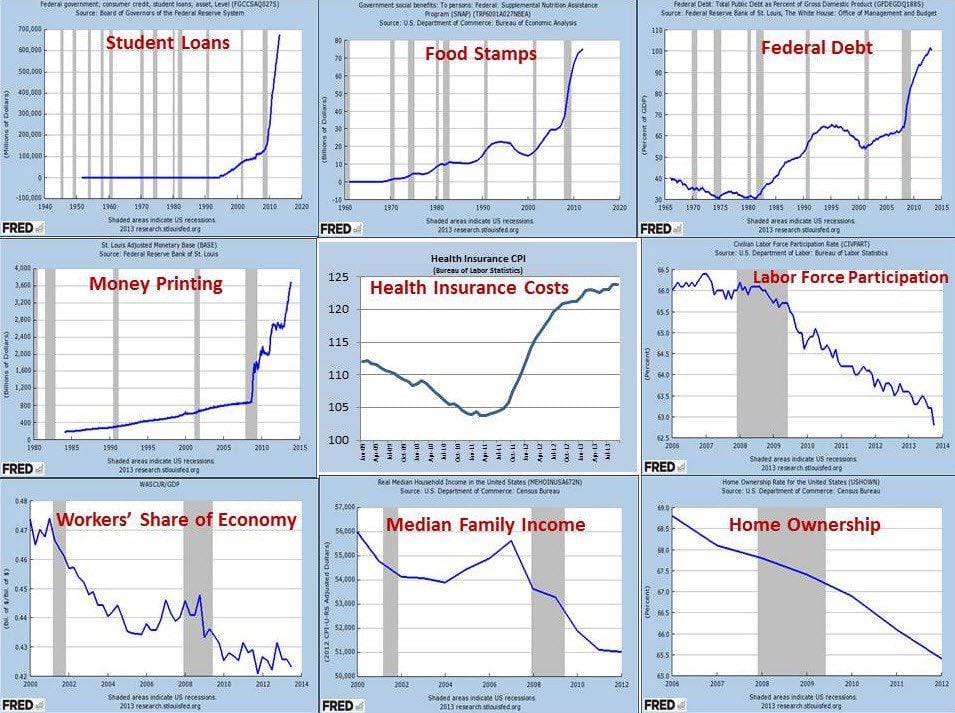
From New Data Shows Absolute Economic Destruction During Obama Years. And these figures are not from some ratbag bunch of observers. This is where they are from:

The Federal Reserve Bank of St Louis just released this single snapshot of economic performance over the Obama years.

And what do the figures show:

Federal debt went through the roof as we added more debt than all other previous periods combined.
We printed lots of money to paper over the monetary effects.
Health costs went way up when we were told they would drop. Obama care was a flop.
Labor force participation went down as unemployment increased and many just dropped out of the workplace altogether.
Inequality went up and up, as the rich got richer and the middle class shrank.
Median income dropped.
Home ownership also fell way down.
Overall, Americans were far worse off than before and we were told there was NO hope.
The country was losing to China and our children and grandchildren would not live as well as their parents and grandparents had.
Jobs would never return.

Venezuela is all that parties of the left know since they know nothing about allowing a market economy to work. Politically totalitarians and economically socialists. Yet they are the almost-governments everywhere and are only stopped because the damage they create causes a backlash before they can go much farther. But eventually they return and carry their projects a little further along.

Time to consider a different approach to economic management

I realise that the Coalition, being from the right side of the political divide, are supposed to know something about how to run an economy, but I fear the evidence is very thin on the ground. And I know the RBA is supposed to be arm’s length from actual policy determined, but I have a feeling the PM and his economic ministers are absolutely onside with this: Rates could fall as low as 0.5% amid warnings of GFC-like slowdown.

Incompetent doesn’t even get near it. Incoherent and ignorant comes closer. Peter Costello was blessed with Glenn Stevens. Now we have this:

Official interest rates could be slashed to just 0.5 per cent to deal with an economy growing at its slowest since the depths of the Global Financial Crisis, markets and economists have warned as investors bet the economy needs more financial support.

Economists at JP Morgan on Wednesday became the first to predict the Reserve Bank of Australia will eventually take the cash rate to 0.5 per cent in a bid to protect the national jobs market and drive growth.

I am not going to try to explain the stupidity of this kind of policy in a blog post. So I will only make a couple of suggestions to our new government. First, talk to Peter Costello. I know, he’s from a different planet and what would he know about running an economy? However, he did set up conditions for a decade long era of extraordinary growth until we hit the GFC at the same time that Kevin Rudd was our PM. If you want to understand why we are now dealing with “an economy growing at its slowest since the depths of the Global Financial Crisis” you have to understand why public spending and low interest rates cannot and will not provide an economy with momentum of any kind.

The second suggestion is that someone provide the Treasurer with a copy of my book: Free Market Economics. It’s now in its third edition, but as a reminder of its message, the second edition of the book was launched by Peter Costello. This is what the book is about.

Key Features include:

* analysis derived from the theories of pre-Keynesian classical economists, as this is the only source available today that explains the classical pre-Keynesian theory of the business cycle
* a focus on the entrepreneur as the driving force in economic activity rather than on anonymous `forces’ as found in most economic theory today
* introduces a powerful though simplified model to explain the difference between modern theory of recession and classical theory of the business cycle
* great emphasis is placed on the consequences of decision making under uncertainty
* offers an introductory understanding, accessible to the non-specialist reader.

The aim of this book is to redirect the attention of economists and policy makers towards the economic theories that prevailed in earlier times. Their problems were little different from ours but their way of understanding the operation of an economy and dealing with those problems was completely different.

Free Market Economics, Third Edition will help students and general readers understand classical economic theory, written by someone who believes that this now-discarded approach to economic thought was superior to what is found in most of our textbooks today.

If you actually believe that lower interest rates will promote economic growth, read the last two chapters to find out the harm that this kind of approach is guaranteed to cause. It is the only anti-Keynesian textbook on the market. After a decade of Keynesian failures, isn’t it time to consider something else?

WHERE TO BUY FREE MARKET ECONOMICS: I have had a request, for which I am very grateful, about where to find a copy of Free Market Economics, and the one certain place is from the publisher, Edward Elgar.

The book is also not very expensive so far as textbooks tend to go. It was never my intention to turn publishing into a money-making project – which I have truly succeeded at – and the price of the book has been kept as low as possible from the start. In this I was assisted by the publisher so that my text became the first publication of theirs that was published from the start in both a hardback and a cheaper paperback edition. No one ever in my memory ever bought the hardback edition, but what I also found interesting was that no one also ever asked the author to sign their copy of the book.