“In countless ways one of the best introductions to economics ever written”

I would also strongly recommend Steven Kates’ Free Market Economics. An Introduction for the General Reader which is in countless ways one of the best introductions to economics ever written; and this assessment includes amongst other things the author’s superb ability to put economics into perspective in terms of the history of economic thought.

I keep going back to this fantastic book. Lucidly written, it can be read with tremendous gain (to students of economics of any level, beginner to advanced scholar) in a few days, maybe even in just two days. At the same time, it is so substantial as to invite countless returns for further appreciation.

As a person strongly influenced by the Austrian school (including its post-Misesian anarchist wing), what gives me a special kick is the fact that the author, who ‘heretically’ recognises a substantial role for government and the state, offers an accurate and brilliant account of a free economy.

Of course, this places Kates much closer to (the great Austrians) Mises and Hayek than to the anarchist successor school, whose anarchist stance I do not share at all, while recognising the school’s considerable intellectual achievments.

I hope Georg Thomas won’t mind my retrieving his kind and generous comment from the thread that followed my putting up a reading list in the history of economics the other day. And I hope you won’t mind if I say that this is how I think about the book myself.

Moreover, the book is, in my view, unique. It explains everything found in an introductory text on economics but in no chapter is its explanation the same. Everything is saturated in the role of the entrepreneur and builds from the crucial importance of uncertainty.

It never assumes there is no government, but instead assumes that there is and that this government will make laws and regulations that are sometimes a net benefit but are also usually the very reason economies underperform and all too frequently fall into recession.

It explains value added across an entire chapter. The fact of the matter is that without understanding value added properly it is impossible to understand good policy from bad. And so far as I know, this book is unique in explaining this crucial part of economic reasoning at the introductory level.

In teaching supply and demand it assumes no one can ever know where either of those curves actually is, a very different way of thinking about markets. The traditional form of marginal cost pricing is shown to be an inane framework that provides no insight into how either prices are set or volumes determined. Instead it explains the margin as the dividing point between the present and the future which the farther into one looks, the less that one can know anything relevant about what is going to take place.

It disdains Keynesian economics even while explaining modern macro, showing why it is an insulting form of nonsense, and I might add, is the only book to my knowledge anywhere to do so. If you know of another written within the last forty years, you must let me know.

Instead, it explains prosperity and recessions using the classical theory of the cycle which was based on a proper understanding of Say’s Law. It is definitely, and I do mean definitely, the only place in the world you can find out about Say’s Law and how Keynes mangled its interpretation leaving the world’s economies in the mess they are in with no theoretical guidance system with which to find our way out.

And as the title makes clear, the point of the book is to explain why there is no other means to manage an economy than through the free market which is not the same as laissez faire.

How to Get the Book

The book is available in paper from the Edward Elgar catalogue for £23.96. And if you would like to read it in an electronic format, this is where you should go which is taken from the Elgar website:

http://www.ebooks.com
http://www.books.google.com/ebooks
http://www.google.co.uk/ebooks

View our ebooks that are with Dawsonera
View our ebooks that are with EBL
View our ebooks that are with Ebooks.com
View our ebooks that are with MyiLibrary
View our ebooks that are with EBSCOhost
View our ebooks that are with Ebrary
View our ebooks that are with Google

Here is the link to the google ebooks in the UK where the price is a mere $A29.00.
The great German inflation of the 1920s – some numbers

Putting some numbers to the historical events:

In 1920, a loaf of bread soared to $1.20, and then in 1921 it hit $1.35. By the middle of 1922 it was $3.50. At the start of 1923 it rocketed to $700 a loaf. Five months later a loaf went for $1200. By September it was $2 million. A month later it was $670 million (wide spread rioting broke out). The next month it hit $3 billion. By mid month it was $100 billion. Then it all collapsed. Let’s go back to “marks”. In 1913, the total currency of Germany was a grand total of 6 billion marks. In November of 1923 that loaf of bread we just talked about cost 428 billion marks. A kilo of fresh butter cost 6000 billion marks (as you will note that kilo of butter cost 1000 times more than the entire money supply of the nation just 10 years earlier).

The article itself adds quite a bit both to the economic side and the social.

The moral case for free enterprise – the winners

I mentioned a few days back that the American Enterprise Institute had put together a contest for the best short video showing the moral case for free enterprise. They have now announced the winners.

This one – The Joke of the Day – only came in third but I really liked it. If you would like to see the video that actually won and the runner up, in fact all of them, you can go here to the AEI website. Defending free enterprise, not just as a system that delivers the goods but also as the most moral and ethical system ever devised to provide for our material welfare, is an even greater necessity today than it has ever been.

The moral case for free enterprise

In June, the American Enterprise Institute launched a $50,000 video contest to illustrate the moral case for free enterprise.They have posted the finalists and the winners will be announced on 9 October.

I have put up the above video because it explains Say’s Law about as well as anything I could hope to. Watch Susie turn her desire for some object into an ability to buy it by first producing something herself. It also shows the crucial role of prior saving to finance investment.

[My thanks to Gab for drawing this to my attention and shame on me for not having seen it myself.]

Lies, damned lies and Keynesian economics

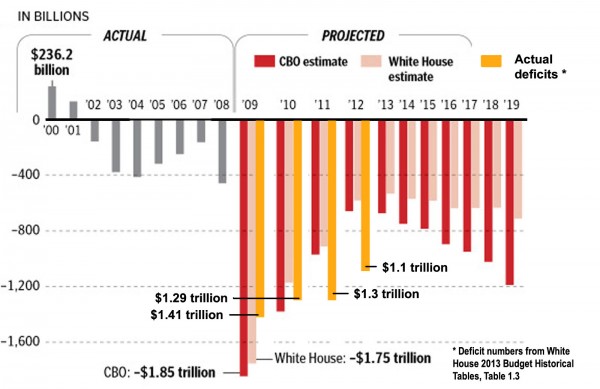
They love spending the money but with the disastrous results now being recorded everywhere, it is turning out that this deficit finance has not been such a great thing after all. We are looking in the eye of the great Keynesian fail and the world will turn to deal with those C+I+G-based theories as soon as we have dispensed with the politicians who have ruined the economies they have managed based on this Keynesian nonsense.

My Free Market Economics was written in 2009 well before these disasters. It was, in fact, written precisely because these were the disasters I fully expected. I am told occasionally that there is some other way to make sense of why this increase in public spending has led to a worsening in employment growth to accompany the debt other than through a return to pre-Keynesian classical theory and Say’s Law but if there is I haven’t come across it. Austerity is the new black which merely says governments must live within their means.

The above chart is doing the rounds – picked up on Instapundit in this instance – and shows that the deficit blow out most assuredly began with Obama who now prefers not to take the credit. The story in Australia would be even worse since the budgets all leading up to Labor taking over in 2007 were in surplus to go with our ZERO debt.

Swan and Gillard promise a surplus they will never deliver but wish they could. They now talk about the need for budget balance in the same way as any of the pre-Keynesians. And the fact is there will be no return to economic health until the public sector is reduced and the private sector is given the space to grow and expand.

Why doesn’t anybody mention Keynes any more?

The Chinese economy is in descent, not quite free fall but close enough.

AUSTRALIAN mining companies and the federal Treasury face fresh pressure as China’s already sluggish economy heads for a further slowdown.
The latest surveys of China’s manufacturing industry showed that activity has continued to ease as the world’s second-largest economy faces a seventh consecutive quarter of slowing growth.

China’s biggest problem remains the continuing malaise in the critical export sector where growth has slowed dramatically due to poor economic conditions in its largest market, Europe, as well as the US, as wages and other costs in China continue to climb.

The closely watched official purchasing managers index (PMI), which covers large businesses, remained in negative territory at 49.8, up from 49.2 in August — its second month in negative territory. Any result below 50 shows activity decreasing.

A parallel HSBC survey of small and medium businesses saw the 11th contraction in a row with a result of 47.9.

Both results were lower than market expectations, and HSBC’s export sub-index hit a 42-month low.

You never hear Keynes mentioned any more, except maybe by me. Wherever we had these Keynesian stimuli, the result has been abysmal. The Australian economy, tied as its success was to Chinese growth, is also melting. The laughable attempt to bring the budget into surplus – highly destructive as well since it will be mostly attempted on the tax revenue side – is now matched by a desperate desire to see interest rates come down. We have a low official unemployment rate but that’s because so much of it is driven by public spending unsupported by value adding economic activity. It can’t last. As the front page article in The Australian points out:

Although the jobless rate is low, domestic pressures are building. The employer lobby Australian Industry Group’s latest business survey, released yesterday, shows that for the seventh consecutive month, a majority of manufacturing firms are contracting.

Contracting industry and they are rushing to balance the budget! Shame this never occurred to them in 2008.

Radio Australian Interview: I’ve just done a Radio Australia interview on Ross Garnaut’s comments last night where he said that Australia’s salad days had gone and our dog days have begun. His comment, from last night’s Lateline:

I said now we’re living in the salad days. In the salad days, ordinary economic policy looks good and good economic policies look stellar. But it won’t be very many years when the salad days turn into the dog days, when good economic policy looks terrible and ordinary economic policy looks in the dogs. . . .

Certainly the rhetoric from the Government about restraint in government expenditure is consistent with what’s required, and in fact in the last couple of years we’ve run very tight budgets by long historical standards.

But this has to be maintained now for quite a long period of time and I think lots of Australians haven’t assimilated that. We’ve got elements of the Australian community thinking that economic reform now is what gives more money to them.

And who’s his example for those who don’t appreciate the need for restraint, the Business Council. Wandering around the main town squares in Athens and Madrid ought to provide a better idea of who wants governments to keep spending money they no longer have.

American economy unraveling – media silent

The data and the following text are from James Pethokoukis of the American Enterprise Institute:

If the above forecast is correct, the National Bureau of Economic Research might wind up declaring that the U.S. economy slipped back into recession in late 2012 even though the economy was actually not yet contracting at that point.

And if that happens, economic historians might well shove aside the weak three-year recovery and call the entire 2007-2013 period the Long Recession or some such. I already have been, just like the 1980-82 period was a long recession, two downturns sandwiching a brief recovery.

This will not be just a long recession but a very long recession and it will be worldwide. Will we then, maybe, just maybe, finally then rid ourselves of this Keynesian economic madness?

Potentially the most transforming president of the twenty-first century

It makes me actually angry that the media are such fools that for reasons that remain entirely invisible they are willing to lie, distort and deceive, not just to keep the worst president in more than a century in office, but also to keep someone who might well turn out to be the best president over the century to come out of office. On this matter, let me take you to an article in today Financial Review that outlines Mitt Romney’s concept of how to deal with foreign aid. Here are the direct quotes from a speech given yesterday about the program he has in mind:

Working with the private sector, the program will identify the barriers to investment and trade and entrepreneurialism in developing nations. In exchange for removing those barriers and opening their markets to US investment and trade, developing nations will receive US assistance packages focused on developing the institutions of liberty, the rule of law and property rights.

The aim of a much larger share of our aid must be the promotion of work and the fostering of free enterprise. Nothing we can do as a nation will change lives and nations more effectively and permanently than sharing the insight that lies at the foundation of America’s own economy – and that is that free people pursuing happiness in their own ways build a strong and prosperous nation.

What an extraordinary vision! A system of foreign aid that will work, that does not empower a bureaucracy but which makes private individuals pursuing their own interests the centrepiece of America’s assistance program. No doubt there are endless obstacles, but if implemented this would work and transform the remaining dead spots of the world’s economies even if this was taken up in only a minor way at first. Not everywhere is going to turn into Chile, Thailand or South Korea but this is the only way in which they could.

Mitt Romney has the potential to become the greatest president of the twenty-first century but first he has to be elected in November. How bizarre that it still remains a close run thing which can only be because of the impaired moral vision of so many of our graduates of higher education and the inanities they have passed on either in teaching others to despise the free market or in writing media stories filled with leftist stupidities and ignorance in which the underlying premise is that governments must protect the poor by preventing others from becoming rich.

Another example of lazy Keynesian thinking

Lazy Keynesian thinking is found everywhere, even in places I least expect it. This is from Alan Mitchell’s column in today’s AFR.

The economic impact of the Gillard Government’s savings will depend on where they fall. If, as seems likely, it targets the tax breaks of higher-income earners, the impact will tend to fall on savings rather than consumption, and the effect on growth should be relatively short term.

So here is what understanding pre-Keynesian economics brings to you. If some economic change falls on savings it falls on investment and therefore will damage the economy. If it had actually fallen on consumption instead then the effect on the economy would have been almost negligible. Keynesian theory blots out most of an economist’s ability to understand the nature of the business cycle which is why hardly anyone saw the current slowdown coming.

Of course, to describe anything the Gillard Government does as a form of saving may be the most ludicrous part of all.