
Classical theory of the cycle

I’m in New Zealand doing some work that has brought me this way. But I thought I’d share this posting on the History of Economics website I put up yesterday. The query had been a follow up to my previous posting on Macro Follies but the fellow who put it up specifically said he didn’t want to reopen these issues but would like to know where he can get some information on the classical theory of the cycle. I was a couple of days late in getting to this reply, but this is what I have finally contributed. Interestingly, no one has posted since and there had only been six contributions before mine. It cannot be that across the world of historians of economics no one any longer even knows where to find a discussion of the theory of the cycle prior to Keynes although you never do know. You really never do know.

If you interested in the classical theory of the cycle and where to read it from the perspective of someone who actually thought it was valid, then the best place to go is to the first edition of Haberler’s Prosperity and Depression published by the League of Nations in 1937. Some tinge of a Keynesian influence but minimal. A second alternative, if you will allow me to say this, is from my Free Market Economics: an Introduction for the General Reader (Elgar 2011) where in Chapters 14 and 15 I discuss and explain the classical theory of the cycle with much of it based on Haberler and give lots of examples.

But it is possible to pick up just about any text published in the nineteenth and early twentieth centuries and find a discussion of the business cycle which was an integral part of the study of any student of economics, in spite of what Keynes might have said. As it happens, I am in New Zealand at the moment and have been scouting the second hand book shops and picked up a copy of Political Economy for Use in Schools and Private Instruction published in London in 1873 by William and Robert Chambers who also seem to have written it although no author is named.

It’s a short book, only 154 pages, but has a section that runs from page 137 to 143 on “Commercial Convulsions”. The discussion is part theory but also focuses on the railroad mania of 1846 which, as described, was in almost every respect identical to the GFC other than that in 1846 the problem was with the capital that poured into building new railroad lines and we were dealing with housing; and they discussed the problems as they affected bond holders while in 2008-09 it was the CDO’s and other credit instruments. If you read it, it may be quite a revelation how much they understood then.

But in the next chapter on “Accumulation and Expenditure” it explains more than half a century before the publication of The General Theory the problem with taking a Keynesian approach to induce recovery. This is from page 146:

If we compare productive and unproductive expenditure, it will be found that the unproductive is most agreeable at the time, to all parties concerned in it. In fact, it is the spending in enjoyment of what other people have made by industry and frugality; hence arises the popularity of the man who is spending money rapidly and thoughtlessly; all around him derive immediate advantage from it. If they are working, and making their daily bread at the same time that they are receiving money thoughtlessly spent, it is so much enjoyed by them in addition to what they can otherwise obtain. If they are idle, which is the far more common case, then they have the satisfaction of enjoying themselves in idleness. Their fate in doing so may not be a happy one, but it is their choice, and they praise the spendthrift who gives it them.

What can I say? The book reminds me once again that a high school student in 1873 might have had a better grasp of the nature of the cycle and the problem with public spending than does our learned profession today. If you are interested in a simple explanation of the classical theory of the cycle, just get a copy of this book which was doing no more than stating the common view of the time which was the common view right through to 1936.

Good news for me

Just arrived in the mail today:

Dear Dr. Kates,

Good news for you: your article “Alesina and the Keynesians: Austerity and Say’s Law” has now been published in the following paginated issue of Atlantic Economic Journal: Volume 40, Issue 4 (2012), Page 401-415

It is good news. It is a paper I presented in July at a symposium on the work of Alberto Alesina who has provided an immense amount of empirical evidence showing that cuts to public spending generally lead to recovery, and the turnaround is almost immediate. This is the abstract:

Alberto Alesina’s empirical work has led to re-examination of Keynesian theory and policy. His demonstration that reductions in public spending are often followed by improvements in economic conditions is a direct contradiction of modern macroeconomic theory, where increases in aggregate demand are seen as the most important precondition for recovery even where such increases in demand are unproductive in themselves and largely wasteful. The present paper suggests that the theoretical framework necessary to understand Alesina’s empirical results is embedded within the classical theory of the cycle which argues that only value adding production could lead to recovery. Most importantly, the paper argues that only through a correct understanding of Say’s Law of markets can Alesina’s empirical results be properly understood.

Then to underscore the same point, there was this article in The Washington Post today by Anne Applebaum comparing Latvia and Greece in their response to the global financial crisis.

Even within Europe, after all, perceptions of economic policy can vary a great deal, as a quick comparison of Latvia and Greece reveals. Recently, the former has received some well-earned attention for its successful pursuit of economic austerity. In the wake of the 2008 crash, the Latvian government slashed public spending, fired a third of its civil servants and reduced salaries of those remaining while refusing to inflate the currency. Gross domestic product declined dramatically, falling 24 percent in two years. And then the recovery began. The Latvian GDP is now growing at more than 5 percent, and the budget deficit has been dramatically reduced.

You could either quote Alesina or you could quote me if you are trying to make a forecast of the policy consequences of reducing unproductive public spending. But if you would like to understand why it happened and not just discover that A follows B on a regular basis where A is a cut to public spending and B is recovery, you really do need to understand Say’s Law and the pre-Keynesian theory of the cycle.

And beyond all this, today I was reading Paul Krugman’s quite interesting and sensible 1994 book on free trade, Pop Internationalism, when I came across this (and to understand Krugman’s point you need to know that Friedrich List was a nineteenth century economist who continually advocated trade protection):

The new cult of List bears an uncanny resemblance to the right-wing supply-siders’ canonization of the classical French economist Jean-Baptiste Say, who claimed that the economy as a whole could never suffer from the falls in aggregate demand that produce recessions.

Well I would claim the same: an economy as a whole cannot ever suffer from a fall in aggregate demand that produces a recession.

I would agree that a recession can cause a fall in aggregate demand – although that’s a very misleading way of phrasing what has happened which will get you into lots of trouble if you think along those lines in framing policy – but I have never seen a single instance where a fall in aggregate demand was the cause of a recession. It’s all about what’s the cause and what’s the effect.

Anyway, it is good news that my paper has now gone out in the world. I might just note that when I presented the paper, Alesina said to everyone who was there about what I had just said that “I agree with everything you say”. It’s a good paper and I commend it to anyone interested in such things.

“The predominant Keynesian thinking has been tested, and it has failed spectacularly”

The evidence that Say’s Law is valid just keeps accumulating. This very nice article with this great title, Why Austerity Works and Stimulus Doesn’t was picked up by Skuter. There it says amongst other things:

After five years of financial crisis, the European record is in: Northern Europe is sound, thanks to austerity, while southern Europe is hurting because of half-hearted austerity or, worse, fiscal stimulus. The predominant Keynesian thinking has been tested, and it has failed spectacularly.

Yes that’s all very well in practice but does it work in theory. This is from a note to a friend that takes the above empirical result into a theoretical dimension.

Every economist knows at some level that

(1) investment is based on saving

and they also all know that

(2) during recessions there is less demand in aggregate for everything that had been produced.

The Keynesian issue has been to put these two together with the first, too much saving, given as the cause of the second, less demand than there is supply.

It was this association that Say’s Law was designed to prevent. Because as we have seen time and again, once you think (1) as the cause of (2) the automatic response during recession is to increase demand as if demand in aggregate were some entity that exists apart from supply in aggregate.

And the crucial bit that was added by the classics was that the only kind of demand that would be effective at job creation over anything other than the short term – that is, would raise the actual level of sales in real terms and therefore the number of jobs – had to be demand that was based on the production of value adding goods and services. You could not raise effective demand or increase employment by digging holes and immediately filling them again.

It shouldn’t be hard to understand and yet it turns out to be almost superhuman. Let me highlight this quote from John Stuart Mill from his Principles.

This theorem, that to purchase produce is not to employ labour; that the demand for labour is constituted by the wages which precede the production, and not by the demand which may exist for the commodities resulting from the production; is a proposition which greatly needs all the illustration it can receive. It is, to common apprehension, a paradox; and even among political economists of reputation, I can hardly point to any, except Mr. Ricardo and M. Say, who have kept it constantly and steadily in view. Almost all others occasionally express themselves as if a person who buys commodities, the produce of labour, was an employer of labour, and created a demand for it as really, and in the same sense, as if he bought the labour itself directly, by the payment of wages. It is no wonder that political economy advances slowly, when such a question as this still remains open at its very threshold.

Mill writing in 1848, three decades past the general glut debates and at a time in which these principles ought to have been embedded in the active consciousness of economists, still can think of no one besides his father and J.-B. Say who understood this proposition well enough never to lose track of its point in the midst of discussion. Buying things does not create jobs. Producing things that are not self-financing through their sale does not create jobs other than in the immediate present.

I would say that hardly anyone got it then or gets it now except that when I teach it, even people who otherwise fail their exam with around a 20% score still get this right. It can be understood if explained properly but whether such people later on in life never confuse buying things with producing things, of this I cannot be sure.

I go along with Mill that “it is no wonder that political economy advances slowly, when such a question as this still remains open at its very threshold”. But open at its threshold it most certainly is, taught to every student of macro except my own as obvious without need of proof.

Can anyone explain this?

Icebergs on the horizon. Full speed ahead. This is Niles Gardner looking at welfare spending in the US:

I have just read a staggering report written by my colleagues Patrick D. Tyrell and William W. Beach for the Heritage Foundation’s Center for Data Analysis (I direct the Margaret Thatcher Centre for Freedom at Heritage.) It is a real eye-opener for anyone who cares about America’s future as the world’s superpower, on either side of the Atlantic. Ironically, Britain, through the tremendous determination of Iain Duncan Smith and his team at the Department of Work and Pensions, is starting to roll back the welfare state, precisely at the same time the current US administration is expanding it.

The United States isn’t just gliding towards a continental European-style future of vast welfare systems, economic decline, and massive debts – it is accelerating towards it at full speed. Or as Acton Institute research director Samuel Gregg puts it in his excellent new book published today by Encounter, America is already ‘becoming Europe,’ with the United States moving far closer to a European-style welfare state than most Americans realize.

How they going to find out? From The New York Times? CBNBABSC? The Telegraph in London? Suppose they knew, would they know enough about what causes what to care? And suppose they did know and they do care, what would they do about it? Refuse to take the money they can get just for asking? It’s all lobster trap from here on in.

Except there was this to sort of remind us that there are some who know better and that good economics does work. Why it works no one can any longer tell you, but at least it does work. One day the theory will catch up with reality, but not just yet.

The state comptroller estimates that Texas will generate $96.2 billion in general revenue in 2014-2015, a major jump in tax collection from the last two-year budget cycle.

Republican Comptroller Susan Combs on Monday was releasing her biennial revenue estimate. The crucial number sets the limit on what lawmakers can spend for 2014 and 2015, when Democrats and teachers hope to reverse, or at least bandage, deep cuts in the current budget that included $5.4 billion slashed from public education.

Combs reported Monday that the state collected $8.8 billion more revenue during the current 2012-2013 revenue cycle than she initially forecast, giving lawmakers breathing room in settling a $5.2 billion deficit in the current budget. . . .

Texas’ economy is humming again after lawmakers in 2011 wrote a cut-to-the-bone budget as the nation lurched out of the Great Recession.

At the time, unemployment in the state was the highest in a decade and the Legislature faced a $27 billion shortfall. But unemployment now is at a four-year low of 6.2 percent, sales tax receipts are skyrocketing and money is pouring into state coffers behind a new energy boom.

Got that. Public spending went down and tax revenue from the private sector is booming. Can someone help me here? Any explanation? Must have a look at my copy of Mankiw to see what it has to say.

Krugman knocks back Tres Sec job he was never offered

Fancy that, there really are people in high places who think Krugman would have made a fine Secretary of the Treasury, not just columnists at The Grauniad. But as he puts it, why should he take a lower less influential job than the one he has already, a pontificating guru with no responsibility and where everything he says comes out right because he tells you so. In his words quoted via The Weekly Standard:

‘Yes, I’ve heard about the notion that I should be nominated as Treasury Secretary. I’m flattered, but it really is a bad idea, writes Krugman.

The first reason Krugman lists is, he admits, that he’s ‘indeed the World’s Worst Administrator — and that does matter.’

The second reason: ‘Oh, and there’s not a chance that I would be confirmed.’

But the foremost reason, according to the guy who was never offered the job in the first place, ‘is that it would mean taking me out of a quasi-official job that I believe I’m good at and putting me into one I’d be bad at.’

And, by his own admission, Krugman’s better at playing the ‘outside’ game than the inside one. He writes, ‘The New York Times isn’t just some newspaper somewhere, it’s the nation’s paper of record. As a result, being an op-ed columnist at the Times is a pretty big deal — one I’m immensely grateful to have been granted — and those who hold the position, if they know how to use it effectively, have a lot more influence on national debate than, say, most senators. Does anyone doubt that the White House pays attention to what I write?’

Working for Obama, rather than the Times, would be a step down. ‘By my reckoning, then, an administration job, no matter how senior, would actually reduce my influence, leaving me unable to say publicly what I really think and all too probably finding myself unable to make headway in internal debates,’ writes Krugman.

Krugman, a metonym for all that’s wrong with economics today, remains at his post. There really could not have been a better way to discredit Keynesian economics although, having observed the world for the past four years, there is nothing at all that could cause Y=C+I+G to disappear from our texts. Why people want to balance budgets in such uncertain times as ours if this little equation is valid is beyond me. But we see (a) that additional deficit financed public spending wrecks an economy and (b) that things get better as budgets are brought into line. How this equation helps to explain the way the world actually behaves no one really knows (they just show it by moving lines on a graph), but we will keep teaching it from now until the crack of doom.

Equalising incomes lowers total income – Laffer curve confirmed by Krugman

A really interesting point made by James Taranto at the WSJ. Paul Krugman has shown some pleasure in the tax increases that came with the New Year fiscal cliff agreement since it has promoted, in Krugman’s view at least, equality of incomes. Of this, James notes that raising taxes does not affect your income, or at least not in the first instance, only how much you keep for yourself.

If you make $2 million and the government taxes it at 50%, your income is the same as if you make $2 million and the government taxes it at 40%. That is to say that higher tax rates do not directly affect income, they only redistribute it.

Some people argue, however, that higher marginal rates indirectly affect income–that the more of each additional dollar of income the government takes, the less incentive a taxpayer has to make the dollar in the first place. Higher marginal tax rates make workers less inclined to work and investors warier about taking risks. Thus if you raise marginal rates at the top, the wealthiest taxpayers will start earning less, reducing income inequality (but also economic growth and government revenue).

These people, they really don’t care that they harm economic prospects in general since it’s envy and personal greed that tend to drive them.

Obama won. So now he owns the economy whatever else may happen next

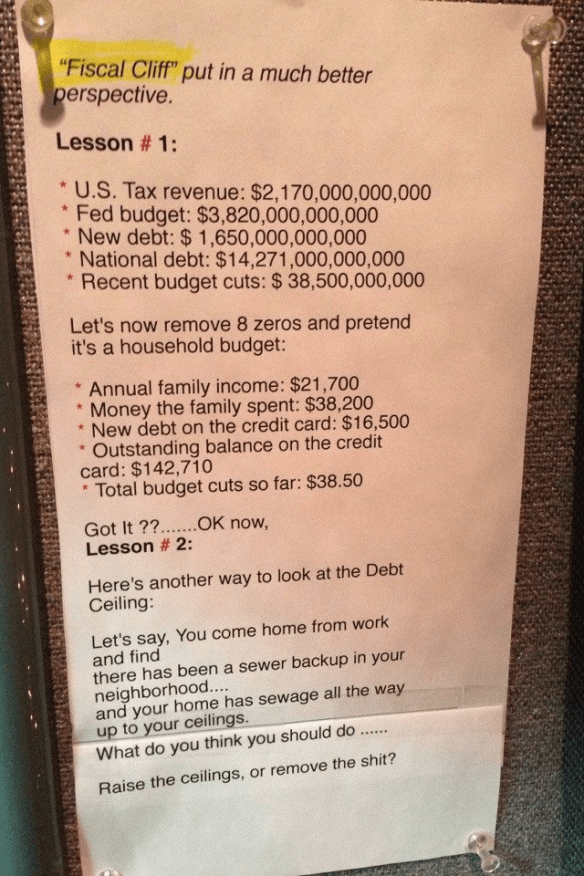
Look Obama won. The fiscal cliff has been averted, taxes were upped a bit, some reductions in spending took place, the debt and deficits will keep on rising and everything can continue as before. And like I say, Obama won so the economy is all his. Whatever happens from now on in belongs to the Democrats. Good luck to them.

The front page story in The Australian is Global markets rocket on US fiscal cliff deal. Those in the know must all be really pleased with the outcome, something like a Neville Chamberlain peace-in-our-time moment. Of course there’s this:

While investors were happy to celebrate the compromise, many also expressed disappointment over the reduced scope of the deal, which props open the door for further rancor in the coming months.

Some investors already were turning their focus to looming congressional fights over the budget, pre-programmed spending cuts and the debt ceiling, which limits the US government’s ability to borrow.

So it’s not all beer and skittles, at least not if you’re a Democrat. It never was for the Republicans.

There are the spending cuts which are almost unambiguously a plus but amongst which will be cuts to defence that will take the US expenditure to the same proportion of GDP as it was in 1916 or so I understand. There is, of course, a much larger GDP for defence to be a proportion of, but it doesn’t seem part of an orderly international future, but that’s just me. But at least most of the Bush tax cuts are legislated in and can’t be so easily removed and there are some reductions in expenditure.

Meanwhile all of the problems that existed before continue. With Obamacare suddenly to enter everyone’s calculations, the US is rapidly heading for a kind of third world elites-and-serfs kind of future. You are in the government, good; you work for the government, good; you are on a direct feed from government, good. These are the new elite. Everyone else will struggle. Upwards mobility through one’s own hard work and effort, that will be the toughest road of all, when in the past it was the American way and many many took that route. It is a roadway that has, for the time being, been turned into a single lane pathway. When it will return to how it was is hard for me to say.

But the one moment of these fiscal cliff negotiations I most enjoyed was when the House Majority Leader, John Boehner, told the Senate Majority Leader, Harry Reid, to “go fxxx yourself”. For that alone, I would keep him as the House Majority Leader. There may be something there for Tony to think about the next time Julia calls him a misogynist or whatever.

Hayek on Keynes

This is from Hayek on Monday Conference in 1976 where he discusses the failures of Keynesian economics. But I must confess that if Hayek thinks of public spending as “a simple monetary device”, then he has characterised Keynesian economics in a way that no one will recognise, including me.

MOORE: In your Nobel Memorial lecture, why did you say, speaking of economists, ‘we have made a mess of things’. Now can I ask you this, why have economists made a mess of things? Why have they? Are they blind or are they …

HAYEK: No, it was the seduction of a very impressive and ingenious man, John Maynard Keynes, who persuaded economists that there was a simple way of permanent[ly] securing full employment. He was wrong but he was exceedingly persuasive, and he had gained the support of probably 95% of the current international economists. I have been arguing against the ever since.

I have been arguing with him when he was still alive, but there was no chance of getting a hearing so long as it seemed plausible that by a simple monetary device you could assure full employment. And that monetary device was in fact of such a nature that in the short run you could do it, that in fact at the same time you created distortions of the structure of the economy which in the long run was bound to bring about unemployment, a thing which a few of us had pointed out.

What seemed to be in contradiction was the actual experience — currently it worked beautifully — that we have been predicting you will have to pay for this in the future, people just wouldn’t listen to you. Well what we have predicted [h]as come to be very true. We found out that the Keynesian method of creating employment by accelerating inflation works only for a limited period and creates a condition for the following unemployment and that is the state of disillusionment in which we are now.

A great many economists feel that what they have — I mean the economists who have been trained between the middle 30s and the present, are now finding out that they have been taught a wrong doctrine.

It was 95% then and it’s 95% now, but if the other 5% thinks we are dealing with a small monetary device and not something larger and more insidious then there really is nowhere to begin the process of reversal.

As for the “simple monetary device”, it seems to me that he may have explained it later:

The basic problem is that with a new Keynesian economics they’ve given a charter to the trade unions to ask as much as they want and imposed the duty on monetary authorities to offset this by providing enough money.

There are many ways to buy off a majority of the population with higher money wages only one of them. His characterisation of the processes involved may have worked for the time and been suitable for a television audience but does not penetrate far enough to explain the nature of the problem.

[My thanks to Rafe for the link.]