‘I am a Socialist,’ Hitler told Otto Strasser in 1930

Daniel Hannan has a useful column in London’s Telegraph on the socialist origins of fascism. I merely describe it as “useful” because it will be read and understood only by people who understand these things already but worth repeating just to remind ourselves who are enemies are and what they stand for.

‘I am a Socialist,’ Hitler told Otto Strasser in 1930, ‘and a very different kind of Socialist from your rich friend, Count Reventlow’.

No one at the time would have regarded it as a controversial statement. The Nazis could hardly have been more open in their socialism, describing themselves with the same terminology as our own SWP: National Socialist German Workers’ Party.

Almost everyone in those days accepted that fascism had emerged from the revolutionary Left. Its militants marched on May Day under red flags. Its leaders stood for collectivism, state control of industry, high tariffs, workers’ councils. Around Europe, fascists were convinced that, as Hitler told an enthusiastic Mussolini in 1934, ‘capitalism has run its course’

If you, too, are of the view that capitalism has run its course you should be aware of the company you keep.

Some very expensive lessons for us all

This is the poor benighted James Callahan in 1979, England’s Prime Minister at the time who gave way to Margaret Thatcher, having learned a lesson or two along the way about just how much junk science Keynesian economics actually is:

We used to think that you could spend your way out of a recession and increase employment by cutting taxes and boosting government spending. I tell you in all candour that that option no longer exists, and in so far as it ever did exist, it only worked on each occasion since the war by injecting a bigger dose of inflation into the economy, followed by a higher level of unemployment as the next step.

I don’t wish to entirely absolve our own Treasurer but really, it’s economic theory and the misguided policies it keeps providing to governments. It’s those folks at Treasury and the faulty economic models they so wholeheartedly believe in and apply, theories which are taught across the world in virtually every introductory text, that is the problem.

Had Swan arrived to be told that we must sit tight and not try to spend our way to prosperity, perhaps just a bit of extra spending here or there but nothing massive, he might have done the right thing. Instead he was told to spend up to the hilt so that is what he did. That he is finding out, in just the same way as James Callahan, that the only way it can work is by ever greater doses of the same bad policy is merely a very very expensive lessons for him and for us all. One can only hope that the next Labor Treasurer, twelve or more years from now let us hope, will have internalised the lessons that have been so painfully taught.

Pierce, epistomology and economic theory

This is a posting by Menno Rol on the SHOE website

The heart of the epistemology of Pierce can be formulated as the claim that sticking to old beliefs is a man’s normal inclination and that this is in fact rational. In order to learn, we update old beliefs with a certain unwillingness in the face of counterevidence, facts that we stumble upon daily. The updating process runs via hypothesis making: inference to the best explanation. What counts as the best explanation depends not only on the newly encountered facts, but just as much – or even more – on our old beliefs. Again, this is rational.

Economics develops ever more into the direction of a science of information exchange – think of Levitt & Dubner’s “Freakonmics”, Constanze Binder’s “Agency, Freedom and Choice” and Frydman & Goldberg’s “Imperfect Knowledge Economics”. If this is true, then it seems that Pierce’s approach becomes ever more relevant for economists.

This may be supplemented by an earlier post:

You asked the SHOE-List about case studies on Peirce’s abductive reasoning. The following publications on Peirce’s philosophy in economics might be of interest to you, although I am not quite sure to what extent they can be considered case studies:

  • James Wible. 1998. The Economics of Science: Methodology and Epistemology as if Economics Really Mattered. Routledge. (See: Chapter 4. Also: check Index.)
  • A. W. Dyer. 1986. “Veblen on Scientific Creativity: The Influence of Charles S. Peirce” Journal of Economic Issues 20(1)
  • Altug Yalcintas. 2013. “The Problem of Epistemic Cost” American Journal of Economics and Sociology 72 (5)

How short life is when all of this is there for study if only one had the time.

How to manage an economy

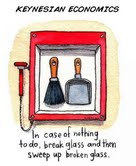
keynesian broken glass

It is becoming more apparent that modern macro with its Keynesian Y=C+I+G is utterly defective to the point of vacuity but the problem remains what ought to replace it? Here is my formula in brief:

1) never use variations in aggregate demand to explain anything
2) recognise that growth is driven by value adding production alone
3) the structure of production is the core concept in understanding how an economy works – even aggregate supply is a near on useless concept
4) government spending after perhaps the first 10% is never value adding
5) only businesses subject to the disciplines of profit and loss can be expected to create value
6) government subsidies to business do not create faster growth or more employment
7) recessions are inevitable
8) recessions can never be cured by higher levels of public spending.

Want more? See my Free Market Economics: an Introduction for the General Reader.

“Men err in their productions, there is no deficiency of demand”

There’s not a lot I agree with Paul Krugman about but his definition of Say’s Law is most certainly one of them. This is from a blog post he wrote on February 10:

When John Maynard Keynes wrote The General Theory, three generations ago, he structured his argument as a refutation of what he called ‘classical economics’, and in particular of Say’s Law the proposition that income must be spent and hence that there can never be an overall deficiency of demand.

He’s wrong about the reason, that it is because income must be spent, but he is right about the conclusion. Whatever may be the state of play in an economy, rapid growth or deep depression, the one point classical economists would agree on was that the level of demand in aggregate had nothing to do with what was going on.

I am sometimes asked why I persist with bringing Say’s Law into the conversation. There are a number of reasons, of which these are the most important.

First, Keynes himself made this his point. He was going to refute Say’s Law. It still seems to me the most direct means to demonstrate that Keynes was wrong if it can be shown and understood that Say’s Law is valid after all. This is a point perfectly well understood by Krugman. This is the Maginot Line of Keynesian economics. If it is ever breached in a serious way the whole of the Keynesian position will be overrun and sent into retreat and disarray.

Second, by bringing the great economists of the classical period into the argument, I am siding with some of the smartest people who have ever lived. Just to have John Stuart Mill, the man with the nineteenth century’s highest IQ on one’s side, adds quite considerable weight to one’s own arguments. If you believe Mill got it wrong you had better have a pretty strong reason for thinking you can see into these things more clearly than he could.

Third, there is a genealogy for these arguments that one can look up. I have become all too aware that virtually no one even amongst historians of economic thought actually knows very much about classical business cycle theory. Expertise in this area is vanishingly small. Yet it is there for anyone to access if they would bother to try. I might mention that an obstacle to even looking is that Keynes explicitly stated that classical theory had no explanation for involuntary unemployment, a statement so ridiculously untrue that it is shameful that saying just this didn’t discredit him on the spot. But the upshot is that no one who wishes to stay onside with the mainstream of the profession ever wishes to make anything of this.

Four, it is important to get people to understand that the crucial issue is aggregate demand. This is Keynes’ innovation. I say this to you, that if you use aggregate demand to explain anything at all in economic theory, you cannot and will not understand anything at all about what you are trying to explain.

If every time you used the phrase aggregate demand you substituted “value adding production” then you would start to see things a bit more clearly. As in, “if employment is to rise we need an increase in aggregate demand” now becomes, “if employment is to rise we need an increase in value adding production”. You employ people to produce, not to buy. Alas, between the writers and publishers of economic texts there is enough heft to stop any such adjustment being made in how we teach and explain economics, but you can do it for yourself. And if you do it, you will then see that nothing that transpired as part of the world’s various stimulus packages could ever have led to recovery since none of it led to an increase in value adding production.

Anyway, there is more along the same lines as this in an article that you can find at Quadrant Online.

And let me just mention the reason for the title. The statement is from David Ricardo and was part of a letter to Thomas Malthus written in 1820. Malthus was arguing that the recession that was then current was due to a deficiency of demand. People preferred to save and not to spend. I will only say that if you think that the depressed level of our economies at the present time is due to too little demand, then so far as the operation of our economies goes, like Malthus in 1820 you do not have a clue.

History of economics comes to TV

I shall fortify myself for the ordeal but tonight at 9:30 on SBS:

John Maynard and Keynesianism – BBC economics editor Stephanie Flanders examines how three extraordinary thinkers, Keynes, Hayek and Marx, helped shape the 20th century. John Maynard Keynes was the first economist to become a global celebrity. He made his name during the worst economic crisis the world had seen, the Great Depression. His theory that only government spending could kick-start a depressed economy was controversial, but recently both the US and UK governments have pumped money into their stuttering economies.

We have seen how well government spending has been at kick starting our economies but I shall look on with interest. Good to see some recognition of the importance of the history of economic thought.

Aggregate demand has NO effect on employment and economic growth

My economics, so far as macro goes, is pure classical and I do personally believe that economics reached a high point with John Stuart Mill before the coming of the marginal revolution which made some sense is many ways but lost quite a bit as well. This is a continuation of the post on The errors of Keynes’ critics on hoarding and demand deficiency.

What is the question we wish to answer? We would like to know (1) what will cause more people to be employed and (2) what will cause the economy to increase its level of production?

So the answer on both counts is that employment and growth will increase if production increases, if there is more capital in existence that can be used to produce with and if the productiveness of capital can be improved. These are all 100% entrepreneurial decisions. At the back of every entrepreneur’s mind there is, of course, the question whether what they produce will find a buyer so there is always some degree of uncertainty and doubt associated with every entrepreneurial decision. And it goes without saying that no one will produce unless they believe that there will be enough demand for the product or service. But demand here is purely notional and exists entirely in the mind of the entrepreneur as he tries to work out what others will do if the product is supplied to the market.

The second part is that there is no level of output that will not find a market. An economy cannot produce so much that it will exhaust the willingness of a population to buy the lot. Demand deficiency will never be the nature of the problem when an economy goes into recession.

But trying to work out what people will buy in the future is fantastically difficult. Some part of that is determined by the level of demand in the past but all production decisions are forward looking so past and present demand is merely one piece of information to go along with the rest.

So there are two possibilities for demand deficiency as it is thought of by Keynes and the Keynesian model. Firstly, for a variety of reasons, the population in aggregate will not wish to buy everything that the economy at full employment could produce. They have the income but are just not willing to spend, or businesses have the lines of credit but there are not enough ventures for them to pursue for the moment so that the level of investment sags and savings run to waste.

Well, the fact of the matter is that no such economy has ever existed anywhere nor is likely to. Pick any recession you like and you will never find even a glimmer of an explanation in some kind of fall off in demand just as things were going so well. The recession in 2009 was not caused by decisions to save or businesses not wanting to invest. Identify your own explanation as you will, no one has argued that recession began because of demand deficiency, not even Krugman.

So the second part is to ask whether once recession begins there is then some kind of independent fall in demand that makes things worse. The downturn would have only gone one notch but because of this uncertainty it has gone down three notches. But again that’s not right. As the economy goes over the cliff, everyone is working as furiously as they can to keep their own boat upright. They are doing everything they can humanly hope to do to maintain their own businesses or if they are employees, to keep the businesses which employ them from sinking.

But recessions are due because a portion of the economy was non value adding. This is the meaning of a misdirected structure of production. Some of the economy could not maintain profitability and down they go and they pull suppliers down with them and there is a large increase in unemployment that coexists with the fall off in the level of activity.

And every such downturn in the real economy has an inevitable effect on the financial system. Loans are not being repaid and money becomes really tight. This is the situation described by Mill wherein everyone is trying to get their hands on cash. This is not hoarding. This is a financial crisis. To think of this as hoarding cash, as if everyone just went out and decided one day that they wanted to hold more money. This is what you saw in 2008-09. There was a drive to cash up in an economy where the financial system was in the process of losing immense amounts of money through the unravelling of the leveraging that had been rampant. It was musical chairs with money. Eight people but only seven chairs and so some ended up without the finance to keep their businesses going.

And that’s where we were in 2009. The economy was in recession and finance was tight. No one was hoarding cash. There was no demand deficiency. There was a breakdown in the structure of production which lasted for about half a year.

So the question then was what to do. The Keynesian interpreted these events as a fall in demand when the reality was that there was a rotting in one part of the structure of production. The Keynesians therefore said we had to boost demand but they really meant we must boost supply by employing people to create goods and services that would not repay their production costs. So we had the stimulus and the result has been deficits and debt as far as the eye can see without even a hint of recovery.

I, being completely classical, said that the problem was not a deficiency of demand but structural imbalance. There are things to do, such as bringing the level of business taxes down or lowering interest rates (which happens anyway so doesn’t have to be done). Governments can also do some small additional expenditure on various value adding forms of activity but it is a palliative so little can be depended on it.

Recovery will take about a year, as businesses climb out of their shell holes and suss out where profitable areas of activity might now be. It takes a while but is hardly an unconscionable length of time, especially when we have so many forms of income protection around (which stimulate no demand and are purely a form of welfare but so what). And then, if my approach had been adopted, by around 2010 we would have been well into recovery and unemployment would have been falling and the economy’s momentum gathering steam.

But at no moment during the recession would it ever have been sensible to say that the problem was too little demand, too much saving or that hoarding was postponing recovery. That is pure Keynesian junk and has rotted plenty of minds already and it isn’t finished yet, as that review I read this morning clearly showed.

At the aggregate level an economy has no demand side, only supply. Demand is constituted by the supply of goods being placed on the market. If the notion of demand even darkens your thoughts for a moment, just try to see what the supply issue is that is the real issue of any moment. Not being immediately able to guess after a recessionary explosion has gone off where to increase production is not to be classified as a failure of demand.

The errors of Keynes’s critics

I was pointed in the direction of this article at Mises.org on “The Errors of Keynes” by Philipp Bagus. It is a review of a book written in Spanish by Juan Ramón Rallo and titled, Los Errores de la Vieja Economía part of which deals with Say’s Law.

The really interesting part is that it is becoming better understood that the road to unwind Keynesian economics travels through Say’s Law. Keynes himself could not have been clearer on this, that he was reversing the conclusion of those who believed Say’s Law to be true. Thus, there are two things that need to be done. First you have to know what Say’s Law is. Then you then have to show it is valid.

But the problem, and it is such a massive obstacle that it gets in the way of many such attempts, is that all economists are brought up on Keynesian demand side theory and it infuses every aspect of their thought. Even while recognising that it is the structure of demand that is the key they still hang onto the level of demand as an integral part of how they approach economic problems.

Let me therefore put it this way. If one is to understand the classical theory of the cycle, this is what one must know in one’s very bones. Hoarding NEVER causes a recession. Too much saving is NEVER the problem. An economy NEVER suffers from demand deficiency. If you want to say that after a recession begins people become tentative because of a lack of confidence, this you can find absolutely everywhere on the classical side of the Keynes-classics divide. .

Here is the reviewer’s discussion of Say’s Law.

Let’s have a look of some of Rallo’s arguments, beginning with Keynes’s famous critique of Say’s Law. Keynes’s distorted version of Say’s Law in TGT states that supply creates its own demand. Rallo vindicates Say’s Law in its original version: In the long run, the supply of a good adjusts to its demand. Ultimately, goods are offered to buy other goods (money included). One produces in order to demand, which implies that a general overproduction is impossible [in the long run].

Say’s Laws leads us straight forward to the most innovative argument in Rallo’s book that addresses the old argument against hoarding. Even harsh critics of Keynes, for example from the monetarist or neoclassical camp, admit that Keynes was at least right in that hoarding is a destabilizing and dangerous activity.

Rallo, however, proves and emphasizes the social function of hoarding. To demand money is not to demand nothing from the market. Hoarding is the natural response of savers and consumers to a structure of production that does not adjust to their needs. It is a signal of protest to entrepreneurs: ‘Please offer different consumer and capital goods! Change the structure of production, since the composition of offered goods is not appropriate.’ (My bolding and my additional text in square brackets)

This is how he controverts Keynes by confirming everything he wrote. People really do hoard, Rallo argues, store money rather than spend. There really is a deficiency of demand in the short to medium term which may finally work itself out in the long run, eventually, in five to ten years perhaps. Overproduction is impossible but only ultimately. Involuntary unemployment does apparently occur because of some problem on the demand side of the economy due to hoarding cash. However, rather than this deficiency of demand being a bad thing, it’s a good thing since the hoarding allows business to think about what to do next. But if you are Krugman, it also allows the government to come to the rescue with a stimulus package that will short circuit this delay. Here is the example Rallo uses of how hoarding can work:

In a situation of great uncertainty, it is even prudent to hoard and not immobilize funds for the long run. Rallo provides us a visual example. Let’s assume that uncertainty increases because people expect an earthquake. They start to hoard, i.e., they increase their cash balance, which gives them more flexibility. This is completely rational and beneficial from the point of view of market participants. The alternative is to immobilize funds through government spending. The public production of skyscrapers is not only against the will of the more prudent people; it will also prove disastrous if the earthquake is realized.

A government should not build skyscrapers when everyone expects an earthquake! But if the economy has gone quiet and there are useful things a government can do – perhaps reinforcing existing buildings – why wouldn’t that make sense? I’m afraid it’s a metaphor that doesn’t necessarily make sense and certainly won’t explain why Keynes is wrong and would never convince a Keynesian.

So let me get to the problem as expressed in this para in the review:

As Rallo points out in contrast to TGT, it is not aggregate supply or aggregate demand that is important, but their composition. If, in a depression with a distorted structure of production, in a liquidity trap situation, aggregate demand is boosted by government spending, the existing structure cannot produce the goods that consumers want most urgently. The solution is not more spending and more debts, but debt reduction and the liquidation of malinvestments to make new and sustainable investments feasible. (My bolding)

I can certainly agree with that the solution is to leave recovery to the private sector as they find their way towards profitable outcomes. But to use “aggregate demand” in the same sentence as “structure of production” must leave the argument confused. Even more certainly, to include mention of “a liquidity trap” will bar entry to the classical world. Demand is constituted by supply: supply is demand. Aggregate demand and aggregate supply are not two separate entities. There is no such thing as an independent force that can be described as aggregate demand.

If you want to get to the essence of Say’s Law you must NEVER think in terms of aggregate demand. Just drop it from all conceptual discussions of the economy and I think, although I can’t be sure, you will find yourself necessarily thinking about issues in the same way as the classics. If you want to defeat Keynesian economics, you need to wage war on the idea of aggregate demand. Nothing else will do.

So God made an entrepreneur

This is the number one Superbowl ad which extols the virtues of a farming life. But if you watch it, which is quite an extraordinary piece of craftsmanship, what it is really extolling is the ethic that applies across the board to all forms of business. There is a sentiment about farmers, perhaps, but the same as is said here could be said about anyone who is trying to keep a business together in the heart of the city. But if they ran an ad about how hard it is to make a living by employing others in a business enterprise you would not get the same response, not by a long chalk.