Harry Harlow’s experiments on love and affection

Rhesus monkey clings to surrogate mother.

I have  just run across this experiment in the psychology of mother love and it is fascinating. This is from Harlow’s Classic Studies Revealed the Importance of Maternal Contact. What amazes me is the criticism he endured for his supposed cruelty to animals.

Infant rhesus monkeys were taken away from their mothers and raised in a laboratory setting, with some infants placed in separate cages away from peers. In social isolation, the monkeys showed disturbed behavior, staring blankly, circling their cages, and engaging in self-mutilation. When the isolated infants were re-introduced to the group, they were unsure of how to interact — many stayed separate from the group, and some even died after refusing to eat.

Even without complete isolation, the infant monkeys raised without mothers developed social deficits, showing reclusive tendencies and clinging to their cloth diapers. Harlow was interested in the infants’ attachment to the cloth diapers, speculating that the soft material may simulate the comfort provided by a mother’s touch. Based on this observation, Harlow designed his now-famous surrogate mother experiment.

In this study, Harlow took infant monkeys from their biological mothers and gave them two inanimate surrogate mothers: one was a simple construction of wire and wood, and the second was covered in foam rubber and soft terry cloth. The infants were assigned to one of two conditions. In the first, the wire mother had a milk bottle and the cloth mother did not; in the second, the cloth mother had the food while the wire mother had none.

In both conditions, Harlow found that the infant monkeys spent significantly more time with the terry cloth mother than they did with the wire mother. When only the wire mother had food, the babies came to the wire mother to feed and immediately returned to cling to the cloth surrogate.

This is what he said in reply to his critics:

Remember, for every mistreated monkey, there are a million mistreated children. If my work will point this out, and save only one million human children then I can’t get overly concerned about ten monkeys.

At least his colleagues seemed to understand the nature and importance of his work.

In 1958, Harlow was elected president of the American Psychological Association. At the APA’s annual meeting on August 31 of that year, he delivered a seminal paper titled “The Nature of Love,” cited in Love at Goon Park (public library) — Deborah Blum’s masterful chronicle of how Harlow pioneered the science of affection.

This is the experimental result that mattered.

His most famous experiment involved giving young rhesus monkeys a choice between two different “mothers.” One was made of soft terrycloth but provided no food. The other was made of wire but provided nourishment from an attached baby bottle.

Harlow removed young monkeys from their natural mothers a few hours after birth and left them to be “raised” by these mother surrogates. The experiment demonstrated that the baby monkeys spent significantly more time with their cloth mother than with their wire mother.

In other words, the infant monkeys went to the wire mother only for food but preferred to spend their time with the soft, comforting cloth mother when they were not eating. Harlow concluded that affection was the primary force behind the need for closeness.

I suspect this is as much true for adults as it is for children.
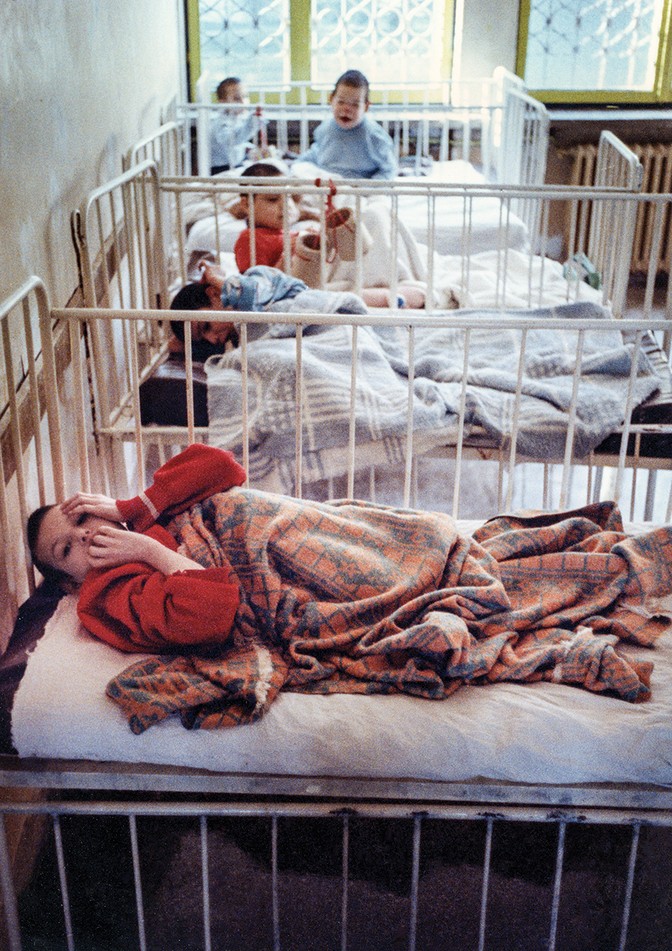
Children at the Home Hospital for Irrecoverable Children in Sighetu Marmaţiei, Romania, in September 1992

But no sooner to I come across that, I came across this: 30 Years Ago, Romania Deprived Thousands of Babies of Human Contact. And there, in the midst of the story there was this:

Neuroscientists tended to view “attachment theory” as suggestive and thought-provoking work within the “soft science” of psychology. It largely relied on case studies or correlational evidence or animal research. In the psychologist Harry Harlow’s infamous “maternal deprivation” experiments, he caged baby rhesus monkeys alone, offering them only maternal facsimiles made of wire and wood, or foam and terry cloth.

Why use monkeys when you can use real children.

By design, 68 of the children would continue to receive “care as usual,” while the other 68 would be placed with foster families recruited and trained by BEIP. (Romania didn’t have a tradition of foster care; officials believed orphanages were safer for children.) Local kids whose parents volunteered to participate made up a third group. The BEIP study would become the first-ever randomized controlled trial to measure the impact of early institutionalization on brain and behavioral development and to examine high-quality foster care as an alternative.

And then they were assessed and then re-assessed again.

When the children were reassessed in a “strange situation” playroom at age 3.5, the portion who displayed secure attachments climbed from the baseline of 3 percent to nearly 50 percent among the foster-care kids, but to only 18 percent among those who remained institutionalized—and, again, the children moved before their second birthday did best. “Timing is critical,” the researchers wrote. Brain plasticity wasn’t “unlimited,” they warned. “Earlier is better.”

The benefits for children who’d achieved secure attachments accrued as time went on. At age 4.5, they had significantly lower rates of depression and anxiety and fewer “callous unemotional traits” (limited empathy, lack of guilt, shallow affect) than their peers still in institutions. About 40 percent of teenagers in the study who’d ever been in orphanages, in fact, were eventually diagnosed with a major psychiatric condition. Their growth was stunted, and their motor skills and language development stalled. MRI studies revealed that the brain volume of the still-institutionalized children was below that of the never institutionalized, and EEGs showed profoundly less brain activity. “If you think of the brain as a light bulb,” Charles Nelson has said, “it’s as though there was a dimmer that had reduced them from a 100-watt bulb to 30 watts.”

And then later in the article we come to this.

As early as 2003, it was evident to the BEIP scientists and their Romanian research partners that the foster-care children were making progress. Glimmering through the data was a sensitive period of 24 months during which it was crucial for a child to establish an attachment relationship with a caregiver, Zeanah says. Children taken out of orphanages before their second birthday were benefiting from being with families far more than those who stayed longer. “When you’re doing a trial and your preliminary evidence is that the intervention is effective, you have to ask, ‘Do we stop now and make the drug available to everyone?’ ” he told me. “For us, the ‘effective drug’ happened to be foster care, and we weren’t capable of creating a national foster-care system.” Instead, the researchers announced their results publicly, and the next year, the Romanian government banned the institutionalization of children under the age of 2. Since then, it has raised the minimum age to 7, and government-sponsored foster care has expanded dramatically.

But in the end, both sets of children ended up damaged. This is a passage towards the end of the article.

The neuropsychologist Ron Federici was another of the first wave of child-development experts to visit the institutions for the “unsalvageables,” and he has become one of the world’s top specialists caring for post-institutionalized children adopted into Western homes. “In the early years, everybody had starry eyes,” Federici says. “They thought loving, caring families could heal these kids. I warned them: These kids are going to push you to the breaking point. Get trained to work with special-needs children. Keep their bedrooms spare and simple. Instead of ‘I love you,’ just tell them, ‘You are safe.’ ” But most new or prospective parents couldn’t bear to hear it, and the adoption agencies that set up shop overnight in Romania weren’t in the business of delivering such dire messages. “I got a lot of hate mail,” says Federici, who is fast-talking and blunt, with a long face and a thatch of shiny black hair. “ ‘You’re cold! They need love! They’ve got to be hugged.’ ” But the former marine, once widely accused of being too pessimistic about the kids’ futures, is now considered prescient.

Federici and his wife adopted eight children from brutal institutions themselves: three from Russia and five from Romania, including a trio of brothers, ages 8, 10, and 12. The two oldest weighed 30 pounds each and were dying from untreated hemophilia and hepatitis C when he carried them out the front door of their orphanage; it took the couple two years to locate the boys’ younger brother in another institution. Since then, in his clinical practice in Northern Virginia, Federici has seen 9,000 young people, close to a third of them from Romania. Tracking his patients across the decades, he has found that 25 percent require round-the-clock care, another 55 percent have “significant” challenges that can be managed with adult-support services, and about 20 percent are able to live independently.

Harry Harlow was not just right, he was more right than he would ever know. It is common sense and indeed obvious; it is very hard to provide warmth outside a family relationship.

Why were the following people famous while they were still alive?

Just thinking about how one might just possibly get around the cancel culture of invincible ignorance that is the most notable characteristic of so much among the left today, and I thought about that kind of question. You might include the following names among the list just as a start.

  • Plato
  • Aristotle
  • Charlemagne
  • Geoffrey Chaucer
  • William Shakespeare
  • Christopher Columbus
  • Copernicus
  • George Washington
  • Wolfgang Amadeus Mozart
  • Captain James Cook
  • Adam Smith
  • John Stuart Mill
  • Abraham Lincoln
  • Karl Marx
  • William Gladstone
  • Winston Churchill

The list should be, of course, much longer and there should be dates and historical periods associated with each of them. An education consists of knowing who did what, when they did it, perhaps even some speculation why they did what they did, so that there is an understanding of why the world ended up in the way it is. And it wouldn’t hurt to know a bit of something about modern chemistry, physics, mathematics and biology as well.

People have been dying for a long time for a lot of reasons

The page above is taken from The Perpetual Almanack of Folklore for February 17 which shows, if you can read the print:

During the week which ended on this day in 1719, the following diseases and conditions proved fatal to the inhabitants of London.

Not all of them died, of course, but only some. And none of them died of Covid-19, unless it was Covid-1719. Meanwhile, back in the real world of modern life as we live it today, we have this: The cult of Dan — coming soon to a garbage bag on you.

A person from Melbourne’s CBD wears a garbage bag during their transfer to the Pullman Hotel in Albert Park. Picture: NCA NewsWire / Ian Currie

This is where we have progressed to today. I will end with a quote from John Stuart Mill which seems especially apposite:

“The only freedom which deserves the name is that of pursuing our own good in our own way, so long as we do not attempt to deprive others of theirs, or impede their efforts to obtain it. Each is the proper guardian of [their] own health, whether bodily, or mental or spiritual. Mankind are greater gainers by suffering each other to live as seems good to themselves, than by compelling each to live as seems good to the rest.”

We do not deserve the freedom we have been bequeathed and will soon lose it if we do not mend our ways assuming it has not been lost already.

I hope the death of Rush Limbaugh today is not a metaphor for much else that is going on.

AND NOW TO ADD TO EVERYTHING ELSE THERE IS THIS: From Tony Thomas: Daniel Andrews’ Bad Case of China Envy. Read it through and see if our freedoms are not actually on the line. The accompanying picture really does say something worth thinking about.

Covid and the political economy of mass hysteria

This is the best single article on the Chinese flu I have seen from anywhere and from anyone, and here it is by Adam Creighton in The Australian: Coronavirus lockdown lunacy is frying our minds. I hope my saying so doesn’t put the moz on him,* but let me take you to the text.

The west, and Australia and New Zealand in particular, are suffering mass psychogenic illness, where only sociology, psychology and the perverse incentives of large welfare states, can explain the ongoing obsession with COVID-19 and our medieval responses to it after almost a year of improved treatments and new information.

Great start, but it gets even better.

For three German and Spanish economists, it’s time to ask this question: have we forgotten the rationality that’s meant to define policymaking in advanced liberal democracies? Their new research paper, COVID-19 and the Political Economy of Mass Hysteria, lays out how our biological tendency to overreact coupled with a social and mass media that profit from panic, plus powerful welfare states, make mass psychosis likely, and hard to reverse.

It does seem that we are locked in with the lockdown mentality and the probability of reversal in the short-term seems very unlikely. We are in the grip of mass lunacy. To continue:

Some seriously weird behaviours have emerged…. Australia and New Zealand have incurred costs equivalent to a world war — and more than any other nation has — fighting a pandemic that has killed not even 1000 people, with a median age in the mid-80s, between them. And this is widely seen as brilliant.

What he means, of course, is that in reality we are collectively speaking utter fools.

Having insisted early last year that lockdowns were necessary to “flatten the curve”, rolling capital city “snap” lockdowns of millions of people have become the norm, at extraordinary economic, psychological and social cost, without a single person in ICU across either country.

Yet the hysteria goes on, and on.

The venerable Economist magazine even wrote last week that 150 million people would die (three times the number killed by the Spanish flu) from COVID-19 without strong government action, a claim breathtaking in its absurdity. Globally, 2.4 million people have died from or with COVID-19, yet every year other communicable diseases kill more. A death is a death, whatever its cause, yet the world is not shut down. It’s time our leaders started pouring cold water over an electorate that’s worked itself into a lather. Our leaders should level with voters that we can’t remain an open liberal society without incurring further deaths and cases from COVID-19. Let vulnerable groups be vaccinated, and let everyone else get on with their life. The three authors, at universities in Spain and Chile, argue that hysteria dissipates more quickly in nations that respect civil liberties, where the minority who wish to behave rationally “can just ignore the collective panic and continue to live their normal lives”, illustrating to the hysterical majority that they too can safely return to normal.

And if you are interested in the paper Adam cites, you can find it here: COVID-19 and the Political Economy of Mass Hysteria. This is the abstract. “Nocebo” means “detrimental effect on health produced by psychological or psychosomatic factors such as negative expectations of treatment or prognosis”.

In this article, we aim to develop a political economy of mass hysteria. Using the background of COVID-19, we study past mass hysteria. Negative information which is spread through mass media repetitively can affect public health negatively in the form of nocebo effects and mass hysteria. We argue that mass and digital media in connection with the state may have had adverse consequences during the COVID-19 crisis. The resulting collective hysteria may have contributed to policy errors by governments not in line with health recommendations. While mass hysteria can occur in societies with a minimal state, we show that there exist certain self-corrective mechanisms and limits to the harm inflicted, such as sacrosanct private property rights. However, mass hysteria can be exacerbated and self-reinforcing when the negative information comes from an authoritative source, when the media are politicized, and social networks make the negative information omnipresent. We conclude that the negative long-term effects of mass hysteria are exacerbated by the size of the state.

There will come a time when our generation will be seen as the biggest bunch of fools in the history of the world, even more inane than the folks who used to burn witches at the stake.

* For our non-Australian readers, “to put the moz on someone” is to jinx them. But here is the origin of which I had no idea. According to Meanings and origins of Australian words and idioms:

moz: put the moz on

To exert a malign influence upon (a person), to jinx. Moz is an abbreviated form of mozzle, which is derived from the Hebrew word mazzal meaning ‘luck’. It probably came into Australian English via German Yiddish speakers. Put the moz on is recorded from the 1920s.

Genesis, a poem by David Solway


The Sun, Edvard Munch, 1909  

Genesis

                 I strongly believe in the existence of God, based on intuition, observations, logic, and also scientific knowledge.
                           —Charles Townes, inventor of the laser

The earth was without form, and void
and darkness was on the face of the deep.
And the Spirit of God hovered over the face of Nothing.
Then God said:
Let there be a zero-point field;
and there was a zero-point field.
And God saw the zero-point field,
that it was good.
And God said:
Let there be a quantum vacuum.
Let it fluctuate in ceaseless waves
in a rippling sea of quantum radiation.
And it was so.
Then God said:
Let matter be sustained
by the underlying sea of quantum radiation
for it is a force that opposes acceleration
and gives a body to things.
Let stochastic electrodynamics be the order of the day.
Let there be inertia.
Let matter be solid.
And it was so.
Thus God created an electromagnetic spectrum
and called it light
which was not the light of the sun, moon and stars
but the light of Creation.
And indeed it was very good. 

From The New English Review. Should also mention:

David Solway’s latest book is Notes from a Derelict Culture, Black House Publishing, 2019, London. A CD of his original songs, Partial to Cain, appeared in 2019.

We are living in an idiocracy

Abstract
 
Dysgenic fertility means that there is a negative correlation between intelligence and number of children. Its presence during the last century has been demonstrated in several countries. We show here that there is dysgenic fertility in the world population quantified by a correlation of 0.73 between IQ and fertility across nations. It is estimated that the effect of this has been a decline in the world’s genotypic IQ of 0.86 IQ points for the years 19502000. A further decline of 1.28 IQ points in the world’s genotypic IQ is projected for the years 20002050. In the period 19502000 this decline has been compensated for by a rise in phenotypic intelligence known as the Flynn Effect, but recent studies in four economically developed countries have found that this has now ceased or gone into reverse. It seems probable that this negative Flynn Effectwill spread to economically developing countries and the whole world will move into a period of declining genotypic and phenotypic intelligence. It is possible that the new eugenicsof biotechnology may evolve to counteract dysgenic fertility.
 
That’s the abstract from a paper on The decline of the world’s IQ of which there are quite a few at the moment. Here’s another that brings the fall of our collective IQ together with its political consequences: The Decline of Intelligence in the West. It’s by David Solway which is one more reason to pay attention. Here’s the opening para with a message for us here down under.
 
Recent studies have reported a worrisome decline in IQ scores in Western nations over the last decades, a reversal of the once-hopeful Flynn Effect (named after the late philosopher and psychologist James R. Flynn) which posited a growth in cognitive abilities for much of the 20th Century. Now the Flynn Effect seems to have reversed, leading to predictions of a general dumbing down of selective populations. Other studies report that IQ erosion is not confined to this century but that IQ has dropped by an average of 14.1 percent over the last century. As Evan Horowitz writes for NBC News, “A range of studies using a variety of well-established IQ tests and metrics have found declining scores across Scandinavia, Britain, Germany, France and Australia.”
 
Let’s get to the nub of the issue.
 
One recalls MIT economist Jonathan Gruber, the architect of Obamacare, who referred to “the stupidity of the American voter” as helping him to pass the controversial law. One wonders if Gruber ever heard of Swiss psychologist Jean Piaget’s test results purporting to show that “the rot starts at the top.” This would implicate Gruber and his cohort in the experience of what Piaget calls horizontal décalage, which stymies the application of cognitive functions and logical operations to extended tasks. In other words, Gruber et al. are also stupid, gradually destroying the very society that enabled them to flourish. But the rot can also start at the bottom, as a combination of generalized mental vacancy and low-to-no-information voters furthers cultural and social degeneration. As Morris Berman remarks in The Twilight of American Culture, “A society cannot function if nearly everyone in it is stupid.”…
 
The travesty of intelligence, prudence, and wisdom is beyond calculation, and it is only getting worse as IQ continues to slip down the great chain of thinking. This is the world that the classic film Idiocracy extravagantly punctures.
 
 
What to do?
 
It’s a daunting task. The number of people incapable of lucid argument and civil debate, whether Internet trolls, social media vulgarians, angry progressivists, media ignoramuses and intellectually challenged political leaders, is legion. It is therefore by no means astonishing that the greatest civilization the world has ever known, the Judeo-Christian West, is subsiding into a state of cognitive expiry, prone to fantasies and delusions, unable to confront and parse the reality of the world, oblivious to the symbiosis of man, history and nature, distracted by pseudo-scientific baubles, bereft of spiritual substance, and foreign to the very idea of truth.

From the fall of Greek civilisation to the rise of Europe in the sixteenth century was around 2000 years. In between, not much although a few crumbs of knowledge and genius. Measure the time between the birth of Archimedes (287 BC) and the birth of Sir Isaac Newton (1643 AD) and you might have some idea when the next advance might come along.