Chesterton on female education

From G.K. Chesteron’s What’s Wrong with the World? published in 1908 but as modern as today.

FOLLY AND FEMALE EDUCATION

I am often solemnly asked what I think of the new ideas about female education. But there are no new ideas about female education. There is not, there never has been, even the vestige of a new idea. All the educational reformers did was to ask what was being done to boys and then go and do it to girls; just as they asked what was being taught to young squires and then taught it to young chimney sweeps. What they call new ideas are very old ideas in the wrong place. Boys play football, why shouldn’t girls play football; boys have school colors, why shouldn’t girls have school-colors; boys go in hundreds to day-schools, why shouldn’t girls go in hundreds to day-schools; boys go to Oxford, why shouldn’t girls go to Oxford—in short, boys grow mustaches, why shouldn’t girls grow mustaches—that is about their notion of a new idea. There is no brain-work in the thing at all; no root query of what sex is, of whether it alters this or that, and why, anymore than there is any imaginative grip of the humor and heart of the populace in the popular education. There is nothing but plodding, elaborate, elephantine imitation. And just as in the case of elementary teaching, the cases are of a cold and reckless inappropriateness. Even a savage could see that bodily things, at least, which are good for a man are very likely to be bad for a woman.

The greatest woman of the twentieth century

In reviewing The Iron Lady I made the offhand comment that Margaret Thatcher had been the Greatest Woman of the Twentieth Century. The debate over the greatest man had taken place at the end of 1999 and the choices, at least in the English speaking world, were narrowed down to Sir Winston Churchill and Franklin Delano Roosevelt. Although there was some debate over which may have been the greater of the two, there did seem to be a distance between them and whoever might have been third.

Oddly, however, there was no one chosen as the Greatest Woman, and I suspect it is because there was no one who stood out to the same extent as Margaret Thatcher. She was clearly so far ahead of the rest that even to raise the question shows how much she stood out from all other possible choices. Whether you loved her, hated her or were merely indifferent, she along with Ronald Reagan, dominated the events of her time. But because she is a woman of the right, a classical liberal in the conservative tradition, those who typically hand out such laurels refused to raise the subject so that they could avoid even having to acknowledge how significant her role had been.

Margaret Thatcher inherited a Britain devastated by industrial mayhem following the Winter of Discontent and within half a decade returned sound governance to the UK. She endured the full impact of the miners’s strikes and restored industrial relations sanity by sheer force of will. She took on and prevailed against Argentina in the War in the Falklands. She strode like a colossus during the Cold War which she, along with Ronald Reagan and Pope John Paul II, were instrumental in bringing to a peaceful end through an unbending moral crusade against political evil. She demanded fiscal and monetary disciplines that ended the economic chaos of the 1970s. She drove privatisation and defended our entrepreneurially-driven system of free enterprise. She was a model for others to follow as many have done. She remains to this day the gold standard of a conviction politician on the right side of history. If being a force for good is what matters, Margaret Thatcher was undoubtedly the greatest woman of the twentieth century.

Originally posted January 20, 2012 and re-posted as a reminder what greatness in politics looks like.

The only answer is to set up a chaperone service inside Parliament House

From Tasmanian Speaker says Liberal senator questioned Brittany Higgins’ drunkenness.

Tasmanian MP Sue Hickey has told State Parliament that Liberal senator Eric Abetz said former federal staffer Brittany Higgins could have put national security at risk by getting “disgustingly drunk”…. “I casually asked the honourable Senator Eric Abetz if the minister allegedly accused of the alleged rape that occurred around 30 years ago was the honourable Christian Porter MP,” Ms Hickey told Tasmanian Parliament on Wednesday morning. “The senator quickly responded that yes, it was the first law officer of the nation, Christian Porter, but not to worry, the woman is dead and the law will protect him.”

Alas, the error the good Senator made was to assume that she was in any way worried how these more than thirty year old allegations might destabilise the government. Sen Abetz is alleged to have further added:

“‘As for that Higgins girl, anybody who is so disgustingly drunk, who would sleep with anybody, could have slept with one of our spies and put the security of our nation at risk,’ ” Ms Hickey said.

The report goes on:

Ms Hickey said she asked Senator Abetz why the security guards hadn’t stepped in knowing how drunk she appeared to be. “He responded abruptly that if any security member dared to question the validity of access to the Parliament, by anyone who held a security pass, they would be sacked,” she said. “I felt sick, knowing that the last line of protection for this young woman was not able to be provided due to the practices and protocols of that Parliament.”

No doubt the only answer is to set up a chaperone service inside Parliament House to provide that last line of protection. You know, as in the definition:

Chaperone: to stay with and take care of a young woman who is not married when she is in public.

The definition also added, “especially in the past”, but some ideas just seem to be perennial. If you cannot count on personal responsibility, obviously something else will need to be tried instead.

Apparently the PM has failed to grasp how diabolical politics has become

Apparently the Prime Minister and I have something in common, which I learned from the first female president of the NSW Young Liberals, Catherine Cusack. This is what she said.

Prime Minister Scott Morrison has failed to grasp any understanding of how diabolical politics has become for women. Ms Cusack, a long-serving NSW upper house MP, said Mr Morrison “no doubt means well” but has no idea about the issues that are leaving Liberal women devastated about the state of the party…. “I hear so many stories from federal Liberal women, but they are too scared to speak up but I say to them that it is time to give Scott Morrison the information he needs.”

Since she is a long-serving NSW upper house MP, why doesn’t she just tell him, why doesn’t she just give him the information he needs? Who is in a better place to explain the problem than she is? In fact, why doesn’t she tell the rest of us as well since I am also in the dark about what the problem is. In fact, that is precisely why she was elected, to help inform the party leadership of issues they are not properly addressing.

Really, why don’t any of them tell anyone. They just keep it to themselves kinda like as if the PM, if he really cared, would understand everything already. So instead of putting the issues straight, as she might even have done in the article I am quoting from, she has decided to quit the party room. These are the final lines from the article:

“Guys, this is your problem to solve,” Ms Cusack said. She said the “toxic factions” were to blame for women being held back at the expense of men. “Bullying is something that men do well, but the bullying within the party does not only drive women away, but also very capable men,” Ms Cusack said.

I will only add that we do not elect Prime Ministers to deal with the after-hours relations between staff members in Parliament House. And if she means by “bullying” the hard edge infighting that always goes on in politics, she is just not suited for this line of work.

What’s Wrong with the World as seen in 1910

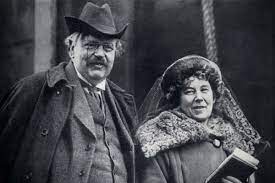
The woman beside the man, Frances Chesterton
GKC with his wife Frances

This is from What’s Wrong with the World by G.K. Chesterton in 1910. Not all that much seems to have changed. This is from Part III: “Feminism, or the Mistake about Women”, Chapter VII: “The Modern Surrender of Women”. And just what was it they surrendered. They capitulated in accepting that work outside the home was better than work inside, and the things boys did were better than the things girls did, which until then they had denied

But in this corner called England, at this end of the century, there has happened a strange and startling thing. Openly and to all appearance, this ancestral conflict has silently and abruptly ended; one of the two sexes has suddenly surrendered to the other. By the beginning of the twentieth century, within the last few years, the woman has in public surrendered to the man. She has seriously and officially owned that the man has been right all along; that the public house (or Parliament) is really more important than the private house; that politics are not (as woman had always maintained) an excuse for pots of beer, but are a sacred solemnity to which new female worshipers may kneel; that the talkative patriots in the tavern are not only admirable but enviable; that talk is not a waste of time, and therefore (as a consequence, surely) that taverns are not a waste of money. All we men had grown used to our wives and mothers, and grandmothers, and great aunts all pouring a chorus of contempt upon our hobbies of sport, drink and party politics. And now comes Miss Pankhurst with tears in her eyes, owning that all the women were wrong and all the men were right; humbly imploring to be admitted into so much as an outer court, from which she may catch a glimpse of those masculine merits which her erring sisters had so thoughtlessly scorned….

For the truth is that they go mainly by precedent; by the mere fact that men have votes already. So far from being a mutinous movement, it is really a very Conservative one; it is in the narrowest rut of the British Constitution. 

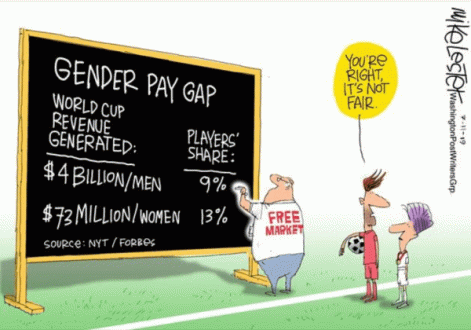
And that, let me remind you, was written in 1910. Women, he wrote, sought the vote because men had the vote. As for drink, we have seen how well they hold up on a night out with some chap but that is still the ambition. And we know how well they withstand the pressures of politics. As for sport, we now have this:

A girl can do anything, once a guy does it first and then shows her how after she has “glimpsed those masculine merits” as Chesterton has put it.