Henry Clay, economist

Adapted from Henry Clay’s entry in the Oxford Dictionary of National Biography (Jewkes and Jewkes: 2004) for an article I have written on Clay’s incomparable introductory text, Economics: an Introduction for the General Reader, which I have described as the best introductory text ever written. Only those sections related to his work as an economist have been included. The text while truncated is exactly as found. It is the Clay whom I well know from his text, and it is interesting to find that, given how similar we are, I may be properly categorised as a Gladstonian Liberal. Strangely, that very much makes me a conservative in modern times.

Clay, Sir Henry (1883–1954), economist, was born on 9 May 1883. He went as a scholar to University College, Oxford, [graduating] in 1902. Between 1909 and 1917 he lectured for the Workers’ Educational Association under the university extension scheme, an experience that led to the writing of Economics: an Introduction for the General Reader (1916; 2nd edn, 1942). The book had great success, especially in Great Britain and the United States, and, by reason of its clarity and real-world examples, broadened public interest in economic matters.

In 1922 Clay became the Stanley Jevons professor of political economy at Manchester. In 1927 Clay asked to exchange his chair for the new professorship of social economics. He perceived that applied economics could be strengthened by closer regular contacts between economists and business people.

Clay was not a foremost economic theorist. Indeed, he often expressed doubts about the value of much of the theorizing then in fashion. As he told Edwin Cannan, another leading economist who shared his structural diagnosis of Britain’s industrial problems, he always felt that as a Professor of Economics I was a fraud … My reading of English economics has been scrappy … I don’t know enough mathematics to follow our Cambridge friends, however suspicious I may be of their results; and I cannot suppress my interest in current political and social questions sufficiently to stick to any one part of the field of economics and so do some serious work on it.

In 1930 Clay resigned his chair to join the Bank of England. Clay’s shrewd advice and his knack of getting on with people, especially with Montagu Norman, led to his appointment in 1933 [at the very trough of the Great Depression] as economic adviser to the governor of the Bank of England. Clay and Norman shared the opinion that, necessary as was a proper budgetary and monetary framework, financial ingenuity by governments in the form of large-scale loan-financed public works did not offer a long-term solution to the problems of British industry. They believed that the solution lay more on the supply side, where widespread inefficiencies in the use of capital and labour resulted in high costs and low productivity, problems that were being addressed by the bank in its promotion of industrial rationalization.

Clay’s writings from his first and famous book in 1916 to the papers unfinished at his death show the main lines of his thinking unbroken. He was in many ways a Gladstonian Liberal, believing that private enterprise was the most efficient form of organizing production, that the liberty of the individual would be endangered by the continued growth of government, and that Britain should maintain its historic internationalism in its economic policies. His views diverged from the main stream of contemporary Liberal economic thought in at least two ways: in his doubts about the practical results of the Keynesian solution to unemployment or more especially of the views of some of Keynes’s disciples; secondly, concerning industrial monopoly. Clay was not prepared to agree that a competitive system would inevitably degenerate into monopoly unless safeguarded by the state: anti-monopoly legislation in his view was unnecessary, inexpedient, and inequitable.

Although in later years he became something of a man of affairs, he retained the habits and enthusiasms of the scholar; nor might he be mistaken for anything else. He could never resist a second-hand bookshelf and he collected a large library, which included many bargains.

The rabbit shall lie down with the fox

My son recommended I see the film even though he said I wouldn’t like the storyline. And we weren’t going to go but the review of Zootopia in the Herald-Sun finally did do the trick. This bit of social engineering is what got me in as this apparently is at the centre of the plot:

Once upon a time, all animals were either prey or predators. A return to that time would be a calamity from which this world would never recover.

So now the lions are lying down with the lambs – a reference unlikely to be picked up by our modernly-mis-educated children who are too busy learning other things, so instead we have a fox and a rabbit hanging out. Just like real life. Too bad if you really are a rabbit hanging out with a fox, although a rabbit is likely to have more sense than anyone brought up on such fantastic nonsense.

Oddly, the reason we are going is because they have cast sloths as public servants. More realistic, of course, but amazing to see portrayed on the screen. Dealing with the government in the US must be so vastly recognised as painful beyond measure, no one even thinks about the offence this must cause those dozens of efficient public servants that one must occasionally come across.

For what it’s worth: Rotten Tomatoes: critics 99%; audience 95% while at IMDb: 8.4.

Haven’t seen the film yet so will let you know how it went when we come back.

BACK FROM THE MOVIES: It is impossible to describe how depraved this film is. In every way worse than I could have imagined. It makes you understand how Europe and America have ended up with civilian invasions for which there are almost no psychological defences across the culture. Here is the final line of the film which is its ultimate message, superseding even the often-repeated mantra that “anyone can be anything”. These words are the actual point:

“Trust – and make the world a better place.”

We are a generation of naive and guileless fools, and if you are looking for the evidence, the 99% critics approval with the audiences at 95% tells you a great deal about what you need to know.

Not recommended, although the 108 minutes passes easily enough if you are curious about understanding how intellectually defenceless and inanely stupid our culture has become.

The Making of Modern Economics third edition

Economists barely understand the history of their own subject today, in large part because most economists no longer even understand what role it could play in making an economist a better economist. I wrote my own book on this very subject, Defending the History of Economic Thought, when many historians of economics were themselves conspiring to remove HET from within economic theory. Strangely, many still are, and it is a battle for the soul of economics that continues. If you would like to have some idea of what would be lost to economists by ridding themselves of their own history, and to learn how economics became what it is, the hands down best history of economics ever written is by Mark Skousen who has just brought out the third edition of his exemplary text. Aside from everything else, it has the astonishing additional feature of being readable and entertaining. You cannot genuinely understand economic theory without understanding its history, and there is no better place I know for learning this history than from this book. Below is the notice put out on the release of the third edition.

March 9, 2016 was the 240th anniversary of the publication of “The Wealth of Nations,” by Adam Smith. On this day Dr. Mark Skousen announced the publication of the new third edition of his bestselling history, “The Making of Modern Economics.”
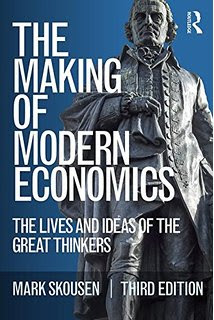
skousen making of modern economics

As you can see from the cover, the heroic figure in Skousen’s book is Adam Smith and his “system of natural liberty.” (Interestingly, the official pub date of the first edition of Skousen’s history was March 9, 2001.) All of the “worldly philosophers” – Ricardo, Say, Mill, Marshall, Menger, Marx, Fisher, Keynes, Schumpeter, Friedman, Krugman — are judged as defenders or critics of the great Scottish philosopher, and whether they advanced or attacked the House that Adam Smith Built.

Routledge, the top British academic publisher (famous for publishing the works of Hayek, another hero in Skousen’s work), is now the publisher of this bold history of the great economic thinkers.

What’s new in the third edition?

What’s the new edition all about?

First, Skousen expands his chapter on Adam Smith, including a new discussion and quotations from Smith’s “Theory of Moral Sentiments.” He also comments on the startling new discovery that Smith’s singular reference to the famous “invisible hand” metaphor is located in the mid-point of both “The Wealth of Nations” and “The Theory of Moral Sentiments.” Purposeful or coincident? Find out in chapter 1, “It All Started with Adam.”

Second, the third edition updates the chapter on Karl Marx, particularly the resurrection of the Marxist-inspired “liberation theology” in Latin America, with comments about Pope Francis and his severe criticism of capitalism. The growth of socialism and corruption in Latin America is discussed.

Third, the final chapter, “Dr. Smith Goes to Washington: Market Economies Face New Challenges,” has been completely revised. Here Skousen focuses on the West’s decline in economic freedom in consequence of higher deficits, taxes and regulations, and the growing debate over inequality, austerity, and the need for a new brand of capitalism following the financial crisis of 2008. The chapter ends on a positive note, with discussions on the advances in game theory, auction design, experimental economics, behavioral finance, and other aspects of the new “imperial” science.

How to Buy a Copy

The third edition (500 pages) of “The Making of Modern Economics” is available in hardback, paperback, Kindle, or audio. You can order on Amazon here.

The new edition is also available directly from the author at a discount. Amazon charges $47.95 for the paperback, but you can buy directly from the author by calling toll-free 1-866-254-2057. You pay only $30 plus $5 P&H. (Orders from outside the US, please add $15 extra for airmail–$45 total.) Or order online at http://www.miracleofamerica.com.

Awards and Translations

In 2009, “The Making of Modern Economics” (the 2nd edition) won the Choice Book Award for Excellence in Academia. It was recently ranked #2 in the Ayn Rand Institute’s Top Ten List of “Must Read Books in Economics.” It has been translated into five languages — Spanish, Chinese, Turkish, Mongolian and Polish.

What’s Different about “The Making of Modern Economics”?

Skousen’s history is a bold, new account of the lives and ideas of the great economists–Adam Smith, Karl Marx, John Maynard Keynes, Ludwig von Mises, Milton Friedman, and many others–all written by a top free-market economist. Presented in an entertaining and persuasive style, Professor Mark Skousen tells a powerful story of economics, with dozens of anecdotes, illustrations and photographs of the great economic thinkers.

First and foremost, Skousen tells the remarkable untold story of free-market capitalism’s long-running battle against Keynesianism, Marxism, socialism and other isms. It is an account of high drama with a singular heroic figure, Adam Smith and his celebrated “system of natural liberty.” The running plot involves many unexpected twists and turns; sometimes our hero is left for dead, only to be resuscitated by his free-market friends; the story even has a surprise ending.

A Full-Scale Critique of All Major Doctrines

All previous histories tend to give a dry, disjointed, and helter-skelter account of economists and their contradictory theories. But Skousen unifies the story of economics by ranking all major economic thinkers either for or against the invisible hand doctrine of Adam Smith. Thus, Marx, Veblen and Keynes are viewed as critics of Smith’s doctrine, while Marshall, Hayek and Friedman are seen as supporters.

Using this ranking system, The Making of Modern Economics offers a full-scale review and critique of every major school and their theories, including classical, Keynesian, monetary, Austrian, institutionalist and Marxist.

A Complete History

Skousen’s history is comprehensive. He makes a point of discussing all schools of economics and not just the ones he agrees with. Too many economists have omitted major characters from the history of economics, a practice bordering on intellectual dishonesty. Robert Heilbroner’s popular book, The Worldly Philosophers, for example, virtually ignores the laissez-faire French, Austrian and Chicago traditions. (His latest edition does not even mention Milton Friedman by name!)

Think of The Making of Modern Economics as a contra-Heilbroner history.

It’s a perfect antidote to all those biased, inaccurate attacks on the free market and its proponents.

Skousen records the lives and ideas of important economists often ignored in other histories, such as Montesquieu, Ben Franklin, J. B. Say, Frederic Bastiat, Friedrich List, Herbert Spencer, Ludwig von Mises, Knut Wicksell, Philip Wicksteed, Max Weber, Irving Fisher, Roger Babson, Frederick Taylor, A. C. Pigou, Joan Robinson, Murray Rothbard, and the three Paul’s: Paul Sweezy, Paul Samuelson and Paul Krugman.

Skousen’s book also restores the vital role of the Austrian and Swedish schools in the marginalist revolution and the development of monetary economics. It emphasizes the impact of other disciplines on economics, such as evolution, sociology, and religion.

“Tell All” Biographies

Skousen’s book brings history alive with exciting new insights into the lives of the great economists through in-depth biographies and the author’s own research, revealing an amazing tale of idle dreamers, academic scribblers, occasional quacks and madmen in authority.

The Making of Modern Economics does its best to entertain, with provocative sidebars, humorous anecdotes, even music selections reflecting the spirit of each major economist. Samples:

–Why Adam Smith burned his clothes…and then burned his papers.
–The “satanic verses” of the poet Karl Marx.
–Were Malthus, Ricardo, Marshall and Keynes anti-female?
–The infamous grading technique of Chicago’s Jacob Viner (he regularly flunked a third of his class).
–The sexual scandals of Karl Marx, Carl Menger, Joseph Schumpeter and Friedrich Hayek.
–The story behind Marx the phrenologist, Jevons the astrologer, –Keynes the palm reader, and Friedman the amateur hand-writing analyst.
–Which famous economist is buried next to rock star Jim Morrison in Paris?
–How Darwin and Wallace discover their theory of evolution after reading Malthus.
–Why Malthus and the doomsdayers have been proven wrong about overpopulation and environmental crises.
–The strange case of David Ricardo: Why Schumpeter, Keynes, and Samuelson admired him–and deplored him.
–Why Malthus refused to have his portrait made until age 67.
–Why Hayek blames John Stuart Mill, a hero of classical liberalism, for popularizing socialism among intellectuals in the 19th century.
–The real origin of the epithet “dismal science,” and why critics are now calling economics the “imperial” science, with ever-increasing applications in law, finance, history, and politics.
–How John Stuart Mill and the disciples of David Ricardo became hostage to the Marxists, and how Carl Menger and the Austrians revived the laissez faire model of Adam Smith from oblivion.
–The inside story of three multi-millionaire economists–David Ricardo, Irving Fisher and John Maynard Keynes.
–The bizarre story of Jeremy Bentham: from democratic reformist to utilitarian fascist.
–The socialist origins of the American Economic Association and the London School of Economics.
–Veblen’s incredible prophecies about World War I and II.
–Thorstein Veblen versus Max Weber: Who had a better vision of capitalism?
–How Irving Fisher became an advisor to the fascist Mussolini.
–The little-known story of how the economics establishment in the West (including economists at Cambridge, Harvard and Yale) failed to forecast the 1929-32 economic collapse.
–How Austrian economists Ludwig von Mises and Friedrich Hayek were able to predict the 1929-33 crisis, yet failed to convince the world of their theories.
–How the 1929 crash served as a catalyst for Keynes’s “general theory.”
–How Keynes saved the world from Marxism in the 1930s.
–The truth about Keynes’s homosexuality and the rumor that his Cambridge colleague, A. C. Pigou, was a Soviet spy.
–Gross Domestic Product (GDP)–how a Keynesian statistic was invented by a Russian.
–How Irving Fisher’s misinterpretation of his quantity theory of money led to his losing a fortune on Wall Street, and how Milton Friedman avoided repeating Fisher’s blunder.
–Why Friedman and the Chicago school triumphed over Mises and the Austrian school in discrediting Keynesianism and restoring the Adam Smith model of market capitalism.

Fully Illustrated with Over 100 Photos, Portraits and Graphs

Finally, The Making of Modern Economics is the first fully-illustrated history of economics, with over 100 charts, portraits, and photographs, including a picture of….
…Keynes in bed (where he made his millions),
…Eugen Boehm-Bawerk in official regalia as finance minister of Austria,
…Alfred Marshall trying to hide his oversized left hand,
…the preserved body of Jeremy Benthem in London,
…the only known photograph of Irving Fisher smiling (before he lost millions in the stock market), and
…over 75 rare and unusual photos and portraits of famous economists.

Provocative Chapter Titles

Here are the titles of each chapter of The Making of Modern Economics:

1. It All Started with Adam (Adam Smith, that is)
2. The French Revolution: Laissez Faire Avance!
3. The Irreverent Malthus Challenges the New Model of Prosperity
4. Tricky Ricardo Takes Economics Down a Dangerous Road
5. Milling Around: John Stuart Mill and the Socialists Search for Utopia
6. Marx Madness Plunges Economics into a New Dark Age
7. Out of the Blue Danube: Menger and the Austrians Reverse the Tide
8. Marshalling the Troops: Scientific Economics Comes of Age
9. Go West, Young Man: Americans Solve the Distribution Problem in Economics
10. The Conspicuous Veblen Versus the Protesting Weber: Two Critics Debate the Meaning of Capitalism
11. The Fisher King Tries to Catch the Missing Link in Macroeconomics
12. The Missing Mises: Mises (and Wicksell) Make a Major Breakthrough
13. The Keynes Mutiny: Capitalism Faces its Greatest Challenge
14. Paul Raises the Keynesian Cross: Samuelson and Modern Economics
15. Milton’s Paradise: Friedman Leads a Monetary Counterrevolution
16. The Creative Destruction of Socialism: The Dark Vision of Joseph Schumpeter
17. Dr. Smith Goes to Washington: Free-Market Economies Face New Challenges

What Others Are Saying

“A story rarely told….It’s unputdownable!”
–Mark Blaug (University of Amsterdam), author of Economic Theory in Retrospect

“I champion Skousen’s book to everyone. I keep it by my bedside and refer to it often. An absolutely ideal gift for college students.” –William F. Buckley, Jr., founder, National Review

“One of the most original books ever published in economics.”
–Richard Swedberg (University of Stockholm), author of Schumpeter: A Biography

“Provocative, engaging, anything but dismal!”
–N. Gregory Mankiw (Harvard University)

“Lively and accurate, a sure bestseller. Skousen is an able, imaginative and energetic economist.” – Milton Friedman

“Mark Skousen has emerged as one of the clearest writers on all matters economic today, the next Milton Friedman.” – Michael Shermer, Scientific American

“Irreverent, passionate, entertaining, sometimes mischievous, like the author himself!”
–David Colander (Middlebury College), coauthor of The Making of an Economist

“I have read Mark’s book three times. It’s fun to read on every page. I have recommended it to dozens of my friends.” – John Mackey, CEO, Whole Foods Market

“I loved the book–spectacular!”
–Arthur B. Laffer

“I couldn’t put it down! The musical accompaniments for each chapter are a wonderful touch. Humor permeates the book and makes it accessible like no other history. It will set the standard.” –Steven Kates, RMIT University, Australia

“Skousen gets the story ‘right’ and does it in an entertaining fashion, without dogmatic rantings.” – Peter Boettke, George Mason University

“Both fascinating and infuriating…engaging, readable, colorful.” – Foreign Affairs

“Lively….amazing….good quotations!” – Journal of Economic Perspectives

About the Author

Mark Skousen (Ph. D., economics, George Washington University) is a Presidential Fellow at Chapman University in California. He has taught economics, finance and business at Columbia Business School, Barnard, Mercy and Rollins colleges, and Chapman University. Since 1980, Skousen has been editor in chief of Forecasts & Strategies, a popular award-winning investment newsletter (www.markskousen.com). He was analyst for the CIA, a columnist to Forbes magazine, chairman of Investment U, and past president of the Foundation for Economic Education (FEE) in New York. He is the editor of his own website, http://www.mskousen.com, and is the producer of FreedomFest, “the world’s largest gathering of free minds,” which meets every July in Las Vegas (www.freedomfest.com). His economics works include The Structure of Production (NYU Press), The Big Three in Economics (ME Sharpe), The Making of Modern Economics (Routledge) and Economic Logic (Capital Press). His investment books include Investing in One Lesson (Capital Press), and The Maxims of Wall Street (Eagle Publishing). In honor of his work in economics, finance and management, Grantham University renamed its business school, “The Mark Skousen School of Business.” Based on his work The Structure of Production (NYU Press, 1990), the federal government now publishes Gross Output (GO) every quarter along with GDP.

An opportunity to find out for yourself what passes for modern thought

There is an article of mine in the latest Quadrant which has been put up online. It is a review of Roger Scruton’s latest book, Fools, Frauds and Firebrands: Thinkers of the New Left. It is as good a book as you are likely to read on political theory in the modern age. How good? This good, taken from a review in The Guardian:

This polemic adopts the abusive and paranoid style it decries in its leftwing opponents.

Abusive, absolutely. It’s a short book and has to cover much territory by cutting to the chase. Paranoid, if this book doesn’t scare you, you must already be on the left. I, on the other hand, describe the book like this:

The book has a specific purpose. It is to provide a way of escape to students who are caught up in various versions of a modern humanities course, where they are fed an endless mind-numbing postmodernist gruel. The book goes through the various manifestations of the modern Left to explain their idiocies and unravel the Newspeak in which they are encoded. But the book does more. It opens up to those of us who are only vaguely aware of the ways in which the humanities are now taught, our own entry into the depths of a problem most of us are, at best, only dimly aware of. . . .

Scruton explains why everything you know, believe and understand about the world can be instantly dismissed by these people through the revolutionary perspective of Grand Theory. And here we are discussing nearly every one of the major philosophical thinkers of the modern age: Hobsbawm, Thompson, Dworkin, Sartre, Foucault, Habermas, Althusser, Lacan, Deleuze, Gramsci, Said, Badiou, Žižek and many others still who do not make it into chapter titles.

Unless you are a specialist in postmodernist philosophy, you will know next to nothing about most of them. Yet these are not just the major authors who people the reading lists of courses in Cultural Studies, but it is their views that underpin the content of the media and political discourse across the West. These people may be as loopy as it is possible to be, and their works near-unreadable nonsense, but they inform our debates and are the essence of politically correct discourse. You cannot avoid any of it. What Scruton offers in Fools, Frauds and Firebrands is an opportunity to find out for yourself what passes for modern thought, provided in a way that you will understand not just their content, not just their dangers, but also their incredible idiocy. This is where one of the most crucially important battles of our time is being fought, and unless you understand what is taking place, you will be unable to do a thing. That is why you should read this book. If nothing else, you will understand the nature of the icebergs that have ripped through the hull of the cultural ship of the West and why it may soon sink into oblivion.

The aim of this post is to get you to read the review. The aim of the review is to get you to read the book. But all of it is to get you to understand the intellectual world in which we live and the dangers we collectively face. Roger Scruton is one of the very few who can explain the depths of these problems in a way you can understand. But he can only do that if you read what he has written which is what you should do.

A film you must not miss

I have just seen one of the most complete and satisfying movies on a conservative theme of my entire life. I will have to dwell on it over the next few days, but in the meantime, I just wish to make sure you do not miss this film. It is the Coen Brothers’ Hail, Caesar!. There is no doubt an IMDb rating, and the critics and audiences at Rotten Tomatoes have no doubt made their appraisals known. And it may turn out that everyone else finds it dull and stupid. That is how these things go. But for myself, I haven’t seen a film in a long long time that has left me as satisfied, not just with its construction, but with its message.

Chronicling the fall of civilisation

This is an article by Roger Scruton: Academic Freedom in Conformist Times which is a review of a book by Joanna Williams with the title, Academic Freedom in an Age of Conformity: Confronting the Fear of Knowledge.

She shows how important historically academic freedom has been to the pursuit of knowledge, and examines the baleful consequences of the contemporary assault on truth and objectivity. I sympathise with her, too. Much as I had to do for my book Fools, Frauds and Firebrands: Thinkers of the New Left, Williams has had to sit down for hours, poring over poisonous stuff written by destructive narcissists and digesting it into something with which issue can be taken. She has done a great service to civilisation – as we wave goodbye to it.

I have just written a review of his Fool, Frauds and Firebrands for Quadrant and there was nothing more evident than the pain that had to be gone through to read through such vast oceans of insanity. I will now order Williams’ book to go along with his. And while I cannot comment on her book, I certainly can on his. You should read it. If you have any interest in understanding the shipwreck of our culture, you should read it. So let me just leave you with this from the end of the review:

Roger Scruton is a philosopher and a fellow of the Royal Society of Literature and the British Academy. He is the author, most recently, of Fools, Frauds and Firebrands: Thinkers of the New Left, published by Bloomsbury Continuum.

Academic Freedom in an Age of Conformity: Confronting the Fear of Knowledge, by Joanna Williams, is published by Palgrave Macmillan.

You can buy it on Amazon or at your local bookshop which I always recommend since we would like to keep as many of these around as we possibly can.

Economics for Infants

IMG_1982

My granddaughter had her first birthday today. I therefore wrote for her an instructional on all things economic, which I have titled Economics for Infants. There will be a new one every year and one for all siblings and cousins as they arrive. But so far, there is only she. Although really quick on the uptake, I didn’t wish to make it too complicated. But while she will never hear from me on the existence or otherwise of Santa, this is part of what I wrote since it is never too young to find these things out.

Most importantly, you must never think of the government as the same as your parents.

The government is not there to give you things although they might pretend that they do.

You cannot look to the government to feed you, to give you clothes, to keep you warm, to give you presents.

The government doesn’t even care about you, not even a tiny bit.

It may be a bit early to say to someone who cannot even walk that a satisfying life comes only if you are able to stand on your own two feet.

My son thought that I should have written something more story-like, along the lines of Animal Farm. And so I shall, but not until she is two when she will be more able to follow the analogy and see the ironies of life. In the meantime, I thought I would set the early scene for more to come.

Sanitising the past

This is the sub-title which explains more closely than the actual title what the article is about: How and why Hollywood distorts history by filming it with a leftist lens. History in a post-modern world is what you want it to be, not an actual account of what happened. The featured distortion of the article is the film Bridge of Spies of which we find:

Bridge of Spies is typical Hollywood myth-making in that it is false on two levels. The lesser level is that of incident, of juicing the details to make a more riveting tale and to create a role more attractive for Hanks, who is so wary of playing any characteristic other than likeable, principled, and trustworthy that he is gradually becoming a sort of Madame Tussaud’s wax figure of himself. So: Donovan’s house wasn’t attacked by gunfire, he didn’t witness East Germans getting gunned down at the Berlin Wall, didn’t get mugged for his overcoat by a gang of East German youths, wasn’t harassed by the East German police, and didn’t have to overcome the hostility of the CIA up to and including the moments at the Glienicke Bridge where Donovan secured the release of both the downed U-2 pilot Francis Gary Powers and a young American economics graduate student named Frederic Pryor, who was being held by East Berlin police. In the film, the CIA is so uninterested in Pryor’s release that the agency effectively works at cross-purposes to Donovan, who insists that both men must be freed. “That was the biggest error,” Pryor said this fall. “It didn’t happen like it did in the movie at all.”

Nor did Pryor dramatically get caught in East Berlin while momentarily venturing from West to East to help a woman at the exact moment when the cement and barbed wire of the Wall were hastily being thrown across that section of Berlin. Pryor didn’t even know until last summer that a movie that dramatized events in his life was in the works (Bridge of Spies had already been filmed by then). He hadn’t been allowed to see, much less comment on, the script.

The higher level of its distortion is to create some kind of moral equivalence between the Soviet Union and the United States during the Cold War. What caught my eye particularly was this, which reminded me of our Malcolm.

The Constitution is “what makes us Americans. It’s all that makes us Americans,” Donovan declares. A nice thought, but that still doesn’t obligate Donovan to work for a Soviet agent any more than it obligates any individual lawyer to defend, say, Dylann Roof. If anything, the question of which clients to accept is an issue for ethicists of the Bar, but “I’m defending a spy because the Bar Association asked me to” isn’t quite so resonant a declaration as one that invokes the Constitution.

Among the strongest evidence that Turnbull is a man of the left in everything he stands for is his role in defending Peter Wright, the MI5 agent who wrote his book Spycatcher outlining everything he could find to discredit and reveal the counter-espionage efforts of the West. Both Wright and Turnbull are heroes of the left because they found against Margaret Thatcher who tried to prevent the book from being published. People tell me that this is what barristers do, they defend their clients whatever their personal views may be. You believe that and you can believe anything. No one who has ever briefed counsel in an important case briefs someone who is not absolutely onside. That is Malcolm’s side. It remains an unmitigated disgrace that he now leads the party of the right in Australia. No one should trust a thing he does.

My favourite economics text of all time

It’s that time of year again. Even as living standards continue to slowly ebb, there is still virtually no understanding why spending of itself cannot hasten growth and increase employment. I have just submitted a paper on my favourite economics text of all time, Henry Clay’s Economics: an Introduction for the General Reader as the hundredth anniversary of its first publication in 1916 is next year. It is why I adopted his title when I wrote my own text. This is part of what I wrote on Clay’s second edition that was published 26 years later and after the publication of The General Theory in 1936. He is trying to explain what’s wrong with Keynesian theory.

Clay then makes the crucial point in noting the error in trying to generate recovery through higher spending, which brings his argument back to the very core of the classical theory of recession and unemployment.

“The error lies in ignoring the patent fact that neither money nor income as such provides employment but only spending.” (Clay 1942: 265)

This is the fundamental difference between classical theory and modern macro confined to a single sentence with no elaboration. It is merely Clay’s restatement of John Stuart Mill’s “demand for commodities is not demand for labour” (see Kates 2015). Clay knows this – it is a “patent fact”. So obvious may it have seemed to him he may not have felt any need to explain further. For whatever reason, this single sentence is his only attempt to bring the classical denial of the possibility of demand deficiency into his critique of the Keynesian Revolution that surrounds him.

The downwards spiral we are now part of is to see our economies floundering, thinking that public spending will improve our economic prospects, therefore increasing public spending and then finding things only getting worse. A hundred years ago they may not have been as wealthy and their technology may not have been as good, but they did at least understand what was needed to hasten recovery after an economic downturn.

Hillary Clinton plays Princess Leia

princess leia hillary clinton

hillary as princess leia

hillary as princess leia 3

princess leia hillary clinton

Hillary Clinton above and Princess Leia to the right. I don’t know if it was intentional, but it hit me around three quarters of the way through the film that it’s the same person. I might add that it is very difficult to get publicity stills of Princess Leia off the net. If I can find a better one at some stage, I will post those as well. [And now, in updating two months later at the beginning of March 2016, there is not a single other photo available anywhere. Quite, quite remarkable and you do have to wonder. But more than ever the resemblance is striking.]

And it’s not the only reason to avoid the film. You may go as I did because you went to the first one and have been going ever since. But as a film and a night’s entertainment, it may have been the worst film I have seen all year. See Mark Steyn for a more extended take. Nevertheless, in keeping with the last remaining social convention of modern America, I will say nothing about the story itself.

Let me also add this from Instapdundit: The ‘secret weapon’ behind Star Wars who was Marcia Lucas, George Lucas’s first wife, now departed from the scene and almost erased from history, who was the one with the judgement that made Star Wars work.