It is bizarre

In the Salem Witch trials as I recall – my memory is a little rusty here – there were a bunch of fanatics burning climate change deniers at the stake. To think there is anything needed at all to “fix” our carbon emissions is a kind of loopyness that I just see as part of the world today, something along the lines of wanting to spend your way out of recession. Which brings me to this:

FORMER Treasury secretary Ken Henry has described Tony Abbott’s direct action scheme for tackling climate change as ‘bizarre’ and predicted the Coalition will wind up implementing an emissions trading scheme.

Direct action, as I understand it, says that we will wait for the rest of the world to come up with some kind of carbon-limitation scheme but in the meantime we will try to lower carbon emissions in ways that actually do some good of some other kind even if there isn’t a carbon emissions problem in the first place, and we will spend far less money on it as well. Carbon taxes and carbon-emissions schemes are both 100% wasteful if there is no carbon problem to solve. Direct action actually takes some positive actions. It is bizarre that people who believe carbon taxes or an ETS will actually do some good can rise to such high places of authority over our lives.

Fixing IR

I had wondered how Tony Abbott and Eric Abetz were going to deal with the now misshapen federal industrial relations tribunal given the disproportionately large number of union appointments under the previous government. Abolish; abolish and re-constitute; new legislation; many new appointments but with an employer background. Every one would have been costly and taken a political toll. What they are now proposing to do shows what a creative and sensible government we are now blessed with. Apparently The Australian has an exclusive: “Tony Abbott to bring in new IR supremo“:

THE Abbott government is moving to impose an appeals body over the nation’s workplace umpire, declaring concern at inconsistent decisions by the Fair Work Commission.

The new body, which follows employer claims that Labor had stacked the tribunal, would be headed by a Coalition appointee and would establish a new avenue for appeal against commission rulings.

And then, with the appeals process in place, the re-balancing of the Commission can take place over the next few years as retirements and other departures take place.

I am filled with admiration for whoever thought this up.

Rebalancing the news

I’d have been happier if the AFR had been pouring out on its front page how hopeless the Rudd-Gillard-Rudd Government had been if they had done it at the time. The front page headline across the page yesterday, under a picture of the four top members of the new Government, read as follows:

Poll confidence rebound stalls

Then above the headline it says, “RBA worried about business investment”.

Does the AFR not know that all this is Labor’s handiwork? That what you see is what they did? That trying to fix this mess is the work of years and will require patient persistence. These are page 10 stories. It is not about “the Coalition’s post-election economic honeymoon is already fading” which is the opening phrase of the article.

What they did not do is place these words at the front which are instead found in para 5:

Reserve Bank of Australia deputy governor Phillip Lowe reassured Australians that all the ingredients are in place for a broad economic rebound.

Might have changed the sense of where things are going, specially since consumer sentiment is the worst of all economic indicators. It’s not a Labor government however so all the news but perhaps a different balance. But what got me was why the deputy governor thought things were about to improve:

Record low interest rates and a weaker dollar meant that Australia was well placed to weather the end of the resources investment boom, he said.

What can I say. Record low interest rates will slow recovery not speed it up but in the low state in which economics has fallen, how is anyone to know.

A few scattered thoughts and questions

On Wednesday this week there was a small article on the editorial page of the AFR under the heading, “Sell Assets and Spend up Big”.

I wouldn’t normally have paid much attention to it except that it’s by Tony Shepherd who is about to head up the Commission of Audit. The headline is not a bad summary of the contents so let me do a bit of a review.

Governments and business and community leaders are increasingly united in recognising the merits of selling publicly owned assets to unlock funding for badly needed new infrastructure.

Here’s the problem which I will start with a question. How does the sale of assets translate into an addition to our resource base to allow us to undertake these projects? Looking separately at the financial side and the real resources side allows plenty of room for conceptual misjudgment. Sell up Medibank and Medibank is still there and operating. What resources have now been freed up? The Government now has more money to spend but has this sale increased the real level of national savings? I don’t see it but am willing to be convinced. But what must be done is to demonstrate that wherever these resources come from they are not crowding out other even more urgently needed and value adding investments. Selling assets won’t ensure that in any way.

Contributing to a rethinking of privatisation is the opportunity to draw on superannuation funds as an alternative source of infrastructure investment.

Those superannuation funds are not presently idle. They are not just sitting around doing nothing. They are invested somewhere, in whatever places the various trustees see as the place where the highest returns can be found. What will be different now? How will these funds become available to governments? What will happen to the projects that are currently being funded by superannuation? There is nothing new here, and if the government is in any way intending to divert these funds using some kind of guarantee or what will appear to provide a more certain monetary return, we are going to see our resources being used less efficiently and our growth rates diminish. Infrastructure is not a magic word that guarantees the money will provide a positive return or the resources used productively. See the NBN for a reality check.

The private sector can shoulder the lion’s share but governments will continue to have a substantial funding role when it comes to non-commercial or social projects.

There’s no doubt about that. No business will go anywhere near this kind of thing. The one certain province for governments is to invest in loss making projects. They do it all the time whether they intend it or not. But if it is loss making then it is slowing the economy and lowering our living standards. There may be equity and other considerations but do not confuse any of these with economic growth. This is four percent of GDP we are talking about, $760 billion on their own reckoning. Bad news to start wasting so much on government projects with no positive return.

We should be seeing a virtuous circle where governments funds get good projects started and, once the asset is mature, it is then sold.

Whatever this is, virtuous is not the word I would use. Governments have NO ability at picking value adding projects, none whatsoever. Before you start on something new, give us the list of previous projects, over the past fifty years let us say, where government money has built some kind of value adding profitable investment. There is no history this side of the Snowy River which may well have been done by the private sector had it been given the opportunity. Governments should never be allowed to choose projects and where they do they should start by admitting that the project will never be profitable but is being done for some other reason. Governments should stick to national defence and road building. Maybe schools and hospitals, maybe. But for the rest, they should leave alone. They have no history of getting it right and there is no reason to think this will change and every reason to think they will get it wrong.

Governments should be encouraging more private investment in green field projects by properly dealing with the problem of early market risk. There are ways to use the government balance sheet to do this.

Danger, danger, danger! The way to deal with early market risk is to leave it to the market. It is the only way. Every business would love to have its risks covered by some kind of government bail-out guarantee. That is the certain way to end up with sub-optimal projects, misdirected investment, slower growth and lower living standards.

But in the end, this is only one man’s view although it is the particular man who will be chairing the Commission of Audit. Hopefully by the time he has come to the end of this process and released his report he will see things in a completely different way.

Where have all the workers gone?

participation rate us 2013

That’s in the US. I hadn’t seen this before but it comes as quite a shock. It is certainly lucky for the President that there’s a D after his party affiliation or else the media would have roasted him alive. Meanwhile back in Australia:

ELECTION of the Abbott government in September might have lifted businesses’ spirits but it failed to spark a hiring spree, with unexpectedly weak jobs growth in September and a further drop in the number of people looking for work.

The unemployment rate fell to 5.6 per cent in September from 5.8 per cent in August but only 9100 new jobs were created, not enough to keep the unemployment rate stable given population growth.

The participation rate – the share of the working-age population in or looking for work – fell to 64.9 per cent, the fourth consecutive monthly fall and the lowest level since 2006.

The total number of people actively seeking work fell a little to 697,000, while full-time employment grew 5000 to 8.1 million and part-time work expanded by 4100 jobs to 3.5 million, according to today’s release from the Australian Bureau of Statistics.

It is a bit early to expect any turnaround from an election that was only a month ago when these data were being collected. Not good figures at all, but they are part of the legacy our new government has inherited, exactly the kind of thing all Coalition governments inherit from their Labor predecessors.

Not really all that sophisticated

I was drawn to this article by Andrew Bolt which is from The Age. “What the Left Need to Do” is the point, how the left can recapture governments in the Westminster systems of our Anglosphere democracies. As our author laments, poor soul, “every major advanced Westminster democracy in the world – Britain, Canada, New Zealand, Ireland and Australia – now has a conservative-led government.”

And the US would as well if they had a Parliamentary system too since the equivalent to our House of Representatives here in Australia is, strangely enough, the House of Representatives in the United States. But it is a Republican system with a separate elected president which allows for an immense number of irrelevant issues to determine the outcome. Republican governments are poorly designed and aside from the United States, every republic has at one time or another fallen into some form of dictatorship because of the way in which power is concentrated at the top.

I think the problem with left of centre governments is that they are incompetent, that their reach exceeds the resources of a nation and they accordingly direct the economies they run into a ditch. Whatever reason it was that John Howard lost in 2007, it was not because the economy was failing and living standards were going down. But the author of the article, however, thinks the problem is as follows:

Meanwhile progressive parties make a more sophisticated but politically difficult argument: that it is in the national interest to improve health, education, infrastructure and social security – underpinned by a healthy level of progressive taxation. Sometimes this works; witness the high degree of public support in Australia for disability care or the national broadband network. Often it does not; witness the travails of the mining tax and carbon pricing.

Talk about sophisticated! Everybody wants more than they have and the collective desires of the Australian community would easily pass 200% of the available product (2000%?). And everyone wants the ends listed although not necessarily as freebies handed out by the political class. Political judgment is about knowing which of the many possible and desirable objectives to pursue. Labor lost because they wanted carbon taxes (which are, of course, not even in the least desirable), increased taxes on the mining industry, industrial regulation that make industry uncompetitive, school halls, insulation and the list goes on. Meanwhile they impoverish the people they pretend to be helping. They lost because in the end most people could see that Labor policies were making things worse, not better.

The point is that the arguments of the left are not more sophisticated. They merely peddle greed and envy. You should have more even if you didn’t earn it and those over there with more than you have should have less. Not really all that sophisticated at all.

Keynesian claptrap

‘We support genuinely liberal policies based on “Austrian economics” in contrast to the Keynesian claptrap routinely espoused,’ Day explains.

This is a quote from Bob Day, Senator Elect from South Australia in today’s Australian.

He thinks of it as Austrian economics but it is much older and broader than that. It is the economics of the entire economics profession during the entire pre-Keynesian era prior to 1936 starting from about 1776. Today’s macro, as I am fond of pointing out, is a classical economic fallacy. Until 1936, the economics of Y=C+I+G was seen as an absurd fallacy, obviously and unmistakeable nonsense. Now it is universally taught at all levels of economics as the fundamental truth.

Here is the issue. Y=C+I+G means total output in the domestic economy is determined by the total of consumption (C), private investment (I) and government spending (G). And thus, so far as this model is concerned, an increase in government spending is absolutely and in every way equivalent to an increase in private investment. If a mining company develops a new mine, according to macro theory, it is identical in every way in its effect on output and employment as increased spending on school halls. This is the economics taught in every mainstream first year macro course in the world. Claptrap doesn’t even get near how idiotic it is nor how destructive.

Welcome Senator Bob Day.

An “unexpected” deterioration in the labour market

employed persons aug 2013

unemployment rate aug 2013

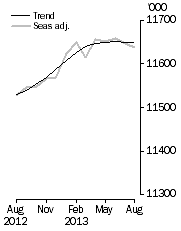
The left hand picture shows the level of employment and the right hand side the unemployment rate. The one that should be going up is thus going down and the one that should be going down is going up.

This ought to be seen as the benchmark moment with the unemployment rate having returned to its peak level at the height of the Global Financial Crisis. The rate is going to get worse before it gets better but there needs to be some clear recognition that the stimulus was not all that stimulating after all.

The reporter in The SMH is either a regular reader of Instapundit or doesn’t read him at all since he describes this turn of events as “unexpected”. Even the participation rate fell which means things are even worse than the stats actually show.

The economy unexpectedly shed jobs in August, taking the unemployment rate to a fresh-four year high and reviving the chance of a rate cut.

The number of people employed fell by 10,800 from the previous month, when it declined by a revised 11,400, the statistics bureau said today. That compares with expectations of a 10,000 increase. The jobless rate rose to 5.8 per cent from 5.7 per cent. . . .

The number of full-time jobs declined by 2600 in August, and part-time employment fell by 8200, today’s report showed. The participation rate, a measure of the labour force in proportion to the population, dropped to 65 per cent in August from 65.1 per cent a month earlier, it showed.

This is with record deficits and public spending continuing to rise. Needs explanation is all I can say.

[The data and the SMH story first noted by Andrew Bolt.]

Vacancy rates at an all time high

Perhaps there is no real need to pile on the ads at this stage since the evidence of Labor failure is everywhere. After my comment the other day about the depressing trek through my local shopping district and then along Swanston Street, Julie Novak sent me this link to an article in The Age which begins:

Almost one in six shops stands empty in one of Melbourne’s premium shopping strips as tough retail conditions continue to hurt suburban streets.

Vacancy rates across 11 prime suburban streets reached an all-time high in August, up to 7 per cent, according to Knight Frank research. [My bolding]

I know this may seem like going over old ground to many, but the textbooks still teach that public spending and deficits are a cure for unemployment and slow growth. The evidence before their eyes ought to be just a tad unsettling but never seems to be. And the recovery that will follow the return to stricter budget control ought to be even more unsettling but won’t be either.

I used to say during the Costello years that when they were over no one will understand what they had lived through, and I think that is largely right. We sailed through the Asian Financial Crisis using cuts to public spending and a balanced budget to pave the way but how can those who teach this dead-end macroeconomic theory found in our schools and texts explain what they personally witnessed.

Entering the conversation on jobs

I have a posting up at The Conversation into which I was very happy to join. It’s been titled, Rudd’s Job Plan Misses the Mark which pretty well says what it says. I have received two emails from possibly the only two people who have read it which I will reprint here, the first very nice, the second not so. But let me start with the more positive of the two. He begins with a quote from the article:

“There was a time when the idea of a job was related to some piece of work that someone wanted done. A job was not a thing in itself but related to the creation of value within some enterprise. One therefore didn’t create jobs as such. What one did was create an economic environment in which one of the limits on production was the amount of labour available.” Correct. And such a time shall come again: this Saturday.

I think that myself. A long hard slog but the repair will begin almost immediately on Saturday night. But then there was another email, not as positive and upbeat as the first.

You have to wonder what happens to the well-studied and diligent Keynesian-leaning student at the RMIT economics department. I think perhaps they are aiming for the ‘Melbourne’ school to take a bronze medal behind Austria and Chicago. The problem is the quality of their ‘research’ versus the aggressive muscularity of their conclusions. We seem to go from assertion to conclusion without the need for any messy, you know, tested hypotheses. Today’s instalment is case in point – lots of assertions without any empirical evidence that a slightly higher uptick in unemployment has anything to do with industrial relations policy. Of course business wants more skilled workers at a lower cost, but when have they not wanted this? For years we have heard dire warnings from the Melbourne Austrians – stagflation, hyperinflation and economic depression. A strike out on all 3. I have said it before – a fund manager investing on the basis of their predictions would be in the street selling pencils from a cup about now. And for all their failures, we continually hear their platitudes as if it’s the dernier cri – not as proven and miserable failures.

A Keynesian-leaning student in my hands, if they understood the theory, would get an A, if they also understood the rest. We do not indoctrinate unlike those who are part of the C+I+G faith-based community. But I must say that anyone who can still think Keynesian economics has anything to offer in the current environment really is not into evidence-based policy making it would seem to me. The point I have made all along is that given the way we have tried to engineer an upturn through deficits and higher public spending, the labour market will never gel and recovery will never become self-sustaining. But he at least did think we were the bronze medal holder after Austria and Chicago. I’d take that.

But as for selling pencils on the street, my walk to work takes me past my own high street and then along Swanston Street. The empty shops for rent make a dismal sight and we have had a continuing increase in public spending and debt since our present government took office. None of this is a surprise to me although I find it deeply depressing. I wonder if it’s a surprise to my correspondent and the rest of the Keynesian brigade who make up 90% of the economics profession, or do they not even notice how badly their economic advice has turned out to be.

Another Comment: And now there is this:

This article seems to assume we are a manufacturing economy, which we aren’t. In fact, only about 8.6% of people are employed in manufacturing, and we are basically an importing economy and we export raw materials. If everyone’s wages were cut, it is unlikely to increase manufacturing job numbers much at all, although it might reduce consumption per person. In terms of overall consumption, we are basically consuming ourselves to death by growing our population through immigration.

Did I say cut wages? It was the farthest thing from my mind. What I wanted was unregulated wages so that no one was ever priced out of a job because of some arbitrary minimum imposed on the labour market. We have a minimum wage of something like $35,000 a year. Really, how insane is that! It cuts out of the job market all of those people who could be productive at say $30,000 who if they were working would add to our output and make the economy stronger as well as themselves somewhat better off. On those immigrants, however, if they are coming in and absorbing our productivity without contributing anything back, then he has a point although to say we are consuming ourselves to death is going too far. But that immigrants without workplace skills who contribute less than they consume are a drain on our wealth, this is obviously true almost by definition. Only a Keynesian who thought that their adding to demand without adding to supply promotes growth could believe such nonsense, but there are no end of such people and you find them everywhere.

And one last one and we’ll stop here: My impression is that he thinks I am not all that reliable a commentator but at least he is spreading the message around. Very nice to see I am being read.

This is rather tame stuff from Dr Kates. However people who enjoy this article may enjoy Catallaxy Files where he supplies his readers with more red meat.

“The interview with Tony Abbott on Andrew Bolt brought out just what I admire about Tony Abbott so much” http://catallaxyfiles.com/2013/08/25/a-philosopher-pm/

“Who does this remind me of?: Eleven signs you are dating a sociopath ” [The answer is Rudd I believe] http://catallaxyfiles.com/2013/08/29/who-does-this-remind-me-of/

“The real question is who are these 49% that the polls say still intend to vote for Labor? Unimaginable really. But I do have an article at Quadrant Online that looks at the election as we enter into our first full day. And what I discuss is the nature of the ballot with the natural constituency of a Labor party made up of those who live by the words they use rather than the goods they produce, those who work for governments at every level (including those crony capitalists) and those who live off the plundering of incomes by the state.” http://catallaxyfiles.com/2013/08/06/the-49/ – It appears plunderers of the states doesn’t include university lecturers, just people like nurses and police and other such leeches. [Wonder why he thinks these people vote Labor.]

Kates on Makeup-Gate: “It is impossible to imagine just how abrasive a personality Kevin Rudd must actually be if you have not experienced it yourself. But here is the testimony of someone who has:” http://catallaxyfiles.com/2013/08/22/it-aint-over-till-its-over/

Come on Dr Kates, tell us what you really think – it is so much more entertaining.

These people lack a sense of irony and of shame.