And unless you are from Toronto, you are unable to pronounce Spadina. Every one of these is a memory still alive to me. It’s where I grew up.
Spadina
1

And unless you are from Toronto, you are unable to pronounce Spadina. Every one of these is a memory still alive to me. It’s where I grew up.
From Australian Man Suffers Suspected Heart Attack While Under Arrest For Not Wearing a Mask.
A shocking video out of Brisbane, Australia shows an elderly man suffering a suspected heart attack after he was arrested by police for not wearing a mask outside while exercising.
The incident occurred in Brisbane Botanical Gardens on Monday while the man was walking. He has a mask exemption due to his medical condition.
The clip shows the man being handcuffed while complaining about his wrists hurting. A woman who is accompanying the elderly man tries to answer the questions police officers are asking about the man’s place of work.
“Absolutely disgraceful,” says the woman as the man is led away.
The video then cuts to him having a violent seizure as he appears to suffer a heart attack.
Police remove the handcuffs as the elderly man desperately reaches for his medicine while the woman shouts, “Just let me get it for God’s sake!”
A shocking video out of Brisbane, Australia shows an elderly man suffering a suspected heart attack after he was arrested by police for not wearing a mask outside while exercising.
“Neither a man nor a crowd nor a nation can be trusted to act humanely or to think sanely under the influence of a great fear.”
With the direct implication, that if a government wishes to drive a population under its control insane, give them something to fear.
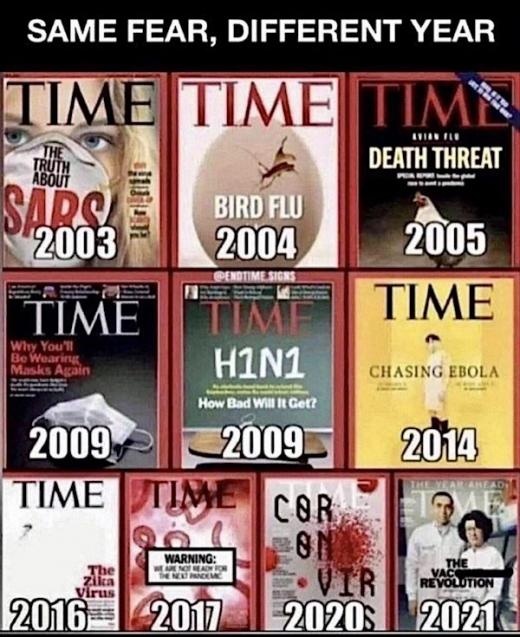
Which is what makes this so relevant: Editor-in-Chief of Germany’s Top Newspaper Apologizes For Fear-Driven COVID Coverage.
Hardly unique, but it is something to apologise for. And not just the media, but our governments as well.
PLUS THIS: From Instapundit.
THE MASKING OF AMERICA: Faceless people make compliant subjects, not good citizens.
In its worldwide impact, the COVID-19 pandemic has been the worst in a century. As a threat to Americans’ health, however, it is closer to the 1968 Hong Kong flu or the 1957 Asian flu—neither of which noticeably altered Americans’ everyday lives—than to the 1918 Spanish flu. In a head-to-head comparison, COVID-19 makes the Spanish flu look like the Black Death of medieval Europe. According to the best available figures from the Centers for Disease Control and Prevention (CDC) and elsewhere, the typical American under the age of 40 in 1918 was more than 100 times as likely to die of the Spanish flu than the typical American under the age of 40 in 2020 was to die of COVID-19. Whereas COVID-19 sadly shortened the lives of many older people already in poor health, the Spanish flu took people in the prime of life and left orphans in its wake.
Americans’ reaction to COVID-19, however, has been radically different from their behavior in 1968, 1957, or even 1918. Writing in the Wall Street Journal, the Hoover Institution’s Niall Ferguson recalls that President Dwight Eisenhower asked Congress for $2.5 million in additional funding for the Public Health Service during the Asian flu. Overall, Congress has authorized about 2 million times that much for COVID-19. In 1957, there were no widespread school closures, travel bans, or mask mandates. Ferguson quotes one person’s recollection of those days: “For those who grew up in the 1930s and 1940s, there was nothing unusual about finding yourself threatened by contagious disease. Mumps, measles, chicken pox, and German measles swept through entire schools and towns; I had all four…. We took the Asian flu in stride.”
One major difference between then and now is the increased role of public health officials. Long before their ascension, Socrates made clear in Plato’s Republic that he did not want doctors to rule. Philosophers or even poets would be better governors of society, because they at least attempt to understand political and social life in its entirety and minister to the human soul. Doctors, by contrast, tend to disregard the soul: it is the nature of their art to focus on the body in lieu of higher concerns. Moreover, Greek philosophers and poets alike celebrated courage in the face of death—Plato’s Socrates and Homer’s Achilles were undeterred from their noble missions by fear of the grave. But rule by public health officials, under which we increasingly live today, encourages excessive risk-aversion and almost transforms cowardice into a virtue.
Cowardly citizens are easier to rule.
Related:
It’s quite apparent that there is more to the official reaction to Covid than trying to limit the harm done from this particular virus, as discussed here: Fearmongering Has Done More Damage Than the Virus.
STORY AT-A-GLANCE
- John Tierney, a contributing science columnist for The New York Times, looks back over the pandemic, providing a timeline of the media-induced viral panic that led to censorship and suppression of scientific research on an unprecedented scale
- Experts who spoke out against the official narrative were attacked and accused of endangering lives by questioning lockdowns
- Numerous research journals refused to publish the results of studies that featured data questioning lockdowns, masks and other COVID policies
- Certain states have stood out for their refusal to buy into the draconian public health measures that were adopted throughout much of the U.S.; Florida is chief among them and has a COVID mortality rate that’s lower than the national average
- The “crisis crisis,” or the ‘incessant state of alarm fomented by journalists and politicians,’ is one reason why so many government, academic and policy leaders could support rampant censorship and suppress scientific debate for so long, all while propagating panic
I am as much interested in what he has to say as where he is from, being a “contributing science columnist for the New York Times. There is no actual truth content in any story from the modern media unless it helps to reinforce some other agenda. Where is this heading if this is what he writes?
The panic was started by journalists beginning in March 2020, when the Imperial College COVID-19 Response Team released “Report 9” on the impact of nonpharmaceutical interventions (NPSs) to reduce deaths and health care demand from COVID-19.2
The report’s computer model projected that intensive care units in the U.S. would be overrun, with 30 COVID-19 patients for every available bed, and 2.2 million dead by summer.3They concluded that “epidemic suppression is the only viable strategy at the current time,”4 which led to lockdowns, business and school closures and population-wide social distancing. But as Tierney noted:5
“What had originally been a limited lockdown — ‘15 days to slow the spread’ — became long-term policy across much of the United States and the world.
A few scientists and public-health experts objected, noting that an extended lockdown was a novel strategy of unknown effectiveness that had been rejected in previous plans for a pandemic. It was a dangerous experiment being conducted without knowing the answer to the most basic question: Just how lethal is this virus?”
Now we know the virus wasn’t all that lethal but there is still the full court press pretty well everywhere else, but not here. It has been absurd from the start, but the question now is whether there is now an agenda in letting the actual truth come out.
In a similar vein, let me also bring this to your attention: At Every Level, Government Has Botched the Covid Response. Lots there but let me focus on this which is not new but is just as true for being old news.
PCR testing was never intended as a diagnostic tool, according to its Nobel Prize-winning inventor. The test shoves a swab up your nose and scrapes around for everything, and then the PCR procedure amplifies what’s in the background. As inventor Kary Mullis says, “It allows you to take a miniscule amount of anything and make it measureable and then talk about it.”
If the sample results are amplified 35 times, everyone would test negative. If the sample results are amplified 60 times, everyone would test positive.
Thus, what nobody really knows or understands is that the number of positive cases are likely vastly over-reported. Yet because the government proclaimed it the gold standard, it became the gold standard, because the government was so terrified of Covid that it had to lock onto something that gave it the feeling of control. “Here’s a test! Let’s go with it!” The result was an unreliable test that produced unreliable data that was presented as gospel.
It’s not that “nobody really knows”, it is that lots of people know but don’t care. There is an agenda in play and that works for those who are trying to set the agenda.





The notion that no one mayknows anything at all about how an economy works is shown by this article from May 1913. Excerpts from What is Money? by A. Mitchell Innes. Attempts to demonstrate the notion that money is nothing other than a form of debt. I don’t have any view on this other than to note its existence since I have only just come across Innes through one of his modern day advocates. I’m not even sure I know what follows if any of this is true.
I have made this rapid survey of early coinages to show that from the beginning of the rise of the art of coining metal, there is no evidence of a metallic standard of value, but later history, especially that of France up to the Revolution, demonstrates with such singular clearness the fact that no such standard ever existed, that it may be said without exaggeration that no scientific theory has ever been put forward which was more completely lacking in foundation.
The official values were purely arbitrary and had nothing to do with the intrinsic value of the coins.
The general idea that the kings wilfully debased their coinage, in the sense of reducing their weight and fineness is without foundation.
Now if it is true that coins had no stable value, that for centuries at a time there was no gold or silver coinage, but only coins of base metal of various alloys, that changes in the coinage did not affect prices, that the coinage never played any considerable part in commerce, that the monetary unit was distinct from the coinage and that the price of gold and silver fluctuated constantly in terms of that unit (and these propositions are so abundantly proved by historical evidence that there is no doubt of their truth), then it is clear that the precious metals could not have been a standard of value nor could they have been the medium of exchange.
Adam Smith’s position depends on the truth of the proposition that, if the baker or the brewer wants meat from the butcher, but has (the latter being sufficiently provided with bread and beer) nothing to offer in exchange, no exchange can be made between them. If this were true, the doctrine of a medium of exchange would, perhaps, be correct. But is it true?
Assuming the baker and the brewer to be honest men, and honesty is no modern virtue, the butcher could take from them an acknowledgment that they had bought from him so much meat, and all we have to assume is that the community would recognize the obligation of the baker and the brewer to redeem these acknowledgments in bread or beer at the relative values current in the village market, whenever they might be presented to them, and we at once have a good and sufficient currency. A sale, according to this theory, is not the exchange of a commodity for some intermediate commodity called the “medium of exchange,” but the exchange of a commodity for a credit.
It is here necessary to explain the primitive and the only true commercial or economic meaning of the word “credit.” It is simply the correlative of debt.
Credit is the purchasing power so often mentioned in economic works as being one of the principal attributes of money, and, as I shall try to show, credit and credit alone is money.
The really important characteristic of a credit is not the right which it gives to “payment” of a debt, but the right that it confers on the holder to liberate himself from debt by its means—a right recognized by all societies.
For many centuries, how many we do not know, the principal instrument of commerce was neither the coin nor the private token, but the tally, a stick of squared hazel-wood, notched in a certain manner to indicate the amount of the purchase or debt. The name of the debtor and the date of the transaction were written on two opposite sides of the stick, which was then split down the middle in such a way that the notches were cut in half, and the name and date appeared on both pieces of the tally. The split was stopped by a cross-cut about an inch from the base of the stick, so that one of the pieces was shorter than the other. One piece, called the “stock,” 6 was issued to the seller or creditor, while the other, called the “stub” or “counter-stock,” was kept by the buyer or debtor. Both halves were thus a complete record of the credit and debt and the debtor was protected by his stub from the fraudulent imitation of or tampering with his tally.
The labors of modern archaeologists have brought to light numbers of objects of extreme antiquity, which may with confidence be pronounced to be ancient tallies, or instruments of a precisely similar nature; so that we can hardly doubt that commerce from the most primitive times was carried on by means of credit, and not with any “medium of exchange.”
We know, of course, hardly anything about the commerce of those far-off days, but what we do know is that great commerce was carried on and that the transfer of credit from hand to hand and from place to place was as well known to the Babylonians as it is to us. We have the accounts of great merchant or banking firms taking part in state finance and state tax collection, just as the great Genoese and Florentine bankers did in the middle ages, and as our banks do to-day.
In China, also, in times as remote as those of the Babylonian Empire, we find banks and instruments of credit long before any coins existed, and throughout practically the whole of Chinese history, so far as I have been able to learn, the coins have always been mere tokens.
There is no question but that credit is far older than cash.
There can be little doubt that banking was brought to Europe by the Jews of Babylonia, who spread over the Greek Colonies of the Asiatic coast, settled on the Grecian mainland and in the coast towns of northern Africa long before the Christian era. Westward they travelled and established themselves in the cities of Italy, Gaul and Spain either before or soon after the Christian era, and, though historians believe that they did not reach Britain till the time of the Roman conquest, it appears to me highly probable that the Jews of Gaul had their agents in the English coast towns over against Gaul, and that the early British coins were chiefly their work.
The monetary unit is merely an arbitrary denomination, by which commodities are measured in terms of credit, and which serves, therefore, as a more or less accurate measure of the value of all commodities.
Money, then, is credit and nothing but credit. A’s money is B’s debt to him, and when B pays his debt, A’s money disappears. This is the whole theory of money.
On no banking question does there exist more confusion of ideas than on the subject of the nature of a banknote.
The quantitative theory of money has impelled all governments to regulate the note issue, so as to prevent an over issue of “money.” But the idea that some special danger lurks in the bank-note is without foundation. The holder of a bank-note is simply a depositor in a bank, and the issue of bank-notes is merely a convenience to depositors.
Future ages will laugh at their forefathers of the nineteenth and twentieth centuries, who gravely bought gold to imprison in dungeons in the belief that they were thereby obeying a high economic law and increasing the wealth and prosperity of the world.
A strange delusion, my masters, for a generation which prides itself on its knowledge of Economy and Finance and one which, let us hope, will not long survive. When once the precious metal has been freed from the shackles of laws which are unworthy of the age in which we live, who knows what uses may not be in store for it to benefit the whole world?
The History of Economic Thought, as with all forms of history at the present time, is on its last legs. This is a post I put up on the Societies for the History of Economics (SHOE) list last week (July 23).
I am actually replying to two different postings, the first one from quite a while ago now, which was the death notice of one of HET’s greatest names, Donald Moggridge. I had assumed that after the two-line notice something more substantial would appear but it seems not. There must have been some notice taken somewhere else, but I just wish to say how much I appreciated the phenomenal effort that must have been required to edit Keynes’s Collected Writings. I will merely tell my own small story which was that there was some part of the thirty volumes that I came across that worried me enough not to pursue some line of inquiry until I had been to the Library at Kings to see what the original had actually looked like. And I was pleased in one sense – but disappointed given what I had intended to write – to find that the passage as printed was exactly as found in the original. I am no Keynesian, but Keynes was served astonishingly well by the work that Don Moggridge put in to edit his writings and his correspondence. The History of Economics has lost a great scholar.`Let me also note here how shallow economic theory has become due to the abandonment of its history by economists worldwide. “The inconvenient aunts locked away in garretts” discussed by Andrew Reamer are the many astonishingly deep analyses of the operations of an economy that are found in so many of the great works of economic theory that are not only no longer read, but no longer can be read. I have merely scratched the surface in my pursuit of the economics of John Stuart Mill, whose Principles, in my view, provides a better understanding of how an economy works than any of the textbooks we mass produce today. I therefore would like to support and endorse the views of Andrew Reamer, assuming I have understood him correctly, and can only wish that a new generation of economists will increasingly rediscover the lost treasures of our economic past. If economists are not scandalised by the economic policies which are being introduced around the world today, and do not say so in public, then really what is the point of any of what we are doing in writing the empty articles that pour out of our modern economic journals?
Although neoclassical economics relies on assumptions that should have been discarded long ago, it remains the mainstream orthodoxy. Three recent books, and one older one, help to show why its staying power should be regarded as a scandal.
- Mason Gaffney and Fred Harrison, The Corruption of Economics, Shepheard-Walwyn Publishers Ltd., 2006 (first published 1994).
- Stephen A. Marglin, Raising Keynes: A Twenty-First-Century General Theory, Harvard University Press, 2021.
- Alessandro Roncaglia, The Age of Fragmentation: A History of Contemporary Economic Thought, Cambridge University Press, 2019.
- Robert Skidelsky, What’s Wrong with Economics?: A Primer for the Perplexed, Yale University Press, 2020.
Opening:Self-regarding economics departments at prestigious academic institutions no longer bother to teach the history of economic thought – a field that I studied at Yale University in 1977, forever compromising my academic career. Why was the topic abandoned – and even shunned and mocked? Students with a skeptical turn of mind would not be wrong to suspect that it was for scandalous reasons (as when, in past centuries, inconvenient aunts were locked away in garrets).
The four books reviewed here each uncover parts of the scandal. Three are brand new, and the other, The Corruption of Economics, first appeared in 1994 and was re-issued in 2006. Its principal author, the American economist Mason Gaffney, kept his remarkable pen flowing until passing away last summer at the age of 96.
You don’t often see an article as pointed as that and it was very welcome to me. But I have remained the only person who has entered into this discussion. I think it is interesting and worth continuing with but no one is willing to put their hand up any longer. Everywhere careers are too fragile to buy into any such controversy. And this was the note put up on June 23 announcing the death of Donald Moggridge.
I write to share the sad news that Donald E. Moggridge died peacefully in Toronto on April 10, 2021. Don was the main editor of The Collected Writings of John Maynard Keynes (1970-1989) as well as the author of biographies of Keynes (1992) and Harry Johnson (2008). Although subscribers to the SHOE list will know Don as a pre-eminent historian of economic thought, he was also a noted economic historian with a specialty in British monetary policy.
Perhaps there was no more to say, but perhaps there was. Anyone who has done work on Keynes must be extremely grateful for the painstaking efforts that went into the thirty volumes of the Keynes Collected Writings. I might add that I am such an outcast that Andrew Reamer has not bothered to write to me either, although I wrote to him offline on two occasions. And that I find just plain rude.
Let me turn to what is apparently the single most important issue in the world, getting everyone vaxxinated against Covid. People are reluctant/hesitant because no one knows what the long-term effect of the vaccines will be once they have been injected. Let me take you to one of the few other sites that have the same concerns: Thanks to Social Marketing, You Will Be Assimilated. There we find this:
They really, really, want us to get vaccinated. Whom do I mean when I use the word “they”?
Well, for starters, there’s the government. All Western governments, in fact, even that of Hungary. “They” also includes the major media, Big Tech, the MSM, the universities and secondary schools, and all major philanthropic organizations.
All of them are pushing relentlessly for all citizens to submit to the injection of an experimental medical treatment that uses messenger RNA, and whose long-term side effects are completely unknown.
For as far back as I can remember, I have never experienced such a relentless full-court press by all social and political institutions in pursuit of a single goal….
There is only one possible outcome from the point of view of the vax pushers. You may be “hesitant”, but you cannot make a decision not to get the jab, and they will prod you and punish you until you do.
Anyway, you can go to the link. With Catallaxy gone, there is one less site in the world arguing for caution, which is the core principle of conservative thought.
PLUS THIS: There are still some out there trying to raise an alarm: Covid-19 Vaccine Analysis: The most common adverse events reported so far.
As of July 19, 2021 there were 419,513 adverse event reports associated with Covid-19 vaccination in the U.S., with a total of 1,814,326 symptoms reported. That’s according to the federal Vaccine Adverse Event Reporting System (VAERS) database…. The following is a summary of some of the most frequent adverse events reported to VAERS after Covid-19 vaccination. (It is not the entire list.)
You can go to the link to see the “summary” but that is only a partial list of what has happened immediately. What will be the effect two or three years from now? No one knows because no one can know. And by then, will there be anyone around who will tell you?
AND NOW THIS: Alan Jones column ended by Daily Telegraph amid controversial Covid and anti-lockdown commentary.
The Daily Telegraph has ended Alan Jones’s regular column amid controversy about his Covid-19 commentary, including calling the NSW chief health officer Kerry Chant a village idiot on his Sky News program. There has been apparent tension inside News Corp Australia between the anti-lockdown Sky After Dark commentators like Jones and Andrew Bolt and the Holt Street newspapers, which have been promoting vaccination and criticising the “freedom” protest in Sydney….
“Have a look at Sky News YouTube, Sky News Facebook and Alan Jones Facebook and you can see. The same column that I write for the Tele goes up on my Facebook page. “The public can check it for themselves. 35 years at top of the radio – and I don’t resonate with the public? Honestly.”
You are either for Vaxxination or you will be cut down and cut off.
From Steve Bannon’s War Room. You may need to go to click the link above to see the vid.
Big Pharma is showing its teeth and California Sec. of State candidate proves she up for the challenge.
Our guests are: Naomi Wolf, Dr. Robert Malone, Col. John Mills, Rachel Hamm, Melissa Huray.

 Law of Markets