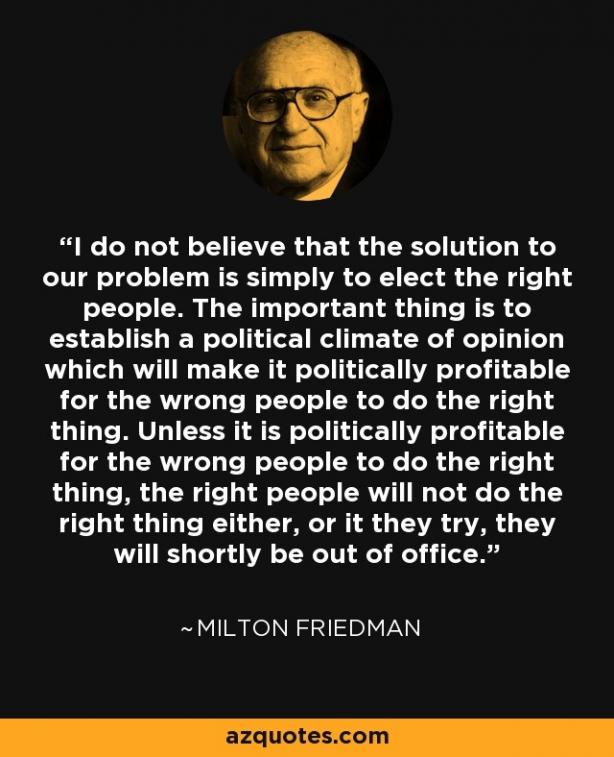
Remember the rule: only pay heed to those who you agree with

I got the rule from my friend Peter Smith. Everyone follows that rule, unconsciously or not. For us conservatives, it means that anyone who seems to side with the left on key issues can no longer be trusted in discussing other issues.

For those of us on the right, the rule does not mean that we never get to hear what the left believes and what its latest delusions are. Not only do we know what these beliefs are, it’s essential to understand pretty well all of what they believe if for no other reason than just as a means to protect ourselves from whatever forms of madness is their latest fad belief.

For the left, that is all they know and are never allowed to hear what their critics say. Living in a world populated by conservatives seldom harms the lives of anyone on the left. In fact, it is all that protects them from their own idiocies and beliefs. Living in a world as they conjure it would plunge them, along with everyone else, into deep pockets of misery and destitution, as has happened often enough.

Here is the basic truth: everyone is conservatives about things they know something about, especially about things which will affect their lives and livelihoods. It is actual personal knowledge about some subject that makes one a conservative, but for those without a conservative disposition, only about that particular subject, tending to limit wild flights of unrealistic conjecturing about things they know from personal experience. I think this quote expresses the same sentiment quite well:

Like Aristotle, conservatives generally accept the world as it is; they distrust the politics of abstract reason – that is, reason divorced from experience.

And more fully, there is a quote from John Stuart Mill that was first stated during a Parliamentary debate in 1866, which given the re-branding of various political inclinations in today’s world, is now best stated in this way:

I did not mean that people on the left are generally stupid; I meant, that stupid persons are generally on the left.

Anyone who genuinely tries to think about the problems of society and how to solve them cannot base their solutions on more than a handful of people ever acting other than in their own interests, with the subtext being that people acting in their own interests are not likely, when acting in a social setting, to lead a community into chaos and ruin, political leaders aside. They may wish to do good but all to often do not. But even without doing good being their intention, they usually cannot go too far because in the end everyone else will stop. Or at least they usually will, but unfortunately not always.
Suppose I hadn’t left Canada and moved to Australia

This is one of my potential alter-egos. It is Bob Bossin, who I remember from my days at the University of Toronto and in whose wider – much wider – circles I travelled. An enchanting fellow but the gravitational pull of all of my then associates would have made my own political migration much more difficult if not actually impossible. This is his Wikipedia page. A genuine banjo player who made a career of it. His warmth and charm comes across in the vid. I wish him well personally, but not politically.

What is also interesting to contemplate is that had he come to Australia as I did, he might have ended up a supporter of Donald Trump. Life is funny like that.

Might add that the Greens won the by-election.

“The best way to destroy the capitalist system is to debauch the currency”

Can you guess who said that?

Something that I have focused on in my Classical Economic Theory and the Modern Economy, but which is an otherwise unknown consequence of the Keynesian Revolution, was the shift in emphasis from the real side of the economy to the monetary side. If one is to understand the operation of an economy it is essential firstly to look at the actual real level of activity and only then look at the monetary side that lies above it and largely outside of it. Every classical economist understood the point. Virtually no modern economist does, and certainly no one without a serious study of economics ever does, which really does mean that near enough no one at all any longer understands this even slightly. Which leads me to this: Pandemic moves Modern Monetary Theory from the fringes to actual US policy.

[Modern Monetary Theory (MMT)] has received increased publicity over the past three years as politicians realized there was not a plausible plan to raise the funds necessary to fund “Healthcare for All,” the “Green New Deal,” free college and other initiatives through taxes alone.

The core principle of MMT is that sovereign governments with sovereign currencies can “print” or “coin” money to support full employment or essentially any government program that would benefit society in the here and now. Critics have labeled it the “Magic Money Tree Theory.” Those detractors include Keynesian and Monetarist economists, who cite Hungary in the 1840′s, Brazil in the 80′s, Mexico in the 90′s as examples of where easy money policies led to hyperinflation.

Warren Mosler was one of the founders of MMT, and what is known as `Mosler’s law’ states: “No financial crisis is so deep that a sufficiently large increase in public spending cannot deal with it.” These words fundamentally represent the actions our policy makers have taken in response to the virus. This pandemic has moved MMT from the fringes to the dead center as the actual monetary policy of the United States.

These are people with PhDs in economics who will comprehensively ruin us, and on this let me quote Keynes with absolute approval:

Lenin is said to have declared that the best way to destroy the capitalist system was to debauch the currency. By a continuing process of inflation, governments can confiscate, secretly and unobserved, an important part of the wealth of their citizens. By this method they not only confiscate, but they confiscate arbitrarily; and, while the process impoverishes many, it actually enriches some. The sight of this arbitrary rearrangement of riches strikes not only at security but [also] at confidence in the equity of the existing distribution of wealth….

As the inflation proceeds and the real value of the currency fluctuates wildly from month to month, all permanent relations between debtors and creditors, which form the ultimate foundation of capitalism, become so utterly disordered as to be almost meaningless; and the process of wealth-getting degenerates into a gamble and a lottery.

Lenin was certainly right. There is no subtler, no surer means of overturning the existing basis of society than to debauch the currency. The process engages all the hidden forces of economic law on the side of destruction, and does it in a manner which not one man in a million is able to diagnose.

It was Lenin who said it, but quoted by Keynes as a warning to us all. Are you that one in a million who sees the point? Well if you are, there are then the other 999,999 who do not, which includes every single political leader heading every single government across the Western world today, each one of whom is engaging “all the hidden forces of economic law on the side of destruction”.

“More people will die from the measures than from the virus”

An interview with Yoram Lass, “the former director of Israel’s Health Ministry, on the hysteria around Covid-19”: ‘Nothing can justify this destruction of people’s lives’ at Spiked. Read it all, but this is how it opens – I have left out the questions that these are the answers to:

Yoram Lass: It is the first epidemic in history which is accompanied by another epidemic – the virus of the social networks. These new media have brainwashed entire populations. What you get is fear and anxiety, and an inability to look at real data. And therefore you have all the ingredients for monstrous hysteria.

It is what is known in science as positive feedback or a snowball effect. The government is afraid of its constituents. Therefore, it implements draconian measures. The constituents look at the draconian measures and become even more hysterical. They feed each other and the snowball becomes larger and larger until you reach irrational territory. This is nothing more than a flu epidemic if you care to look at the numbers and the data, but people who are in a state of anxiety are blind. If I were making the decisions, I would try to give people the real numbers. And I would never destroy my country.

Mortality due to coronavirus is a fake number. Most people are not dying from coronavirus. Those recording deaths simply change the label. If patients died from leukaemia, from metastatic cancer, from cardiovascular disease or from dementia, they put coronavirus. Also, the number of infected people is fake, because it depends on the number of tests. The more tests you do the more infected people you get.

The only real number is the total number of deaths – all causes of death, not just coronavirus. If you look at those numbers, you will see that every winter we get what is called an excess death rate. That is, during the winter more people die compared to the average, due to regular, seasonal flu epidemics, which nobody cares about. If you look at the coronavirus wave on a graph, you will see that it looks like a spike. Coronavirus comes very fast, but it also goes away very fast. The influenza wave is shallow as it takes three months to pass, but coronavirus takes one month. If you count the number of people who die in terms of excess mortality – which is the area under the curve – you will see that during the coronavirus season, we have had an excess mortality which is about 15 per cent larger than the epidemic of regular flu in 2017.

Compared to that rise, the draconian measures are of biblical proportions. Hundreds of millions of people are suffering. In developing countries many will die from starvation. In developed countries many will die from unemployment. Unemployment is mortality. More people will die from the measures than from the virus. And the people who die from the measures are the breadwinners. They are younger. Among the people who die from coronavirus, the median age is often higher than the life expectancy of the population. What has been done is not proportionate. But people are afraid. People are brainwashed. They do not listen to the data. And that includes governments.

Much more at the link. And speaking of outcomes of Biblical proportions, there is also this to think about.

Two weeks ago, when looking at the recent flurry of chapter 11 filings and a striking correlation between the unemployment rate and loan delinquencies, we said that a “biblical” wave of bankruptcies is about to flood the US economy.

It now appears that the wave is starting to coming because according to Fitch, the monthly tally of defaults in the U.S. leveraged loan market has hit a six-year high, as companies are either missing payments or filing for bankruptcy because of the fallout from the coronavirus pandemic.

Speaking biblically again, there is no doubt that governments around the world have sown the wind. You know what comes next.

There is a lot more going on than we so far know

Two consecutive stories at Instapundit.

AUSTRALIAN RESEARCHERS SEE VIRUS DESIGN MANIPULATION: “A forthcoming Australian scientific study concludes that the coronavirus causing the global pandemic contains unique properties suggesting it was manipulated in a Chinese laboratory and was not the result of a natural occurrence.“

`
`
GRANDMA-KILLER CUOMO: AP count: Over 4,300 virus patients sent to NY nursing homes. “More than 4,300 recovering coronavirus patients were sent to New York’s already vulnerable nursing homes under a controversial state directive that was ultimately scrapped amid criticisms it was accelerating the nation’s deadliest outbreaks, according to a count by The Associated Press. AP compiled its own tally to find out how many COVID-19 patients were discharged from hospitals to nursing homes under the March 25 directive after New York’s Health Department declined to release its internal survey conducted two weeks ago.”“That’s right — people who were still contagious with a disease that is especially deadly to the old and sick were placed in facilities that were full of the old and sick.”

`

The price of ignorance

The History of Economic Thought is far and away the most interesting part of economics. Unlike the history of other disciplines, the history of chemistry for example, it can only be studied by someone with an economics background, but is also a very good medium through which to learn economics itself. And with modern economics courses drenched in junk science, HET is perhaps the only way to learn about how an economy works. A couple of days ago, the moderator at the Societies for the History of Economics (the SHOE list) put up a brief note:

Here is a second review of Zachary Carter’s The Price of Peace: Money, Democracy, and the Life of John Maynard Keynes, in The New York Times from Jennifer Szalai [the first one was from the WSJ]. This reviewer says it is “outstanding” and “brilliantly incisive.”

Which led me to this reply:

I am grateful again to the moderator for putting up another review of The Price of Peace, subtitled, “Money, Democracy and the Life of John Maynard Keynes. The review was from The New York Times. Its title, “John Maynard Keynes Died in 1946. An Outstanding New Biography Shows Him Relevant Still”. More of the usual mythology.

“The General Theory” aside, the rough outline of the Keynes story is that nobody with any power listened to his visionary proposals before the crisis of the Depression hit; after that, almost everyone did. Keynes’s ideas were radical, Carter writes, but he was staunchly anti-revolutionary: Having been traumatized by World War I, Keynes was at pains to persuade some of his Marxist students at Cambridge that a more just and equitable society didn’t have to come at the point of a gun. An activist government and deficit spending could alleviate suffering and spur growth, he reasoned, and the world eventually obliged. As much as Franklin Roosevelt didn’t like running a deficit, his New Deal offered one version of how Keynesianism worked; World War II offered another.

Of course, Harry Truman offered a third version on how things should be done. At the end of World War II, Truman immediately “sacked” all of the millions who had been in the armed forces while virtually the entire armaments industry was closing, thus creating perhaps the largest potential increase in mass unemployment in history. At the same time, and immediately the war was over, Truman balanced the budget, eliminating the largest deficit as a proportion of GDP in American history. And the result, as we all know, was the largest and most sustained period of growth in history with full employment continuing almost year after year through until the 1970s.

I might contrast The Price of Peace and its review with this: The Politics of Fear, whose sub-title is, “For economist Robert Higgs, Covid-19 is just the latest emergency justifying expanded government power”. Lots there to ponder, but will merely quote this:

“I foresee the worst depression since the Great Depression right around the corner. That alone would be enough to bring forth a host of bad government policies with long-lasting consequences. Many such policies have already been adopted. But much more awaits us along these lines.”

There have been so many breakages in the way our economies knit together in the past few months there is nothing that might not yet happen, and there is no telling how bad it might get. We are so far beyond anything that Keynes ever wrote about or dealt with that calling up his name is more than just a total irrelevance, it is an astonishing distraction. Yet the reviewer writes, in her very first paragraph, that this new biography of Keynes “offers a resonant guide to our current moment, even if he finished writing it in the time before Covid-19”.

Does it no longer occur to most economists to leave things to the market to sort themselves out? With Keynesian economics we are not only fighting the last war, we are fighting a war that had ceased in 1933 when the Great Depression ended (everywhere, it might be noted but in FDR’s USA), using classical economic theory to bring the Depression to an end. How inappropriate would Keynesian theory be in trying to deal with problems associated with our present government-engineered downturn that cannot in any sense be attributed to a deficiency of aggregate demand and an excess of saving.

The moderator has now added this:

To avoid any potential confusion, I just want to say that I posted these two reviews to point out that this bio of Keynes is getting a great deal of mainstream attention. It’s nice to see the history of economic thought in the WSJ and NYT. I have not read it and I do not have an opinion on it.

I thank Steve for his view and if any of our many other SHOE experts on Keynes has a reaction to the book, I hope they will share it with us.

There are 1200 who link into the SHOE list. Will let you know if anyone does.

People on the left never disagree with each other

As near as I can tell, people on the left never disagree with each other. They certainly disagree with people on the right, but other than in relation to to all the things they all agree about amongst themselves, where are the internal debates so that you can find examples of one person on the left saying something that another person, still on the left, disagrees with, and yet both remain on the same side of politics.

On the left there is a single acceptable position and after that, no deviation is permitted. That they believe themselves to be critical thinkers is only because they all collectively disagree with people who disagree with any element of the common set of beliefs.

One does not have to be on the left to believe that climate change is a problem. Or that gay marriage should be legal. Or that many aspects of the market economy are unacceptable. Or that Donald Trump is not a nice person. On the right, all these are open for debate. On the left, they are fixed positions, in no sense open for discussion.

This is a depiction of conservatism as I see it, written by Irving Kristol. Titled The right stuff, it explains the difference between the conservative perspective in the US and in the UK. Being from the New World myself, and Australians fit into this pattern as well, I find myself siding here with Kristol.

Conservatism in the US today is a movement, a popular movement, not a faction within any political party. Although most conservatives vote Republican, they are not party loyalists and the party has to woo them to win their votes. The movement is issue-oriented. It will happily combine with the Republicans if the party is “right” on the issues. If not, it will walk away. This troubled relationship between the conservative movement and the Republicans is a key to the understanding of American politics today. The conservative movement is a powerful force within the party, but it does not dominate. And there is no possibility of the party ever dominating the movement.

American conservatism after the second world war begins to take shape with the American publication of Hayek’s The Road to Serfdom in 1943 and the founding in 1955 of William F Buckley’s National Review. Previously, there had been a small circle who were admirers of the Jeffersonian, quasi-anarchist, teaching of the likes of Albert Jay Nock, but no one paid much attention to them. Hayek’s polemic against socialism did strike a chord, however, especially among members of the business community. There may have been people converted from statism to anti-statism by that book, but my impression is that most admirers of the book were already pro-free market. What Hayek did was to mobilise them intellectually, and to make their views more respectable.

I will take you to the final para which seems more relevant today than when it was first written in 1996.

The US today shares all of the evils, all of the problems, to be found among the western democracies, sometimes in an exaggerated form. But it is also the only western democracy that is witnessing a serious conservative revival that is an active response to these evils and problems. The fact that it is a populist conservatism dismays the conservative elites of Britain and western Europe, who prefer a more orderly and dignified kind of conservatism. It is true that populism can be a danger to our democratic orders. But it is also true that populism can be a corrective to the defects of democratic order, defects often arising from the intellectual influence and the entrepreneurial politics, of our democratic elites. Classical political thought was wary of democracy because it saw the people as fickle, envious and inherently turbulent. They had no knowledge of democracies where the people were conservative and the educated elites that governed them were ideological, always busy provoking disorder and discontent in the name of some utopian goal. Populist conservatism is a distinctly modern phenomenon, and conservative thinking has not yet caught up with it. That is why the “exceptional” kind of conservative politics we are now witnessing in the US is so important. It could turn out to represent the “last, best hope” of contemporary conservatism.

Whether it is the best hope or not is uncertain, but that it may be the last hope is looking all to possible all the time.

But why should we steer the economy away from carbon?

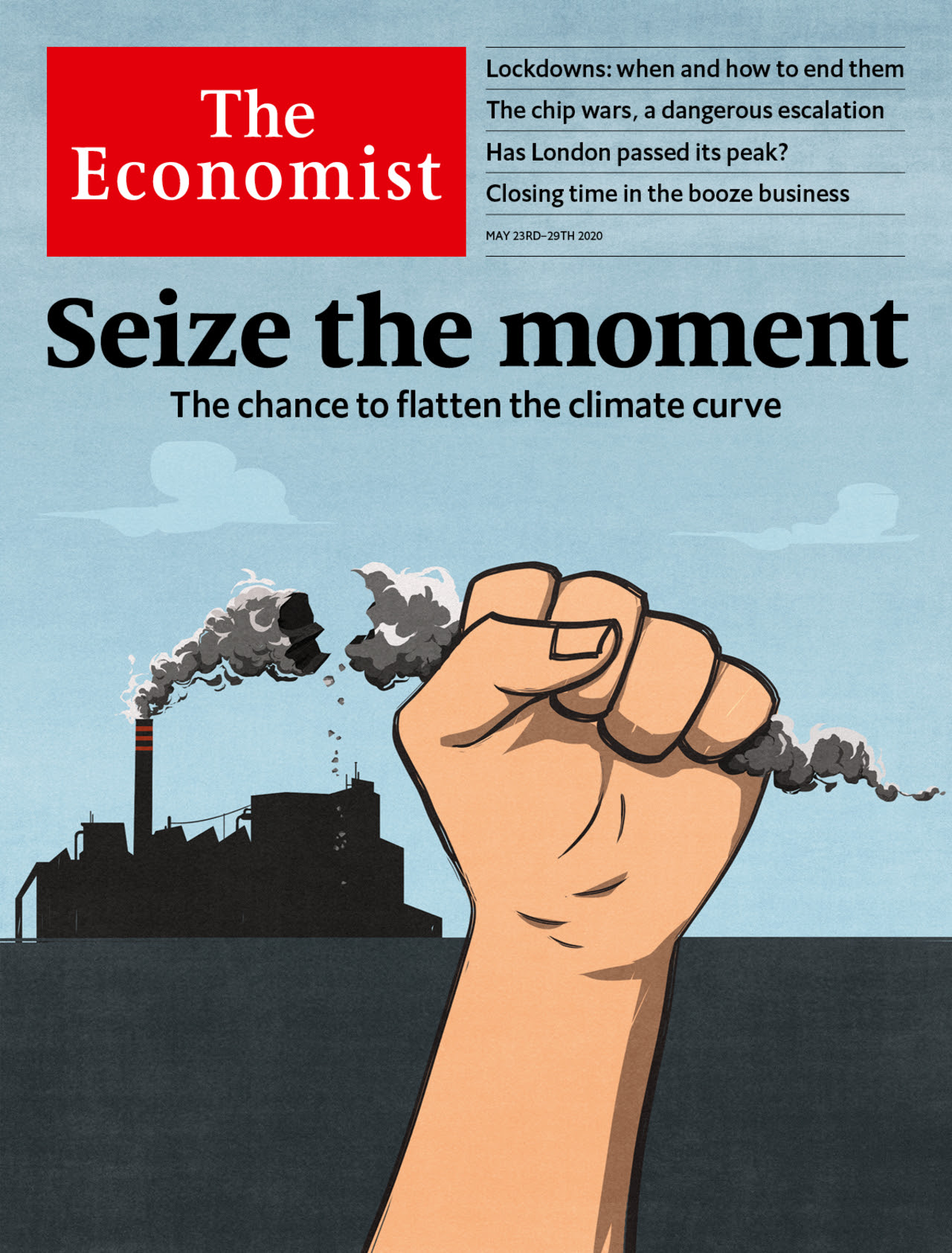
From The Economist just now. We live in the midst of such idiocy in almost every direction that it will be a miracle if we get through this without a major collapse, going well beyond a mere depression. You really have much to fear when it’s Daniel Andrews leading the way. Plus this:

cover-image
Our cover this week calls for a global effort to tackle climate change. Covid-19 creates a unique chance to steer the economy away from carbon at a much lower financial, social and political cost than before. Rock-bottom energy prices make it easier to cut subsidies for fossil fuels and to introduce a tax on carbon. The revenues from that tax can help repair battered government finances. The businesses at the heart of the fossil-fuel economy—oil and gas firms, steel producers, carmakers—are already going through the agony of shrinking their long-term capacity and employment. Getting economies back on their feet calls for investment in climate-friendly infrastructure that boosts growth and creates new jobs. Low interest rates make the bill smaller than ever. The world should seize the moment.

“I foresee the worst depression since the Great Depression right around the corner”

I am grateful again for the moderator at the Societies for the History of Economics discussion thread for putting up another review of The Price of Peace, the book subtitled, “Money, Democracy and the Life of John Maynard Keynes. This review is from The New York Times. More of the usual mythology.

Carter’s explications of macroeconomic theory are so seamlessly woven into his narrative that they’re almost imperceptible; you only notice how substantive they are once you get to his chapter on Keynes’s notoriously dense 1936 book, “The General Theory of Employment, Interest and Money,” and realize that you’re riveted by a passage on fluctuations in liquidity preference because you somehow know exactly what it is that Carter is talking about.

“The General Theory” aside, the rough outline of the Keynes story is that nobody with any power listened to his visionary proposals before the crisis of the Depression hit; after that, almost everyone did. Keynes’s ideas were radical, Carter writes, but he was staunchly anti-revolutionary: Having been traumatized by World War I, Keynes was at pains to persuade some of his Marxist students at Cambridge that a more just and equitable society didn’t have to come at the point of a gun. An activist government and deficit spending could alleviate suffering and spur growth, he reasoned, and the world eventually obliged. As much as Franklin Roosevelt didn’t like running a deficit, his New Deal offered one version of how Keynesianism worked; World War II offered another.

Of course, Harry Truman offered a third version. At the end of World War II, Truman immediately sacked all of the millions who had been in the armed forces and closed virtually the entire armaments industry, thus creating the largest mass of unemployed people in history. At the same time, and immediately the war was over, he balanced the budget, eliminating the largest deficit as a proportion of GDP in history. And the result: the largest and most sustained period of growth in history. I might contrast The Price of Peace and its review with this: The Politics of Fear, whose sub-title is, “For economist Robert Higgs, Covid-19 is just the latest emergency justifying expanded government power”. Lots there to ponder, and it should all be read, but will merely quote this:

“I foresee the worst depression since the Great Depression right around the corner. That alone would be enough to bring forth a host of bad government policies with long-lasting consequences. Many such policies have already been adopted. But much more awaits us along these lines.”

And there is no doubt that the reviewer sees “The Price of Peace” as relevant to bringing our economies out of the present lockdown. This is from her opening para:

Zachary D. Carter’s outstanding new intellectual biography of John Maynard Keynes, offers a resonant guide to our current moment, even if he finished writing it in the time before Covid-19.

There have been so many breakages in our structure of production in the past few months there is nothing that might not yet happen, and there is no telling how bad it might get. We are so far beyond anything that Keynes ever wrote about or dealt with that calling up his name is a total irrelevance. Does it no longer ever occur to most economists to leave things to the market to sort themselves out?