“In case you are not familiar with Kates . . .”

The video is Economics for Independent Thinkers which discusses the way economics is discussed outside the mainstream. There are many many reason for watching the above video from end to end, but this especially works for me, starting at the 14:30 mark.

“The lesser known terms are mostly thanks to the Australian economist Steven Kates. In case you are not familiar with Kates, Kates wrote possibly the most thoroughly researched of the studies showing that there was a fairly strong consensus before the Keynesian Revolution about how the business cycle worked.”

And not only that, I explain in modern terms what that theory was. And as strange as you may find this, there is no other modern source where you can find classical theory explained.

The presentation was to The Heritage Foundation in Washington. This is the synopsis and I could not agree more with what he says:

Too many mainstream economists view the world as a collection of equilibrium models, without concern for when these models fail to explain real-world risks. In Economics for Independent Thinkers, author Daniel Nevins scours under appreciated corners of the economics and investment worlds for more realistic thinking. What results is a no-nonsense approach to economics that appreciates the importance of credit and banks in business cycles, and provides a different perspective on Keynesian stimulus and the consequences of government debt accumulation.

The speaker is Daniel Nevins.

Daniel Nevins, CFA, has invested professionally for thirty years, including more than a decade at both J.P. Morgan and SEI Investments. He is perhaps best known for his behavioral economics research, which was included in the curriculum for the Chartered Financial Analyst® program and earned him recognition as one of the founders of “goals-based investing.” He has an economics degree from the Wharton School of Business and a degree from the University of Pennsylvania’s engineering school.

And you know what? Till now I did not think it was possible but you never know the way things are going. We may yet rid ourselves of this Keynesian economic mess, but to do that we will need to understand economic theory before Keynes. Speaking of which, have I mentioned my introductory text before: Free Market Economics, now in its third edition?
Racing towards Gomorrah

Picked up from Ace of Spades:

My father would have been 100 years old today

I am what is known in the trade as a red diaper baby. But that was only on my Father’s side. I have always wondered about William James’s observation that the children of parents of conflicting temperaments find those conflicts raging inside themselves. I followed my Father’s communist line right through to the end of university, then took my second degree and spent a year and a half as a gardener in London working things through. It was then that I read Solzhenitsyn who may have been the catalyst or perhaps only the vehicle to announce to myself how my philosophy of life had sorted itself out, more towards my Mother’s side of the family tree.

Yet I am like my Dad in my allegiance to Mill in the way he had his allegiance to Marx. I loved my Dad who loved me in turn, but I ended up in Australia as far from his influence as I could possibly go. So I will tell my favourite story of my Dad, about when he had been made a manager in a factory where he then set up a union which he could not become a member of. The management knew someone had organised the union but didn’t know who. So they brought in each of the workers, asked who it was who had set up the union, and when they refused to say, fired each of them on the spot [it was the 1950s]. They then hired them all back, no one ever found out who had been the organiser and the factory remained unionised from that day on.

He had himself always remarked on his having been born almost to the day of the Russian Revolution, which is why I was so aware of the timing of the October Revolution and the storming of the Winter Palace. He outlived the Communist era but never gave up the faith. May he rest in peace wherever he may be.

Mill’s lost ‘supply-side’ perspective has now been found

Here’s the subhead to an article on the editorial page of the AFR today with the title: Job creators don’t need subsidy.

The billions spent on industry support seems to make very little difference to new job creation.

This is the rediscovery of classical economic theory, and here let me quote John Stuart Mill:

“Demand for commodities is not demand for labour.”

Alas, the amount of unlearning that would have to happen for Mill’s point to be understood is an impossibility, but it is interesting that someone has noticed the actual facts on the ground even if they don’t understand why it’s true. As a wonderful example of someone who sees the point but doesn’t understand it, here is the abstract of a paper by an economist by name of Roy Grieve criticising my paper on Mill’s Fourth Proposition on Capital in which I have, for the first time in more than a century, explained what Mill and the classics meant:

Steven Kates has recently (2015a) attempted to explain and justify J S Mill’s paradoxical “fourth proposition on capital”, which states that “demand for commodities is not demand for labour”, a proposition which notoriously – over generations – has baffled many eminent commentators. Kates intends to resolve the puzzle by offering “a proper understanding of Say’s Law as it was understood by Mill and his contemporaries.” We conclude that Kates does indeed reveal the logic of Mill’s proposition, making it clear that from Mill’s lost “supply-side” perspective, it is in no way puzzling or paradoxical. However, at the same time it becomes evident that Mill’s whole position is undermined by his acceptance of the untenable belief that “demand is constituted by supply”, which leaves us with the clear understanding that his fourth proposition, despite Kates’s rationalisation and defence thereof, as well as certainly being paradoxical, is simply untrue.

I hadn’t even known the paper had been published until just now, but found it only because I was looking online for my own. But this is wonderful since he says five things I am extraordinarily happy to have said about what I wrote:

1) I really am the first economist in well over a century to understand Mill’s Fourth Proposition.

2) I do indeed “reveal the logic of Mill’s proposition”.

3) And what is shown by the Fourth Proposition on Capital is “Mill’s lost ‘supply-side’ perspective”.

4) Say’s Law is the central proposition of supply-side economic theory.

5) And what does Say’s Law teach: that “demand is constituted by supply”.

That Grieve thinks Mill’s Fourth Proposition is untrue only has him lining up with around 98% of modern economists. That it actually is true is demonstrated by the failure of every single peacetime stimulus package in history to increase the level of employment. There has never been an exception to this rule.

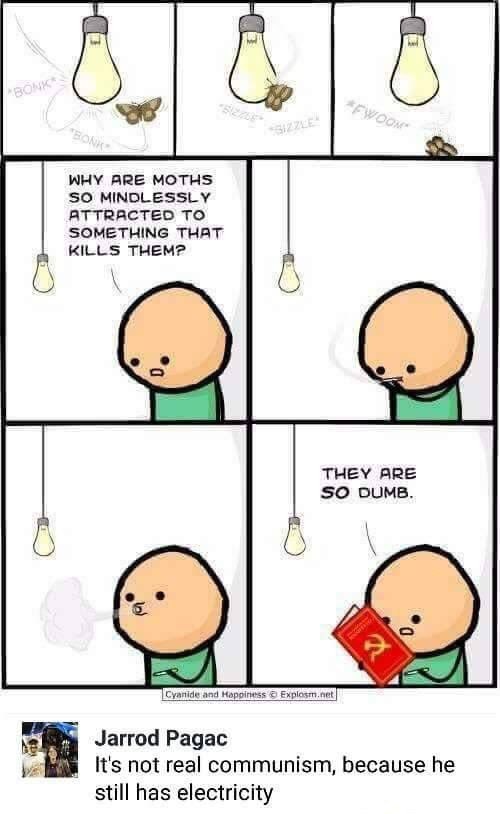
Let there be darkness

Comes with the old joke:

Q: What did Victorians use to light their homes before candles?

A: Electricity

You know, Victorians, as in those folks who live in Melbourne.

And this from the comments which has a reality that is not far from the truth, if they could arrange it.

The Truth, Yarragrad, Democratic People’s Republic of Victoriastan

The People’s News

Order of Correction of Counter Revolutionary Tendencies
Comrade M. Hardy

After a democratic trial before the Peoples Revolutionary Court for the Elimination of Counter Revolutionary Hoarders, Wreckers and Traitors, the convicted counter-revolutionary wrecker and traitor Steve Kates is hereby ordered to be subject to Revolutionary Justice in Stalin Square, Yarragrad. The convicted counter-revolutionary wrecker and traitor Steve Kates confessed to 106,789 counts of use of pre-revolutionary wrongthink. As the convicted counter-revolutionary wrecker and traitor Steve Kates confessed his crimes against the people and under rigorous questioning denounced 1,287 other counter-revolutionary wreckers, wrongthinkers and traitors. The glorious People’s Safety Bureau is currently hunting the counter-revolutionary wreckers and traitors and wrongthinkers the convicted counter-revolutionary wrecker and traitor Steve Kates denounced under rigorous questioning.

Ever-merciful glorious and radiant supreme leader of the Democratic People’s Republic of Victoriastan Secretary General Comrade Andrews has exercised his magnificent mercy in sublime judgement. From Karl Marx room in the Lenin people’s Administrative Complex he has announced that the convicted counter-revolutionary wrecker and traitor Steve Kates will not be dissolved in acid as is normal for counter-revolutionary wreckers and traitors and wrongthinkers but will instead be burned at the stake.

The people will bring their children and attend this glorious entertainment. Entry is free, with a voluntary Peoples Donation of 12 trillion Blokhins at this mornings 0912:35 rate. Alternatively, a piece of firewood will be accepted.

Adam Smith and “the man of system”

From Smith’s Theory of Moral Sentiments (paragraph VI.II.41-42):

The man whose public spirit is prompted altogether by humanity and benevolence, will respect the established powers and privileges even of individuals, and still more those of the great orders and societies, into which the state is divided. Though he should consider some of them as in some measure abusive, he will content himself with moderating, what he often cannot annihilate without great violence. When he cannot conquer the rooted prejudices of the people by reason and persuasion, he will not attempt to subdue them by force; but will religiously observe what, by Cicero, is justly called the divine maxim of Plato, never to use violence to his country no more than to his parents. He will accommodate, as well as he can, his public arrangements to the confirmed habits and prejudices of the people; and will remedy as well as he can, the inconveniencies which may flow from the want of those regulations which the people are averse to submit to. When he cannot establish the right, he will not disdain to ameliorate the wrong; but like Solon, when he cannot establish the best system of laws, he will endeavour to establish the best that the people can bear.

The man of system, on the contrary, is apt to be very wise in his own conceit; and is often so enamoured with the supposed beauty of his own ideal plan of government, that he cannot suffer the smallest deviation from any part of it. He goes on to establish it completely and in all its parts, without any regard either to the great interests, or to the strong prejudices which may oppose it. He seems to imagine that he can arrange the different members of a great society with as much ease as the hand arranges the different pieces upon a chess-board. He does not consider that the pieces upon the chess-board have no other principle of motion besides that which the hand impresses upon them; but that, in the great chess-board of human society, every single piece has a principle of motion of its own, altogether different from that which the legislature might chuse to impress upon it. If those two principles coincide and act in the same direction, the game of human society will go on easily and harmoniously, and is very likely to be happy and successful. If they are opposite or different, the game will go on miserably, and the society must be at all times in the highest degree of disorder.

They have all the answers to questions that are not being asked. Smith could see the gulag even before he had seen Robespierre.

The approach to foreign policy America has desperately needed

Via Instapundit whose heading is Ridiculous, it’s not getting any press as if anything PDT did right would ever be mentioned: Trump’s Malaysia Gambit: Call It Another Win. Who would have thought foreign policy would be one of his major strengths? The following is only for those to whom foreign policy counts:

Trump’s Malaysia gambit is an excellent example of the kind of realpolitik approach to foreign policy that America has desperately needed for more than a decade. Rather than coddling tin-pot dictators and terrorists at the White House, we have an administration that is willing to work with leaders who are willing to work with the United States, reach mutually beneficial agreements, and along the way strengthen U.S. national and economic security both abroad and at home. . . .

We’ve seen what happens when we have a president unwilling to defend and uphold our nation’s interests at home and abroad. It will take years for us to recover, but the Trump White House is digging in and rebuilding that trust and that national interest one ally at a time and whether the media elite and its friends like it or not.

It’s not long so you should read it all. As discussed already, the most transformative president in American history. The more you see what he does, the more vile his opponents become.

The most transformative president in American history

Unique to a degree unimaginable even to those who supported him for president. And it was unimaginable since no one, not even DJT, understood the obstacles that stand in the way of good policy both domestic and international. But Trump is an action figure who wants to get things done, and so far all of the things he has wanted to get done are what I would like to see done. This, however, is beyond anything I could have imagined, but here it is: Crown Prince Mohammad Bin Salman Al Saud: “We Will Eradicate Extremism Very Soon”…. Who knows how much of this is possible, but I do know that if it can be done, there is little I would consider more worth doing. The quote below is itself a quote within the article from the Egyptian President, but you should link to the article to read it all if these things interest you.

Abdel Fattah al-Sisi: “I first saw the campaign of his excellency President Trump, and I listened to his speech of the neccessity of facing and confronting terrorism all over the world; that he is a great personality and a unique individual, and that he will find great success.”

“I fully trust the capabilities of President Trump, and I have full conviction that he can do things, exert efforts, that very few people can do. And he can succeed in so many fields that others cannot. I trust him wholeheartedly.”

“I followed all his announcements through his campaign, he has a very unique personality and administration, and now I’m speaking with full confidence of unprecedented success for him. He is seeking the interests of the United States and the American people in a very clear manner, and a very direct manner. And a very strong manner as well.”

“His true will is a very strong will to counter terrorism and extremism in the world; and that is a very strong commitment from his excellency the president, and in addition I am very supportive with full force in facing this terrorism.”

“There is a true understanding to the realities in the region, and there is a seriousness and responsible actions in facing extremism and terrorism in the region, and that’s a wonderful thing indeed. There is nothing better than to counter evil.”

Nothing may come of any of it, but change can only happen from small beginnings that blossom and grow. These are those small beginnings. Only time can now tell.

You would think they would hope we would all forget

From today’s Cut & Paste in The Oz:

We gave him a hard time in 2007? We gave him our endorsement. The Australian’s editorial, November 23, 2007:

Mr Rudd has spoken of recapturing some of the reform zeal of the Hawke and Keating years … We recognise that no change is free of risk, but we recommend a vote for Mr Rudd.

The Australian preferred Kevin ’07 to John Howard! Why would you bring it up? Have you no shame!