Marine le Pen’s first campaign ad. If you are deaf to what she is saying, you are deaf to the most important issue of our times.
Via Andrew Bolt.

Marine le Pen’s first campaign ad. If you are deaf to what she is saying, you are deaf to the most important issue of our times.
Via Andrew Bolt.
Sunday morning so thought I would look at the paper and there we have this column by PVO on Political discourse coarsened by reactionary war against ‘elites’. It’s not every reactionary who becomes the wave of the future, but there is this possibility in DJT. It is a bit old timey, but let me take you back to what I still think makes a lot of sense:
The circulation of elite is a theory of regime change described by Italian social scientist Vilfredo Pareto (1848–1923). Changes of regime, revolutions, and so on occur not when rulers are overthrown from below, but when one elite replaces another.
There will always be leaders in every society and they will come from a variety of directions and use different means to hold on when challenged. But this is the essence of what PVO has to say:
A book by American professor Tom Nichols titled The Death of Expertise: The Campaign Against Established Knowledge and Why It Matters, explores how and why modern society has embraced such a lowbrow approach. [My bolding]
Let me take my own area of expertise, economics. You can certainly accuse me of campaigning against modern textbook theory which, so far as I can see, has brought our economies very low although making some people very rich. Go back to the first civilisations and you will see this everywhere you go. There are some few who are very rich and there are others who are not. The thing about our societies in the West is that those who are not do very very well by historical standards. But if your expertise is founded on the belief that increased aggregate demand and higher public spending are good for growth and employment, then your expertise, in my view, is junk science.
And the fact is, there is a lot of that kind of stuff around at the moment, with agw as large a danger to our communal wealth and well being as I have ever seen. So what does PVO say about that?
Climate change scientists might be the specialists when it comes to assessing global warming, and I’ll defer to their judgment rather than embrace the conspiracy theories of polemicists who dispute the evidence. But when climate scientists seek to influence policy mechanisms for addressing climate change, they move outside their area of expertise. Scientists recommending how best to structure tax or energy trading systems is akin to me offering medical advice: buyer beware. [My bolding again]
Those lowbrow polemicists attacking our elites who indulge in various forms of crony capitalism as they sell us massively government-subsidised wind farms and solar panels may actually have a point, and even more so if you think that these very same elites want to open our borders to anyone who decides to show up.
I suppose I am being bated by LIQ’s reference to J.-B. Say but the world is as it is. The point really about free trade is that the country that does not enter into it is depriving itself of the possibilities of a higher standard of living. So it is nice to see such concern for the future economic prosperity of the US but since Keynes at least, the issue has not been wealth creation as such but jobs. As Say so rightly pointed out:
A country, in one way or other, direct or indirect, always consumes the values it produces, and can consume nothing more. If it cannot exchange its products with its neighbors, it is compelled to produce values of such kinds only as it can consume at home. This is the utmost effect of prohibitions; both parties are worse provided, and neither is at all the richer.
But it’s not a jobs thing in and of itself. And the US is a very large country so that the division of labour is widely extended. If they want to make their own fridges and cars, well that’s their own business. The EU, for example, I might note has tariffs, just not between its member states. This refers to the EU: What is the Common Customs Tariff?:
Since the completion of the internal market, goods can circulate freely between Member States. The ‘Common Customs Tariff’ (CCT) therefore applies to the import of goods across the external borders of the EU.
The tariff is common to all EU members, but the rates of duty differ from one kind of import to another depending on what they are and where they come from. The rates depend on the economic sensitivity of products.
The tariff is therefore the name given to the combination of the nomenclature (or classification of goods) and the duty rates which apply to each class of goods. In addition the tariff contains all other Community legislation that has an effect on the level of customs duty payable on a particular import, for example country of origin.
The tariff is a concept, a collection of laws as opposed to a single codified law in itself. There is however a kind of working tariff, called TARIC, which is not actually a piece of legislation.
Through the tariff, the Community applies the principle that domestic producers should be able to compete fairly and equally on the internal market with manufacturers exporting from other countries.
If you want to worry about economic policies under Trump, I have a number of my own but these are hardly the central reason he ended up president. The 1930s were defaced by the Smoot-Hawley Tariff and the retaliations to the largest American increase in history. Whatever else Trump may be about to do, this is not it:
The Tariff Act of 1930 (codified at 19 U.S.C. ch. 4), otherwise known as the Smoot–Hawley Tariff or Hawley–Smoot Tariff, was an act sponsored by Senator Reed Smoot and Representative Willis C. Hawley and signed into law on June 17, 1930. The act raised U.S. tariffs on over 20,000 imported goods.
Meanwhile, the question is whether the US should let its trade partners do anything they like to manipulate their trade to the disadvantage of America or should there be some rules in place? Even Hillary ended up campaigning against the TPP.
From Victor Davis Hanson:
California is becoming a winner-take-all society. It hosts the largest numbers of impoverished and the greatest number of rich people of any state in the country. Eager for cheap service labor, California has welcomed in nearly a quarter of the nation’s undocumented immigrants. California has more residents living in poverty than any other state. It is home to one third of all the nation’s welfare recipients.
The income of California’s wealthy seems to make them immune from the effects of the highest basket of sales, income, and gas taxes in the nation. The poor look to subsidies and social services to get by. Over the last 30 years, California’s middle classes have increasingly fled the state.
Gone With the Wind–like wealth disparity in California is shocking to the naked eye. Mostly poor Redwood City looks like it’s on a different planet from tony nearby Atherton or Woodside. California is becoming a reactionary two-tier state of masters and serfs whose culture is as peculiar and out of step with the rest of the country as was the antebellum South’s.
How does all this remain invisible to it its elites?
Although written in 1841, it has always been in print: Extraordinary Popular Delusions and the Madness of Crowds. The reason, of course, is because everyone – and that means you (and me) – likes to laugh at the stupid ideas other people have. The problem with the governance in our democracies is that those at the top – our elites – harbour a set of delusions so truly unfounded it is hard to credit anyone with such bizarre ideas. Open borders, global warming, demand-driven crony-capitalist economic theories, are forms of delusion that for some reason make these elites rich while making the rest of society poor. So they do all the laughing and we try to wok out how to stop them from ruining us even further.
Let me take you to the delusion I know best, the belief taught in virtually every economics course across the West, that economies can be made to grow through public spending on unproductive forms of capital. In a recession, lift the level of “G”. Works every time, other than on every single occasion it has been tried. But if you are on the receiving end of this expenditure, the idea seems utterly fantastic.
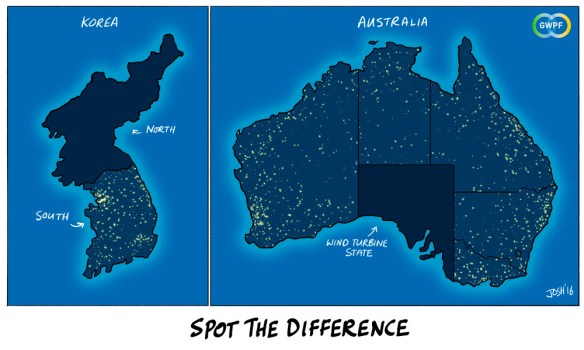
Here’s the dual headline that comes with the pic: Rolling Blackouts In South Australia As Wind Farms Fail Again/Coldest Winter In Decade Causes Energy Shortages Across Southeast Europe. I’ve often invited my wife to write a post or two, but I have never seen her as furious as she is about the devastation of our carbon-based energy supplies. This is the true meaning of “populism”, where our political leaders bend to the greatest mass delusion in history. Here are the excerpts of the different news stories that come with the photo.
The Federal Government needs to take urgent action to improve its energy policies before the rest of Australia falls victim to the type of large-scale blackouts experienced in South Australia, the Australian Energy Council has warned. About 90,000 South Australian homes and businesses were blacked out Wednesday when the Australian Energy Market Operator (AEMO) issued a load-shedding order to avoid potential damage to the network equipment due to supply deficiency. –Claire Campbell, ABC News, 9 February 2017
German coal and gas-fired power plant output in January rose to its highest in almost five years as cold weather boosted demand while below average wind and record-low winter nuclear availability reduced supply, according to power generation data compiled by think-tank Fraunhofer ISE. –Platts, 3 February 2017
To appreciate how quickly and fundamentally things are changing, it is necessary to go no further than a one-hour press briefing held jointly this week by the Global Warming Policy Foundation and Foreign Press Association in London. Rising from a sea of incredulity was a question from one journalist present [Channel 4 science editor Tom Clark] that underscored just how things had changed. “Me and my colleagues in this room haven’t spent much time speaking to people like yourselves and the Global Warming Policy Foundation over recent times because nothing you have to say has any support in fact,” the journalist said. “There are a lot of politicians and policymakers who have determined what you have to offer is essentially meaningless in terms of where the planet should be going, where the economy should be going and business should be going, but yet here we are all sitting in a room listening to you again. Why do you think that is?” he asked. Ebell said: “Well, elections are surprising things sometimes.” –Graham Lloyd, The Australian, 3 February 2017
As freezing weather triggered energy shortages across southeast Europe at the start of the year, Bulgaria’s refusal to export power was typical in a region where everyone had to fend for themselves. Nations from Greece to Hungary hoarded power last month in response to the coldest winter in a decade, exposing the weakness of the region’s power markets, which should enjoy unrestricted flows. –Bloomberg, 9 February 2017
The German Muenster district court on Thursday granted an emission-control permit to Datteln 4, a hard-coal fired power station under construction by utility Uniper that has been held up by an intense legal battle with environmentalists. Uniper said it aims to begin supplying electricity and district heating from the 1,050 megawatts plant in western Germany in the first half of 2018. –Reuters, 19 January 2017
If you want to read the full news stories you can find the links to the originals there.
DEATHBED CONVERSION UPDATE: I’ve just come to the story on the front page of The Australian wherein we find: Turnbull slams Labor’s power ‘horror show’.
Malcolm Turnbull has blasted Labor’s renewable energy “horror show” by seizing on blackouts in South Australia to warn of outages across the country under the “insanity” of Bill Shorten’s 50 per cent renewables target.
As the energy crisis dominated parliamentary debate, the national energy market operator ordered a mothballed Adelaide gas-fired power station to fire up to increase supply and prevent further outages.
As Canberra residents were urged to restrict electricity use today by limiting cooking and avoiding using home appliances such as dishwashers, the Prime Minister warned that the blackouts could be repeated in other states under Labor’s policy for a national rollout of the failed renewable energy “experiment” in South Australia.
I do not know what Malcolm personally believes nor do I care. But when even “Canberra residents” are in the firing line, you have to know that a cool change is on the way.
Trump’s America First theme in his inauguration did not in the least worry me since it was pro-American and not anti-anyone else. I am Australia First in the same kind of way. We have created our own way of life and I am not prepared to allow an open-borders idiocy to destroy the way we do things unless I think there is a better way of doing things. And no doubt there is, as we will find out as we move into the future, but we will not find out if our way of life is brought to an end through the arrival of a vast flow of migrants and refugees who follow entirely different traditions. So here is an article that puts it very well in a very small number of words: The New Trumpist Nationalism. This is how it ends:
In an age of globalization, transnationalism, and ever more porous borders, Trumpian nationalism is a healthy and necessary re-assertion of the primacy of the nation-state in world affairs and of the interests of all American citizens in domestic politics. Trumpism represents not the rebirth of an older European ethnic nationalism, but instead constitutes a re-affirmation of American civic nationalism to deal with the realities of the 21st century.
Now go and see how it begins.
First this:
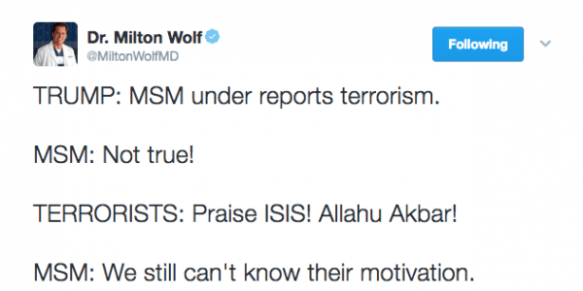
And then this:
‘Jihadi Bonnie and Clyde’ teens charged with planning Sydney terrorist attack
Followed by this:
And finally this:
So how surprised are you by this?
SHOCK POLL Collapses Media Narrative – Overwhelming EU Support for a Muslim Ban…
What would they know about the meaning of conservative? First we have Paul Kelly writing his column with the heading Conservative principles and values are being trashed. And then there’s Brian Loughnane with this as the highlighted quote from his article, also in The Oz, “Trump is the most serious challenge to conservatism since World War II”. Really, what would then know? Michael Anton, on the other hand, does know.
And the question asked in this column, naturally not at The Australian, is this: Why did so many conservative intellectuals become Trumpists. And here is the conservative answer: there was and is no other way to save our civilisation from collapse. Even with the election, there is hardly any certainty we have turned the corner, but at least there is now the possibility. This, apparently, is the part of the conservative world in which I belong. The Anton referred to in the passage below is Michael Anton who wrote, under the pseudonym Publius Decius Mus, the much-discussed article, “The Flight 93 Election” which I blogged on at length on three separate occasions during the election. Since he and I see things almost identically, this is how we are described:
The crux of Anton’s case for supporting Trump was that if he didn’t win, it would mean the effective end of self-government in the United States. For eight years Obama expanded the administrative state more radically than any president since Lyndon Johnson, injecting intrusive regulations much further than ever before into the health-care sector, the energy sector, marriage, religion, even bathroom use in public schools. If Hillary Clinton prevailed, it would mean that those innovations would become the new baseline for even more acts of administrative overreach. After four to eight more years of that, the century-long progressive transformation of the American regime would be complete, rendering constitutional government and the conservative movement lost causes once and for all.
Desperate times call for desperate measures. Anton (as Decius) came out in favor of Trump, in part, because he hoped the real-estate mogul would serve as a blunt instrument to bring down key elements of the administrative state, including those outposts of the conservative movement (which he memorably dubbed “Conservative, Inc.”) that live like parasites off of the federal government even while criticizing it and waiting for the next election that gives them an opportunity to trim it at the margins and change nothing fundamental about it at all. But Anton also hoped that Trump’s full-throated defense of the nation, borders, and citizenship would catch fire among the American people, who would at long last rise up to demand that the administrative state be put back in its place — to make room once again for constitutionalism, statesmanship, and republican government of free and equal citizens.
I remain mystified by anyone who does not see things this way. And if you do not, you cannot call yourself a conservative. And if you don’t understand his point, you have no idea what being a conservative is or what conservative principles are.
There is an easy answer to the question Why so many conservative intellectuals became Trumpists. There was and is no other way to save our civilisation from collapse. Even with the election, there is hardly any certainty we have turned the corner, but at least there is now the possibility. This, apparently, is the part of the conservative world in which I belong. The Anton referred to in the passage below is Michael Anton who wrote, under the pseudonym Publius Decius Mus, the much-discussed article, “The Flight 93 Election” which I blogged on on three separate occasions during the election. Since he and I see things identically, this is how we are described:
The crux of Anton’s case for supporting Trump was that if he didn’t win, it would mean the effective end of self-government in the United States. For eight years Obama expanded the administrative state more radically than any president since Lyndon Johnson, injecting intrusive regulations much further than ever before into the health-care sector, the energy sector, marriage, religion, even bathroom use in public schools. If Hillary Clinton prevailed, it would mean that those innovations would become the new baseline for even more acts of administrative overreach. After four to eight more years of that, the century-long progressive transformation of the American regime would be complete, rendering constitutional government and the conservative movement lost causes once and for all.
Desperate times call for desperate measures. Anton (as Decius) came out in favor of Trump, in part, because he hoped the real-estate mogul would serve as a blunt instrument to bring down key elements of the administrative state, including those outposts of the conservative movement (which he memorably dubbed “Conservative, Inc.”) that live like parasites off of the federal government even while criticizing it and waiting for the next election that gives them an opportunity to trim it at the margins and change nothing fundamental about it at all. But Anton also hoped that Trump’s full-throated defense of the nation, borders, and citizenship would catch fire among the American people, who would at long last rise up to demand that the administrative state be put back in its place — to make room once again for constitutionalism, statesmanship, and republican government of free and equal citizens.
I remain mystified by anyone who does not see things this way.
 Law of Markets