Is there also a war on boys?

This is a quite remarkable article: Campus turmoil begins in high school. It deals with the deadening effect on free speech of various PC codes that are rigidly enforced, and which begin in high school. The problem is described as a lack of “viewpoint diversity”. Its pervasive existence may be why Donald Trump has been so successful, since he can and does say what no one else can get away with in public life, and as the article suggests, in private life as well. Well worth a read. This comes from somewhere near the end.

High schools and colleges that lack viewpoint diversity should make it their top priority. Race and gender diversity matter too, but if those goals are pursued in the ways that student activists are currently demanding, then political orthodoxy is likely to intensify. Schools that value freedom of thought should therefore actively seek out non-leftist faculty, and they should explicitly include viewpoint diversity and political diversity in all statements about diversity and discrimination. Parents and students who value freedom of thought should take viewpoint diversity into account when applying to colleges. Alumni should take it into account before writing any more checks.

[Found at Instapundit]

It’s all Greek to me but not to thee

For no reason at all, I have begun to study ancient Greek. I am hardly systematic and it’s only just to put me to sleep at night. It serves no purpose other than to allow me to pretend that my life has infinite extension and everything can be done. I therefore noticed this story when normally it would not even have caused a flicker of interest: Beginning Greek, Again and Again. It is by someone who is teaching Greek to reluctant students, but I am not so sure that it is much different for someone teaching economics. Some people get it and some don’t and if there were some way to change the balance to a larger net surplus, we would all do it. At least I had done Latin in high school so understand cases and declensions and how they work. But let us share Professor Romm’s frustrations.

Reading Greek (or Latin) depends, first and foremost, on recognition of case endings. A student must develop an instinct for seeing the word “anthrōpou” as “of a man,” “anthrōpois” as “for men,” and similarly with eight other forms of the same word. To look for meaning rather than case, to see only “man” in either word, is what readers of English are programmed to do. My task, as a teacher, is to defeat this impulse. The experience of reading without reference to word order, once students “get it,” can be exhilarating, like being freed from a kind of gravity.

But for reasons I don’t understand, some take far longer than others to “get it,” and a few never will. Lack of intelligence isn’t the problem; it’s more about adaptability, acceptance of change. How long should such students go on in the language, hoping for an epiphany? Should I encourage them to continue? And if I do, is it only to assuage my own sense of failure?

Cheer up. John Stuart Mill started Greek at age 3, but many people born in Greece start even younger. To be learned is tough, and we can only be knowledgeable in a minutely narrow range of things.

Leadership 101 – today’s lesson

OK Malcolm. Paying attention? Here’s the lesson: you are on your own side, you are on the same side as all the other people who sit with you and behind you in Parliament. No self-inflicted wounds. No creating hostages to fortune. No sacking of ministers, or anyone else, until the costs of not doing so are clearly overwhelming. That’s the lesson. Now a working example.

Exhibit A: Jamie Briggs. No doubt a story so terrible that if we heard it all, we would personally take every action to ensure that he was ostracised from decent company and run out of Parliament. At that point, out he goes, but not till that point is reached. Hasty action makes you look like a clown. This is where have now arrived at because of your intemperate actions. Although the heading looks OK – Journalist Samantha Maiden accepts Peter Dutton’s ‘mad witch’ text apology – the first paras in the Malcolm-friendly Oz are a bit of a worry:

Labor has lashed out at Immigration Minister Peter Dutton’s “boorish” and “unbecoming” text after he called a female journalist a “mad f.king witch”, urging Malcolm Turnbull to explain the cabinet minister’s behaviour.

Mr Dutton has come under fire for the text message he accidentally sent to News Corp Australia’s Sunday political editor, Samantha Maiden, over her coverage of fallen junior minister Jamie Briggs’s late-night bar incident with a female public servant in Hong Kong.

Mr Dutton has apologised for calling Maiden a “mad f.king witch” after she reported yesterday that Mr Briggs had sent colleagues a photograph of the diplomat who complained about his behaviour, which ultimately led to his resignation from the frontbench.

Dutton would not have emailed anything had you not created the Jamie Briggs saga. You are not the calming influence you need to be. I know you thought Tony Abbott should have sacked Bronwyn Bishop the moment he had heard about the helicopter ride. Maybe, but who knew then how it would unfold? How’s Tony Burke going, by the way? You remember, it was only last August: Tony Burke: Taxpayers slugged $2.2 million for travel costs including charter flights on VIP jets. Let me just give you a para from the story to help you remember:

The Western Sydney MP — who led the attack on former Speaker Bronwyn Bishop for hiring a charter helicopter for an 80km flight to attend a Liberal fundraiser — is a prolific entitlements seeker.

So Malcolm, if you are going to jump at every shadow, you will be an even bigger disaster than even I had thought you would be. From this moment on, you are in 100% defend-your-ministers mode. If Peter Dutton goes, so will you.

Americans are so stupid – their country has become a dumping ground

Actually, I don’t think this way at all about Americans who are among the most generous and sensible people on the planet. But America is being taken for a ride by its political elites, and in this heading I am only echoing Donald Trump’s own concerns. This is a story from the Washington Post on Donald Trump’s first paid ad where the above sentiment is found:

In an interview Sunday with The Post, Trump said that he has six to eight ads in production and that his was a “major buy and it’s going to go on for months.” He said he hopes the spots impress upon undecided voters that the country has become “a dumping ground.”

“The world is laughing at us, at our stupidity,” he said. “It’s got to stop. We’ve got to get smart fast — or else we won’t have a country.”

It is America’s elites that are not quite there. Obama describing foreign leaders as “insane” is the most perfect example of projection I have ever seen.

A political tin ear

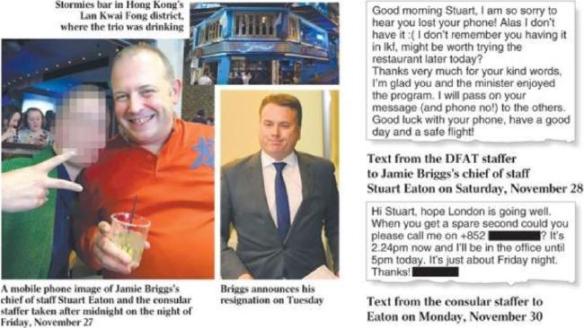
briggsphoto

The part that gets me about all this is that Malcolm has such a political tin ear that he is quite content to create havoc in his own parliamentary party for no political advantage that I can see. There are lots of different issues but I will mention only one. Comes the next election, he will be very happy to have as many of his colleagues back as he can get. He thinks he’s on his way to an increased majority. I think it may be one of the closest election in years. If this is how to win more seats in South Australia, then there is a new world of political calculation I am not yet acquainted with.

Here are the further details so far as they are known. The photo is from an article up on The OZ website along with the heading, Jamie Briggs defends conduct over photo of public servant. How many hundreds of photos do politicians take just like this? How many nights out are there just like that? The further details:

Disgraced junior minister Jamie Briggs has confirmed to the Sunday Telegraph that he forwarded a photograph identifying the female public servant who lodged a confidential complaint about his behaviour in a Hong Kong bar to some colleagues.’

After publicly stating he had chosen not to name the woman to “protect her privacy’’ Mr Briggs has confirmed the photograph of the public servant published on the front page of The Weekend Australian was taken on his own mobile phone.

The Australian pixelated the image to protect the woman’s privacy but it was forwarded by Mr Briggs to his colleagues without an attempt to protect her identity.

The former minister did not leak the photo to The Australian but confirmed he had “sent it to a few ­people prior to the complaint and following’’.

He sent the photo prior to the complaint. And after the complaint became public, why should he not have sent the photo to colleagues as well. The name of the woman involved is no doubt now known across the entire public service by everyone in Canberra. Anyway, here is what he said.

“We interacted between the three of us and with others in what I believed at the time was an informal manner,” Mr Briggs said in announcing his resignation.

“At the conclusion of the evening, the public servant left to return home and my chief of staff and I returned to our hotel together. At no point was it my intention to act inappropriately and I’m obliged to note for the record that nothing illegal has been alleged or in fact did occur.

“However, in the days following the evening, the public servant concerned raised concerns about the appropriateness of my behaviour towards her at the venue. I’ve apologised directly to her but after careful reflection about the concerns she raised and the fact that I was at a bar late at night while on an overseas visit, I have concluded this behaviour has not met the particularly high standards for ministers. Therefore, the proper course of action for me is to resign.”

Labelling his behaviour an “error of professional judgment”, Mr Briggs publicly apologised to the public servant, his colleagues and the Australian community for his actions.

“(This has) given me cause to consider aspects of my behaviour, which I will address,” he said.

Unless there is more to this story than I have so far heard, there is nothing to this story at all, certainly not enough to create the lasting enmities that this one is very likely to do.

And to all this may be added this: Peter Dutton sorry for ‘mad witch’ attack on reporter. Or more accurately:

Senior cabinet member Peter ­Dutton has apologised for calling a female journalist a “mad f. king witch” over her coverage of fallen junior minister Jamie Briggs’s ­exploits in Hong Kong.

The Immigration Minister ­yesterday admitted that he sent the message to the political editor for News Corp Australia’s Sunday papers, Samantha Maiden, after she ­reported Mr Briggs had sent colleagues a photograph of the diplomat who complained about his behaviour at the Stormies Bar in late November.

It is understood Mr Dutton ­accidentally sent the text message to Maiden instead of Mr Briggs in what was intended as a show of support for the besieged South Australian MP.

This all distracts from how empty Malcolm’s economic understanding is. This is just as sad as it gets, a man with no plan hoping for the best: Households to drive the economy in 2016. A consumer-led recovery! There are no words.

My best paper published in 2015

This was my self-nomination for the Best Paper Award in the history of economics published during 2015. There are many other excellent papers that were also published so it is a very low probability entry. All the same, I believe the paper has genuine merit, as discussed in the note I sent to the Committee. I should mention that Mill’s Fourth Proposition on Capital states that “demand for commodities is not demand for labour”. If Mill is right, all modern macro is completely false.

Although my article is found in JHET and will therefore be automatically considered for the 2015 Best Paper award, I thought I would call attention to it since there are a number of aspects to it that may not be fully appreciated. The article is:

Kates, Steven. 2015 “Mill’s Fourth Fundamental Proposition on Capital: a Paradox Explained.” JHET. Vol 37, Number 1, March 2015, pp. 39-56.

Purely in terms of HET, the article explains in a completely natural way an issue that had been dealt with by some of the greatest economists of the past who could not fully make sense of what it meant. The proposition was first stated by John Stuart Mill in 1848, was never challenged in his lifetime and was described by Leslie Stephen in 1876 as “the best test of a sound economist”. Yet only fourteen years later, Alfred Marshall could not explain it, nor could Friedrich Hayek in 1941, both of whom tried to defend it in their own way. The proposition was attacked relentlessly by others. Keynes, for example, raises it twice within five pages in The General Theory (359n, 364n). It had last been looked at with any depth in HOPE in 1975 where the sub-title was “A Paradox Revisited”, emphasising the difficulty in making sense of the words. And yet, once the proposition is viewed within the context of the General Glut debate and within a classical understanding of Say’s Law, its meaning is apparent, indeed I would say obvious. It is thus not often that an issue that had remained unresolved since 1876 has been finally brought to an end. I compare Mill’s Fourth Proposition in the article to Fermat’s Last Theorem which, for economists, it is.

Second, the article does what I think HET ought to do – not exclusively, of course – but what it ought to do, at least where it is relevant, is use the economic theory of the past to illuminate economic issues of the present. The question whether increases in aggregate demand will lead to improvements in production and employment is a crucial issue in economics, never more so since the stimulus packages following the GFC have not led to a return to full employment and rapid growth. One does not have to agree with Mill to at least recognise that he has something to add to our contemporary debates. What if it is the case that an increased demand for goods and services does not lead to an increased demand for labour? This was not just Mill’s view, but was repeated as the “Treasury view” as late as the 1930s. Merely because macroeconomic theory today has rejected this conclusion does not mean that it is therefore certainly wrong. Some of the greatest economists who have ever lived accepted this conclusion. What this paper does is revisit this conclusion and puts the alternative perspective back into consideration.

It was also not my only paper published last year since I published two others, both on the role of the entrepreneur in economic theory. But this one was far and away the best.

That was 2015 – wait till you see 2016

Roger Simon in 2016: Year of the Chinese Curse first reviews the Obama years 1-7:

On the domestic front, race relations — initially pretty good, considering we’re talking about flawed human beings — have turned more sour than they’ve been in decades. A healthcare program was rammed down the country’s throat with multiple lies and now appears to be imploding on itself. The economy has stalled for years with the key labor participation rate near an all-time low. And our college campuses have turned into spawning grounds for over-privileged brats poised to imitate the excesses of the Chinese Cultural Revolution.

But those problems are almost nothing compared to the international situation. Sunni extremism, which looked to be somewhat contained, has exploded in barbarism not seen since the mass butcheries of Stalin, Mao and Pol Pot with ISIS, Boko Haram and al Qaeda. Add to this the bizarre non-agreement made by our country and others with Iran, bankrolling the religious psychotic mullahs to the tune of $100 billion plus, and the only conclusion you can come to is our government has gone insane or willfully seeks the suicide of the West in the face of Islam. On top of all this, the West, including the USA, is being invaded by Muslim refugees, a vast majority of whom undoubtedly believe in Sharia.

The past is prelude. Whatever is about to happen next has a darkness to it that makes optimism hard to find. It is why people such as myself wish Abbott were still PM. He had his flaws, but he at least understood the times in which we live. Mr Inane and Empty has no evident idea what the problems are never mind what to do about anything.

Breaching ministerial guidelines

At the same time that Bill Clinton’s depraved behaviour has entered the American political debate, we have “the Jamie Briggs affair” to consider. This is the sentence from the story in The Oz that needs to be focused on first:

Because of … concerns that any action taken against Mr Briggs might be seen as vindictive towards a supporter of Tony Abbott …

We certainly wouldn’t want to have that. So what exactly is alleged. First there is this:

At one point, the staffer, a legal graduate on her first overseas posting, complained to Mr Eaton that Mr Briggs was standing too close to her. Mr Eaton suggested she stand next to him, which the staffer did until the night out wrapped up about 2am.

Then there is this:

The consular staffer told the investigator Mr Briggs had told her she had “piercing” eyes and had placed his arm around her and kissed her on the neck.

But then there is Brigg’s version:

Mr Briggs, a South Australian conservative, has told colleagues he told another person in the bar the staffer had “beautiful eyes”, had only placed his arm around her when posing for a photograph and gave her a goodnight kiss on the cheek. There was no independent witness to the incident.

And this is how the story ends:

Senior government sources have confirmed cabinet governance committee members were concerned about the precedent that would be set by a sacking or resignation over such a borderline incident.

The claim against Mr Briggs did not contain any specific allegation of sexual harassment but rather “inappropriate” attention, but the committee members also recognised there were no sanctions available other than a sacking or resignation.

The process was seen by some to direct the outcome because once the committee was presented with a declaration that ministerial guidelines had been breached, it had little option but to endorse it.

The story did not say which ministerial guidelines in particular had been breached.

Skeptics form the scientific consensus

Not that it matters, of course, but Peer-Reviewed Survey Finds Majority Of Scientists Skeptical Of Global Warming Crisis.

Don’t look now, but maybe a scientific consensus exists concerning global warming after all. Only 36 percent of geoscientists and engineers believe that humans are creating a global warming crisis, according to a survey reported in the peer-reviewed Organization Studies. By contrast, a strong majority of the 1,077 respondents believe that nature is the primary cause of recent global warming and/or that future global warming will not be a very serious problem.

The survey results show geoscientists (also known as earth scientists) and engineers hold similar views as meteorologists. Two recent surveys of meteorologists (summarized here and here) revealed similar skepticism of alarmist global warming claims. . . .

People who look behind the self-serving statements by global warming alarmists about an alleged “consensus” have always known that no such alarmist consensus exists among scientists. Now that we have access to hard surveys of scientists themselves, it is becoming clear that not only do many scientists dispute the asserted global warming crisis, but these skeptical scientists may indeed form a scientific consensus.

Since it was almost never about science in the first place, nothing changes. If the study showed that there was no money to be made in grants and funding by arguing that global warming was a problem, that would be really valuable. But merely to show that all of those people lining up for money are wrong, how is that supposed to matter?