Hillary – the worst imaginable successor to Obama

That there has been more controversy around Donald Trump than around Hillary Clinton is further evidence, if more were needed, of the deeply corrupt nature of the media, and the American media in particular. Hillary should go to jail. She illegally used a personal server for her correspondence as Secretary of State because in this way nothing she wrote could be subpoenaed by the American Congress. Instead, every email she sent could be read by governments around the world. Just think of this:

The ex-CIA official said there is “zero ambiguity — none” about the impropriety of SAP-level intelligence being housed on an unsecure private email server. Faddis added that the very existence of that information on her server means that highly classified information must have been moved off of a “completely separate channel” under a process that is “specifically forbidden.” If you had done this while working at the CIA, Hemmer asked, what would’ve happened to you? Faddis’ response: “My career’s over, I lose my clearance, I lose my job, and then I go to prison, probably for a very long time.” Faddis explained that the “consequences are enormous” when information at this level of secrecy is made vulnerable to foreign penetration. “The reason this stuff is in this channel is because it’s going to do incredible damage to US national security if it gets out in the open. That’s why we protect it this way.” When Hemmer inquired whether Hillary’s conduct could have cost lives, Faddis didn’t hesitate. “Absolutely. Without question,” he asserted.

That she protected her husband from harassment charges and highly plausible accusations of rape in order to protect Bill’s presidency and her own political prospects is known to everyone without it becoming the impediment to ought to be. But to go even beyond the personal disgust everyone ought to have in seeing her in public, here is a story from The Oz yesterday reprinted from The Times that ought to disqualify her if we have even an ounce of self-preservation left in our collective veins: Sex scandal dogs Hillary’s ‘surrogate daughter’ Huma Abedin. A big Hillary problem, it seems, in the movie that is being released on Huma’s marriage to former Congressman, Anthony Weiner, who became notorious for exposing himself on the internet. Weiner is a Jew, so the following ought to be more than of passing interest, which comes as a throw-away in paragraph 22:

Abedin’s mother is Pakistani; her late father was Indian. She was born in Michigan but when Abedin was two her family moved to Saudi Arabia, where her father establish­ed a think tank, the Instit­ute of Muslim Minority Affairs. Some alleged the family had connections to figures inside­ the Muslim Brotherhood, which has fuelled conspiracy theor­ies.

They certainly have “alleged” these connections and with good reason. Here’s just one example: Huma Abedin’s Muslim Brotherhood Ties which are a good deal more significant, you would think, than her marriage ties. It is the absence of controversy about her background that needs to be accounted for. From the story, which appeared in National Review:

Huma Abedin’s mother, Saleha, who is a member of the Muslim Brotherhood’s female division (the “Muslim Sisterhood”), is a major figure in not one but two Union for Good components. The first is the International Islamic Council for Dawa and Relief (IICDR). It is banned in Israel for supporting Hamas under the auspices of the Union for Good. Then there’s the International Islamic Committee for Woman and Child (IICWC) — an organization that Dr. Saleha Abedin has long headed. Dr. Abedin’s IICWC describes itself as part of the IICDR. And wouldn’t you know it, the IICWC charter was written by none other than . . . Sheikh Qaradawi [“the Muslim Brotherhood’s chief sharia jurist”], in conjunction with several self-proclaimed members of the Muslim Brotherhood.

It’s not that Abedin is a close friend and confidant, but that she is Hillary’s closest political advisor that should make you think about what is going on in the US. Possibly the most interesting thing about the times in which we live is that everything is known but nothing seems to matter. The media is the fourth estate, more powerful than whatever might be classified as numbers two and three. What makes Donald Trump so important is that he is able to say things the media would murder anyone else for saying and remain viable. Anyone who thinks of Hillary as anything other than near enough the worst imaginable successor to Obama really has nothing to add to a conversation about the politics of the United States.

AND IN NEWS JUST TO HAND: Former House Oversight chairman: ‘FBI director would like to indict Clinton and Abedin’.

California Congressman Darrell Issa, who previously led an investigation into Benghazi as former chairman of the House Oversight Committee, says the FBI “would like to indict both Huma [Abedin] and Hillary Clinton” for conducting sensitive government business on an unsecure, private email server.

“I think the FBI director would like to indict both Huma and Hillary as we speak,” the Republican heavyweight told the Washington Examiner Thursday, during a debate watch-party at Florida Sen. Marco Rubio’s New Hampshire campaign headquarters.

“I think he’s in a position where he’s being forced to triple-time make a case of what would otherwise be, what they call, a slam dunk,” Issa said, referring to FBI Director James Comey, who previously told the Senate Judiciary Committee he would conduct a “competent,” “honest” and “independent” probe into Clinton’s handling of classified information during her tenure as secretary of state.

Why isn’t this the Huma Abedin scandal?

Here is the story in The Oz reprinted from The Times: Sex scandal dogs Hillary’s ‘surrogate daughter’ Huma Abedin. A big Hillary problem, it seems, in the movie that is being released on Huma’s marriage to former Congressman, Anthony Weiner, who became notorious for exposing himself on the internet. Weiner is a Jew, so the following ought to be more than of passing interest, which comes as a throw-away in paragraph 22:

Abedin’s mother is Pakistani; her late father was Indian. She was born in Michigan but when Abedin was two her family moved to Saudi Arabia, where her father establish­ed a think tank, the Instit­ute of Muslim Minority Affairs. Some alleged the family had connections to figures inside­ the Muslim Brotherhood, which has fuelled conspiracy theor­ies.

They certainly have “alleged” these connections. Here’s just one example: Huma Abedin’s Muslim Brotherhood Ties which are a good deal more significant, you would think, than her marriage ties. It is the absence of controversy about her background that needs to be accounted for. From the story, which appeared in National Review:

Huma Abedin’s mother, Saleha, who is a member of the Muslim Brotherhood’s female division (the “Muslim Sisterhood”), is a major figure in not one but two Union for Good components. The first is the International Islamic Council for Dawa and Relief (IICDR). It is banned in Israel for supporting Hamas under the auspices of the Union for Good. Then there’s the International Islamic Committee for Woman and Child (IICWC) — an organization that Dr. Saleha Abedin has long headed. Dr. Abedin’s IICWC describes itself as part of the IICDR. And wouldn’t you know it, the IICWC charter was written by none other than . . . Sheikh Qaradawi [“the Muslim Brotherhood’s chief sharia jurist”], in conjunction with several self-proclaimed members of the Muslim Brotherhood.

What may be the most interesting thing about the times in which we live is that everything is known but nothing seems to matter.

He was, after all, Reverend Martin Luther King

From a great post by Steve Hayward at Powerline that focuses on the views of Martin Luther King. There we find this quote from King:

One may well ask: “How can you advocate breaking some laws and obeying others?” The answer lies in the fact that there are two types of laws: just and unjust. I would be the first to advocate obeying just laws. One has not only a legal but a moral responsibility to obey just laws. Conversely, one has a moral responsibility to disobey unjust laws. I would agree with St. Augustine that “an unjust law is no law at all”

Now, what is the difference between the two? How does one determine whether a law is just or unjust? A just law is a man-made code that squares with the moral law or the law of God. An unjust law is a code that is out of harmony with the moral law. To put it in the terms of St. Thomas Aquinas: An unjust law is a human law that is not rooted in eternal law and natural law.

“Eternal law.” “Natural law.” Supplemented in the comments by this.

From Rabbi Mordechai Finley on origins of moral law:

“The being that created the universe had the power to bring into being a universe – the one we know of – with the energy and mass of 140 billion galaxies. This being created the laws of the universe that scientists and mathematicians have discovered. I am committed to believing that the God who created the laws of light, energy and matter also created a moral law, that reveals itself to those who study it, just as scientists have discovered the laws of nature. I am a moral realist – there really are better and worse answers to moral problems.”

There is right and wrong. Our duty is to discover the moral law and act accordingly.

For something to be hotter something else must be colder

From Ace of Spades, Are the Global Warmistas Simply Juicing Up the Latest Years’ Temperatures With “Adjustments” While Reducing the Temperatures of Previous Years, To Always Make the Current Year “The Hottest”?

Sure seems that way — and people have noticed this tendency in their ever-changing adjustments to the temperature record.

But now they may have gone too far — in order to declare 2015 the “hottest on record,” they apparently had to revise and “adjust” the previously declared all-time “hottest on record,” 1997.

Because 1997 was more than three and half degrees warmer than 2015 — going by NOAA’s published data.

If they’ve now adjusted 1997’s temperature down by three and a half degrees or more — thus making the former All Time Hottest Year On Record not particularly hot — this should be the lead, no?

And this would then reveal a lot of about their practices, where the “adjustments” made to the numbers change so much depending on current political messaging needs, and where all the warming comes from the “adjustments,” and not the actual temperature records themselves.

Gone too far? Not a chance. Them’s that want to believe are grateful for one more lie to keep them from facing their non-preferred reality.

What makes war inevitable is the growing power of ISIS

My favourite book of all time is Herodotus’s Histories. It is the first historical narrative ever written and tells the story of how our way of life was preserved in the face of a Persian invasion in the fifth century BC.

What brings this to mind is Tim Blair’s discussion of our Prime Minister in a post Tim has titled, AUSTRALIA’S LEADING THUCYDIOT. I have also read Thucydides but it’s not as pleasant a story since the wrong side won. Nevertheless, I had taught my children this one sentence from Thucydides almost from the time they could talk: “What made war inevitable was the growing power of Athens and the fear this caused in Sparta”. From Tim we find a sequence of Malcolm quotes about (not from) Thucydides of which this was the last:

“White reminds us that Thucydides, considering the several incidents that led to the Peloponnesian War, concluded that the real reason was Sparta’s growing anxiety about the rise of Athenian wealth and power.”

I’m not sure what the Prime Minister wishes us to learn from these quotes, but I will tell you one I have learned from reading the book. No matter how rich and powerful a civilisation is, it can lose everything if it is not capable of defending itself and is willing to do so.

Herodotus tells an earlier story about the defence of the West. Had the Persians defeated the Greeks all those 2500 years ago our Western civilisation, with its rational, philosophical and scientific approach to the world, would have disappeared there and then.

The question that really comes to mind is whether our PM, even as he quotes Thucydides, understands what the issues are in the war in the Middle East that we are in the midst of right now. The point about reading history is to give you insights into the permanent struggles of humans to preserve their way of life in the face of dangers that inevitably confront them. Here is the Western leader who decided not to increase Australia’s commitment in fighting the Islamic State even when asked to do so by the most relentlessly useless leader in American history:

“The Peloponnesian war lives on in our imagination, inspiring (and misleading) generations of statesmen and generals simply because of the quality of Thucydides’ history.”

The one thought that would never come to my mind from reading Thucydides is “inspiring”. It might fascinate you, or educate you, or terrify you. It might get you to spend a lot more time on building national defences, and in working out who our enemies are and how to deal with them. There is nothing about how the PM goes about his business that makes me think he has the slightest idea about any of the things that the Peloponnesian war ought to teach a national leader. Meantime he should go and read Herodotus and find out what a close run thing it was the first time our civilisation was confronted with an existential enemy and what had to be done to maintain our way of life.

UPDATE: From the local paper, perhaps of enduring interest:

Scientists have found grisly evidence of a massacre in Kenya about 10,000 years ago, providing rare evidence of violence between groups in ancient hunter-gatherer societies.

Researchers said the discovery casts light on the poorly understood roots of warfare.

Evidence of violence appeared in 10 of 12 relatively complete fossil skeletons the scientists found by what used to be the edge of a lagoon. That included five or six cases of apparent arrow wounds to the head or neck, and five cases where the head was smashed with something like a club. One skull had a sharpened stone still embedded.

The researchers said the wounds would have been fatal immediately or soon thereafter.

Two skeletons didn’t show evidence of violence but the position of the hands suggested they might have been tied up at the time of death. One was a woman who was pregnant or had recently given birth.

The 12 bodies were adults, and at least four were female. The site also revealed partial remains of at least 15 other people.

The 2012 discovery, made west of Lake Turkana, was reported by scientists at Cambridge University and elsewhere. Writing in a paper released Wednesday by the journal Nature, they said it’s one of the clearest cases of violence between groups among prehistoric hunter-gatherers.

The reason for the violence is not clear. The victims may have been raided for resources, like territory or food stored in pots, the researchers said. Or the violence may have resulted from antagonism between two groups, they said.

I love that last para, about a massacre that occurred 10,000 years ago. I won’t say that they had been attacked by ISIS, but near enough if you can see how human nature continues to play out.

Keynesian policy in three pictures

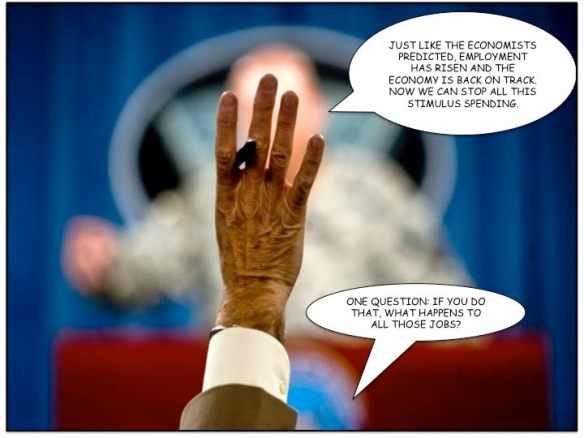
It’s my birthday, and my younger son has given me a present. You can see whose house he was brought up in. And while it may spoil the joke a bit by adding some commentary, you never know in this day and age what others will and will not see. The first picture is straightforward, however. You hear the equivalent said all the time in every economy.

josh keynes 01

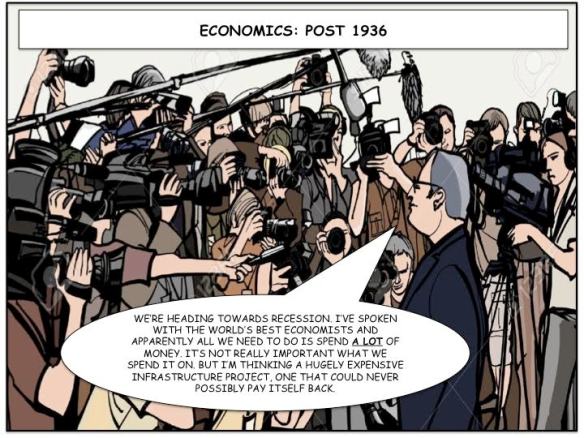
The second is the subtle one. The government has chosen projects that will never repay their costs which means that the economy, so far as these expenditures go, will end up less well off at the end than it was before. Other projects, almost invariably from the private sector, will usually make up for this loss. But non-value-adding projects pull an economy backwards. If you are getting fewer units of output back compared with the number of units used up in production, living standards must contract. But as the picture shows, lots of people are employed. They are just not employed in projects that create net wealth, which includes those employed in industries supplying inputs.

josh keynes 02

Because Keynesian economics is all aggregates, the structural problems created by this expenditure is invisible both in theory and in relation to the actual circumstances of the economy. People are, to all appearances, working and producing. The problem remains that what is produced has less value than the resources used up. One day, as the debts pile up and deficits grow, the expenditure must be withdrawn with the result that the entire structure of production must then be reconfigured in a way that allows productivity to grow. That reconfiguration is infinitely more painful than things would have been had you let the economy adjust in the first place.

josh keynes 03

My son is neither an economist nor a graphic designer. The message is nevertheless sound and coherent with the presentation clarity itself.

And the world is changing. I have just been sent this from The Spectator: The one thing most people think they know about economics is wrong with the subheading, “Keynesian deficit spending makes sense – but over and over again it has not worked”. My What’s Wrong with Keynesian Economics? was sent off for production on Friday. Most people, especially economists, do indeed still think Keynesian theory “makes sense”, they just cannot work out why it never works. If they actually understood how an economy does work, they would understand why Keynesian theory is complete nonsense.

And because the manuscript has now gone off, I am heading off and away for my version of lying by the beach. Blogging may therefore be more intermittent than usual.

NO Keynesian stimulus has ever succeeded in bringing about a recovery

Some ideas just will not die, no matter how much damage they do. Keynesian economics is one of those. So let me say it again: NO Keynesian stimulus has ever succeeded in bringing about a recovery. Not one, not ever. Go on, you Keynesians out there. Name one, anywhere, any time. Name a single occasion when an increase in public spending brought a recession to an end and returned an economy with high unemployment to full employment. The General Theory was published in 1936. Since then, there is not a single occasion when an increase in public spending led to an economic recovery. Every pre-Keynesian economist would have understood not just this fact, but also why it was so. But such is the dead hand of received ideas, that economists continue to push for an increase in public spending to bring recessions to an end.

So here is the latest set of economic instructions, this time from Canada. The headline reads Economy needs bigger deficit spending with the sub-head, “economist tells Ottawa now is the time to spend, not worry about balanced books”. And this is how it begins:

Ottawa should not be afraid to spend a lot of money it doesn’t have quickly in order to give the economy a shot in the arm, an influential economist says.

That was the gist of a note Thursday from David Rosenberg, the chief economist and strategist at Toronto-based money manager Gluskin Sheff Inc.

During the recent election campaign, the Liberals ran on a pledge to run “modest” deficits in the $10-billion range for the next few years, in an attempt to stimulate the economy.

Debt-to-GDP can come down even with deficits, economists say
But Rosenberg says more drastic measures are warranted, noting that Ottawa could run deficits of up to $24 billion a year all the way until 2020 and still be below the average 70 per cent debt-to-GDP ratio among OECD nations.

Canada’s debt-to-GDP ratio currently stands at 31 per cent.

“What is Ottawa waiting for?” Rosenberg wrote.

“If the government wasn’t spending years strengthening our nation’s balance sheet to use it as a weapon against downside economic risks as is the case today, then what was the point of it all?”

Rosenberg says it is time for the federal government to get off the sidelines and start “fighting the economic forces” instead of leaving the heavy lifting to the Bank of Canada, in the form of monetary policy.

This is identical to the advice that Ken Henry gave Kevin Rudd, with the usual disastrous results. But it’s advice that has an older pedigree than that. Let me take you back to my 2009 classic, The Dangerous Return to Keynesian Economics, where you will find the identical advice offered to Japan in the 1990s.

Stanley Fischer, who in 1998 was the First Deputy Managing Director of the IMF, was very clear on the need for the massive increases in spending. Addressing a symposium in Tokyo in April that year, he said:

Japan’s economic performance is of course a matter of grave domestic concern. But given the prominent role of Japan in the world economy, and especially in Asia, it is also a legitimate matter for concern by Japan’s neighbors and by the international community. There is little disagreement about what needs to be done. There is an immediate need for a substantial fiscal expansion …

On fiscal policy, the recent suggestion of a package of 16 trillion yen, about 3 per cent of GDP, would be a good starting point. But, unlike on previous occasions, the program that is implemented should be close to the starting point. The well-known reservations about increases in wasteful public spending are correct: that is why much of the package, at least half, should take the form of tax cuts. Anyone who doubts the effectiveness of tax measures need only consider the effectiveness of last year’s tax increases in curbing demand.

The IMF is not famous for supporting fiscal expansions. And it is true that Japan faces a long-term demographic problem that has major fiscal implications. But after so many years of near-stagnation, fiscal policy must help get the economy moving again. There will be time to deal with the longer-term fiscal problem later.

Another example of the same kind of advice is found in a February 28, 1998, editorial in The Economist under the heading, “Japan’s feeble economy needs a boost”:

The [Japanese] government says it cannot afford a big stimulus because its finances are perilous. It is true that Japan’s gross public debt has risen to 87% of GDP, but net debt amounts to only 18% of GDP, the smallest among the G7 economies. The general-government budget deficit, 2½% of GDP, is smaller than its European counterparts’. Rightly, the Japanese are worried about the future pension liabilities implied by their rapidly ageing population. But now is not the time to sort the problem out. Far better to cut the budget later, when the economy has recovered its strength.

I need hardly point out that Japan’s “lost decade” has continued for more than twenty years yet in all the investigations over what had gone wrong, the increase in public spending has never even been glanced at. Modern macroeconomics is a disaster continuously in wait for its next victim. If you would like to understand why, once again I cannot suggest anything written more recently than 1936, other than, of course, this.

[My thanks to SMc for alerting me to the advice being offered to the Canadian PM, who will, no doubt, now take it.]

So what was it related to?

Picked up on Instapundit where the story read:

PRECAUTIONARY MEASURE “NOT RELATED TO TERRORISM” IN SIDNEY, AUSTRALIA: Sydney Opera House evacuated and Manly ferry cancelled during police operation.

So they can’t spell Sydney in America. This, however, is what they were referring to:

The Sydney Opera House precinct reopened to the public Thursday afternoon after a police operation caused staff and tourists to be evacuated from the landmark.

Police simultaneously conducted an operation across the harbour in Manly as a “precautionary measure” following information on social media.

“Following information on social media, police conducted an operation in the vicinity of the Opera House and Manly as a precautionary measure,” police said.

It is understood the operation, which began just after lunchtime and was over by mid-afternoon, was not related to terrorism.

Well, that’s a relief. One suggestion of what it was all about is found at the comments thread at Instapundit: “It was probably militant feminists driven berserk by the name ‘Manly’ Ferry.” You never know, these days, you never know.

Obama thanks Iran for spitting in his eye

Iran-humilates-US

This is pretty well where things have washed up: Iran Releases Sailors After U.S. Promises ‘Not to Repeat Such Mistakes’. There is also this, Iran’s Humiliation of Barack Obama is Now Complete. Meanwhile, perhaps out of embarrassment, this is so far down the page on Drudge that for all practical purposes they might as well have left it out.

Iran says seizure of boats lesson to ‘troublemakers’ in Congress…
Warns Missiles Locked on US Aircraft Carrier…
Releases Humiliating Images of Sailors in Captivity…
VIDEO NAVAL COMMANDER: ‘Our Mistake’…
Sanctions Seen Lifted by Monday as Nuke Deal Implemented…
TRUMP: Why isn’t Iran releasing other Americans?

It’s that first one that is the truly interesting link. This is the entire story:

Iran’s army chief said on Wednesday the seizure of two U.S. navy boats and their 10 sailors should be a lesson to members the U.S. Congress trying to impose new sanctions on Tehran.

“This incident in the Persian Gulf, which probably will not be the American forces’ last mistake in the region, should be a lesson to troublemakers in the U.S. Congress,” Major General Hassan Firouzabadi, head of Iran’s armed forces, was quoted as saying by Tasnim news agency.

They have zero fear of any kind over what the United States might do. You also do not get any kind of flavour of what Trump said from the quote of the last story referenced at Drudge. No one could be less capable than Obama, but there are degrees. See what you think.

Republican presidential front-runner Donald Trump on Wednesday praised the ten American sailors who spent the previous night in Iranian military detention.

“These [are] ten wonderful soldiers who went through hell, by the way,” he said on “MSNBC Live with Thomas Roberts.”

“When I see pictures of them with arms up in the air and guns pointed at them, I wouldn’t exactly say that’s friendly,” Trump added.

Tehran announced early Wednesday that it was releasing the group of U.S. sailors who had crossed into its “territorial waters” Tuesday evening.

Trump said Iran resolved the standoff so quickly because Tehran wants to stay on good terms with the United States until its nuclear agreement takes effect in the coming days.

“They get $100 billion during the next short period of time, they don’t want to jeopardize that,” he said.

“Obviously they’re going to release them,” Trump said of the detained sailors. “They’re not going to keep them. If it happened two weeks from now, they would have kept them, and they would’ve kept them for a long period of time.”

Trump also ripped the Obama administration for not negotiating the release of other Americans detained by Iran.

“We still have four hostages over there,” he said. “Why aren’t they giving those hostages back? They get everything. We get nothing.”