
My take on the debate

You can see my own views of the debate at Quadrant Online which in many ways is similar to Trump’s.

Donald Trump said on “Fox & Friends” this morning that last night’s presidential debate went well, despite the fact that he was asked much tougher questions than Hillary Clinton . . . .

Trump pointed out that moderator Lester Holt pressed him on his tax returns, the President Obama birther scandal and his stance on the Iraq War.

He said that Clinton, on the other hand, was not asked about her email scandal, the Clinton Foundation or the Benghazi terror attack.

Trump said that even though it was obvious that Holt leaned “more than a little” to the left, he was satisfied with the message he got out to the American people, particularly his policies on illegal immigration, law and order, and trade.

“Those are basically the three things we’re going to have to get out. And I got them out early and strong,” Trump said. “And a lot of people think the poll numbers are going to go up because of that.”

And his poll numbers are going up with virtually every poll that is run untouched by human hands – that is, every poll not run through the media and their polling organisations – show Trump having won last night. In the end, as I point out at Quadrant, American is not electing a debating team, it is electing the person who must lead them through the next four years which may be among the most perilous in American history. Who knows what is happening, but I will end with this from a comments thread at Lucianne:

There is a truly unscientific poll going on wherever 7-11 is found…they have a sale on hot beverages in their new “thermal” extra large cups with either “Republican”, “Democrat” or a “rant” design. On the east end of Long Island (of all places) there is a shortage of Republican cups and it´s attributable to brisk sales, not someone hiding the pubbie cups. The discount to buy these cups is significant (around 33 cents with tax) but the demonrat cups aren´t selling according to a friend who´s an owner.

Granted it´s unscientific but in the past when they´ve done this you don´t see the pubbie cups selling out.

This election has a feel like the one in ´72 where no one “voted” for Nixon yet he won 49 States over McG.

The media are all-in for Hillary and it is up hill for Trump in every way, but we shall see in November, and before that we will have two more debates.
The first debate

I cannot deny that I was disappointed at the end of the debate. Trump ought to have put her away with so many issues opened up for which there are answers aplenty. He went after her in the first half and drove her to the edge of the field but then let her back.

So let me think about this a bit more. First, the totally one-sided “moderating” really is irritating. The issues that will matter looking forward for the next four years do not include where Obama was really born or what Donald Trump shows on his tax form. These are not policy matters and do not much matter. What counts are the things that were not touched, such as Benghazi, her public email server which has allowed every foreign intelligence agency to read every email she sent, the open border that is not being sealed off and would not be by Clinton, her inveterate lying on everything, large and small. These were not brought into the mix by the moderator.

Second, I think Trump is conscious of the Romney experience. Romney won the first debate and then didn’t win the election. If there is anything that Trump has shown, it is that he gets his timing right. I thought he let her off the hook in a number of places which he ought to have driven a Panzer division through, but didn’t. I don’t know if it was deliberate, but on purpose or not, he will be back for the second and third events. What did Hillary learn from this? Nothing that I think can help her, while Trump learned a lot.

Third, the Trump I saw was not the Trump I believe he can be. The Trump others saw for the first time was, however, someone who does not scare the horses and had as presidential a look about him as one could wish. That Trump has won every one of the online polls asking who won the debate says something about the common expectation which he more than seems to have filled.

Fourth, Hillary’s desire to raise taxes on “the rich” and increase the minimum wage are massive disasters that would ruin the working lives of many, especially those at the bottom. Trump, on the other hand, wants to lower taxes and remove regulations on business. Hillary panders to the ignorant while Trump has a more sophisticated view of how a capitalist system works. It is not a zero-sum game in the way it is discussed by Clinton. Adding to that, his aim to re-negotiate the various trade deals, and have others contribute to the cost of their defence by the United States. These are the kinds of changes that really can make the American economy succeed. Nothing that Hillary says or has ever done, makes you think she has much of an idea how things work, other than via various forms of patronage and corruption.

In all, I wish it had been more of a win for Trump. But on this very day the electoral college for the first time rolled in his favour. He has till the start of November to build on what he has achieved, and there is no reason to think he cannot do what needs to be done. And there is always the possibility that the people who are voting understand that they are not selecting a debating team but who will lead their nation for the next four years during one of the most perilous times in its history.

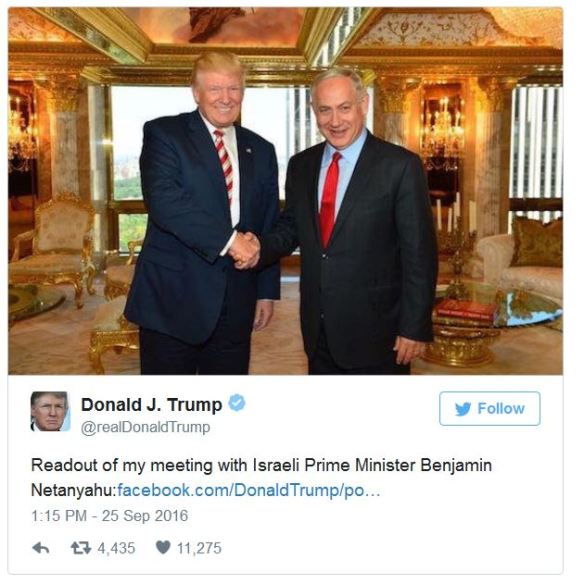
Trump meets with Netanyahu

trump-and-netanyahu

This communique is found at Powerline under the heading, Bibi calls on Trump and Clinton.

Donald J. Trump met privately today with Prime Minister Netanyahu for over an hour at Mr. Trump’s residence in Trump Tower. The two have known each other for many years and had the opportunity to discuss many topics important to both countries.

Mr. Trump and the Prime Minister discussed the special relationship between America and Israel and the unbreakable bond between the two countries. The topics of military assistance, security and regional stability were addressed. Mr. Trump agreed that the military assistance provided to Israel and missile defense cooperation with Israel are an excellent investment for America. Mr. Trump said that under a Trump administration, there will be extraordinary strategic, technological, military and intelligence cooperation between the two countries. Mr. Trump recognized Israel as a vital partner of the United States in the global war against radical Islamic terrorism.

They discussed at length the nuclear deal with Iran, the battle against ISIS and many other regional security concerns.

Mr. Trump and Prime Minister Netanyahu discussed at length Israel’s successful experience with a security fence that helped secure its borders. They discussed Israel’s burgeoning hi-tech and biotech economy and how it has made stunning advances improving and saving lives around the world. In particular, Mr. Trump noted Israel’s emergence as a world leader in cyber defense and security and its cooperation with the United States in this regard.

Mr. Trump recognized that Israel and its citizens have suffered far too long on the front lines of Islamic terrorism. He agreed with Prime Minister Netanyahu that the Israeli people want a just and lasting peace with their neighbors, but that peace will only come when the Palestinians renounce hatred and violence and accept Israel as a Jewish State.

Finally, Mr. Trump acknowledged that Jerusalem has been the eternal capital of the Jewish People for over 3000 years, and that the United States, under a Trump administration, will finally accept the long-standing Congressional mandate to recognize Jerusalem as the undivided capital of the State of Israel.

The meeting concluded with both leaders promising the highest level of mutual support and cooperation should Mr. Trump have the honor and privilege of being elected President of the United States.

For Clinton’s summary of the discussion you can go here.

Tackling climate change and low inflation all at once

The RBA wants to see prices rise in Australia and here is the answer: Climate science support puts pressure on Turnbull.

Malcolm Turnbull faces intensifying public pressure to phase out coal fired power stations and set stronger emissions reduction targets with new polling showing growing support for climate science and greater action to tackle the effects of dangerous climate change.

And so here is the good news: Hazelwood closure could force power prices up.

Estimates of the impact of its closure on retail electricity bills vary from an initial 25 per cent spike reducing to a 9 per cent rise – about the same as the carbon price – to a jump of less than 2 per cent.

If inflation is too low, whatever that means. this is one way to ensure that it gets too high.

Where are the critics of Keynesian economics today?

aust unemployment stats

The thing about these Keynesians is that they have no shame. The nonsense that Australia avoided recession after the GFC is one of those self-serving myths that will not stand an ounce of analysis. The data above (from the IPA) are the latest much-revised version of what happened to the unemployment rate during the GFC. A rise in the unemployment rate by two-plus percentage points over the course of a few months is recession enough for me, whether or not we actually had two consecutive quarters of a falling GDP. Ken Henry was Secretary of the Treasury at the time, and his advice was “go hard, go early”. So Rudd and Co went hard and early, with the results before us for all to see.

So now the self-same Ken Henry is on the front page of The Australian today with some advice on how to fix the problem that hard and early have led to: Fix budget before the crunch hits, urges Ken Henry.

National Australia Bank chairman and former Treasury chief Ken Henry warns that Australia faces an unacceptable risk with its budget deficit and fears the nation will wait for a painful economic crunch before confronting true ­financial repair.

In an exclusive interview, Dr Henry issued his most powerful warning about the failure of politicians and the national parliament, saying responsible fiscal policy had become a “pretence”, the economic reform narrative “no longer exists” and politicians are fixated by “appeals to populism”.

Dr Henry said Australia was now running the risk that its AAA sovereign credit rating might be downgraded, coinciding with another global financial disturbance, and in this situation the consequences for Australia “would be truly catastrophic”.

He said this was a “small risk” in relative terms but “the consequences are so large you cannot take the risk”.

Dr Henry said politicians through domestic economic ­policy failures were now exposing the nation to such risks that the entire reason for the reforms of the 1980s and 90s had been ­forgotten.

Unless the momentum was recovered, Australia would find “we are right back with Paul Keating’s banana republic statement”.

Well Ken, what a disaster we have created for ourselves. You must tell us where we went wrong. The following gets to the heart of the matter, which one would have hoped a Treasury Secretary would already have known. The quote is from Henry Hazlitt’s Economics in One Lesson which was brought to our attention by Tel on a previous post.

When the government comes to repay the debt it has accumulated for public works, it must necessarily tax more heavily than it spends. In this later period, therefore, it must necessarily destroy more jobs than it creates. The extra heavy taxation then required does not merely take away purchasing power; it also lowers or destroys incentives to production, and so reduces the total wealth and income of the country.

The only escape from this conclusion is to assume (as of course the apostles of spending always do) that the politicians in power will spend money only in what would otherwise have been depressed or “deflationary” periods, and will promptly pay the debt off in what would otherwise have been boom or “inflationary” periods. This is a beguiling fiction, but unfortunately the politicians in power have never acted that way. Economic forecasting, moreover, is so precarious, and the political pressures at work are of such a nature, that governments are unlikely ever to act that way. Deficit spending, once embarked upon, creates powerful vested interests which demand its continuance under all conditions.

Hazlitt also published his Critics of Keynesian Economics of which it is said:

Henry Hazlitt confronted the rise of Keynesianism in his day and put together an intellectual arsenal: the most brilliant economists of the time showing what is wrong with the system, in great detail with great rigor. With excerpts from books and articles published between the 30s and 50s, it remains the most powerful anti-Keynesian collection ever assembled.

And here’s the thing. The book was published in 1960 and other than Mark Skousen’s sadly out-of-print Dissent on Keynes (Praeger 1992) there has not been another attempt to do the same until my own modest What’s Wrong with Keynesian Economic Theory? which was only released last month. It is thus almost twenty-five years since anyone has has brought together a series of critics of Keynesian economics and more than fifty years since the only other. And as scarce as they were even then, critics of Keynes were easier to find, let me tell you, in the 1930s, 40s and 50s [and I might mention that Hazlitt included two nineteenth century articles of sublime excellence by J.-B. Say and J.S Mill]. Such economists are almost completely gone today in spite of there being every reason to think they should be found at every turn.

The mysterious and inexplicable survival of Keynesian economics

Now this was very promising: The Reasons Behind the Obama Non-Recovery: It wasn’t the severity of the Great Recession that caused the weak recovery, but government policies, an article by Robert Barro which I was alerted to by a post at Powerline. The Global Financial Crisis was over within six months. The deep and ongoing recession we are in is due to the Keynesian policies that followed.

The essence of a Keynesian policy is to start with Y=C+I+G, assume that the problem is demand deficiency and then try to fix things by raising the level of G. As I have also pointed out in the past, unless government spending is value adding – that is, until whatever is being produced earns revenues greater than their costs – such expenditure is a drain on the economy and will make you worse off, not better. I am near enough the only person I ever come across saying this, so here I lived in hope that perhaps Barro would start to say it. Someone has to say it before we wreck ourselves totally by following one Keynesian idiocy after another.

Here’s the thing. Neither the words “Keynes” nor “Keynesian” show up neither in the original article nor in the comment at Powerline. The vast waste of our resources in one mis-guided stimulus program after another goes unmentioned (although it does show up in a few of the comments). Almost no one even thinks that the problems with policy is the nature of modern economic theory.

The strange thing about my What’s Wrong with Keynesian Economic Theory? is how unique it is. No one seeks to go after the actual problem, which is macroeconomic theory based as it is on deficient aggregate demand. Indeed, no one would even dare to suggest Say’s Law may actually be true, the absolute fundamental guide to managing an economy.

Here it is as it seems to me. I said in 2009 that the stimulus would be a disaster. I wrote my article for Quadrant, The Dangerous Return to Keynesian Economics in which everything that has occurred was mapped out before it began. I started writing my Free Market Economics which is now heading for a third edition. But really, I never thought the reasons for this catastrophic fall in our living standards would remain such a mystery and for so long.

Another Keynesian at the RBA

So what’s the new RBA governor like? He is standard issue Keynesian, that’s what he’s like, which means he will never have a clue what’s going on. This is so depressing: Reserve Bank governor Philip Lowe urges government to invest in infrastructure. The opening paras:

Incoming Reserve Bank chief Philip Lowe has appealed to the Turnbull government to help him out with economic management by borrowing big for infrastructure, saying there’s only so much that further cuts in interest rates can do.

In what amounted to a plea to the Prime Minister and Treasurer to take advantage of near-record low interest rates and borrow now that the Reserve Bank’s cash rate was close to zero at 1.5 per cent, he told a parliamentary hearing that monetary policy is “not working as effectively as it might have”.

“One response is to keep doing more of it in the hope that it finally works, he said. “My judgment is that that has not been particularly useful.

“Another option is for some entity in the economy to use the low interest rates to increase its spending. The government could either use its balance sheet or its planning capacity to do infrastructure spending.”

Does he not know that we have already tried the public spending and that it didn’t work. We have also tried low interest rates, and that didn’t work either.

Only private sector spending, where a genuine profit and loss statement in involved, will generate recovery. How about cutting deficit-increasing expenditures and reducing the weight of business regulation? Having seen his first go at giving policy advice, I am not encouraged by what he will now do to rates. As for public infrastructure, right under the AFR story on the RBA, there was this: Communications Minister Mitch Fifield eases NBN charge concerns. Wherein we read:

Investors saw the first real impact of the high wholesale access charges on Tuesday after David Teoh’s TPG Telecom warned that its margins will be cut as more users switch to the NBN under the current pricing model. TPG shares have been savaged since, dropping 24.5 per cent since Tuesday, while shares in Vocus Communications have dropped 10.4 per cent.

Mr Fifield said that “NBN is acutely aware of this issue.” The NBN is under increasing pressure over the charges as telco entrepreneurs warn that the industry may reach a point where some companies may go broke.

NBN would not even exist except for the billions blown by both governments on this ridiculous project. It is now the white elephant in the room and is threatening to devastate the industry. This is government infrastructure at its finest, a perfect example, along with unusable desal plants, green energy projects, billion-dollar Myki cards and beyond the idiocies found across the globe, we in Victoria have billion dollar non-existing roads-to nowhere. Let me give you my favourite quote from Adam Smith.

[Governments] are themselves always, and without any exception, the greatest spendthrifts in the society. Let them look well after their own expence, and they may safely trust private people with theirs. If their own extravagance does not ruin the state, that of their subjects never will.”

Written in 1776 and with the words “always” and “without any exception” found in a quote from the normally cautious and careful Dr Smith. No one who has ever read that passage in all the years since it was written has ever seen a government that could be described as in any way different from what was described. It is a passage our new RBA Governor needs to read and takes to heart, while he goes back and has a look at Wicksell at the same time. Haven’t these people ever heard of the private sector?

Saying the thing which is not about raising rates

The front page of The OZ: Interest rate cuts losing power: RBA. The premise is that there was a time that interest rate cuts had done some good, but if so, that was only when they had been set too high. If you would like to understand why interest rates can be too low, and have been much too low everywhere for quite a long time, you should look at the last two chapters of my Free Market Economics. But the main message is that the era of low interest rates is over. Let me therefore take you two articles on the same theme.

The first is Yellen helps Clinton dodge a bullet which comes with the sub-head: “Federal Reserve policymakers keep their key interest rate steady, putting the central bank on the sidelines until after Election Day.” The first sentence of the article is merely about politics. The economics is about what lies in wait. But first that opening sentence:

Scratch one big economic worry off the list for Hillary Clinton.

The worry being scratched off is that interest rates will be raised before the election. Trump knows what a problem this would be for the Democrats better than anyone. Yellen knows exactly what Trump knows, but says the thing which is not like the rest of her leftist tribe:

Fed Chair Janet Yellen also strongly rejected claims lobbed at her by GOP presidential nominee Donald Trump that she is keeping rates artificially low to boost stock prices and aid Democrats.

“I can say emphatically that partisan politics plays no role in our decisions about the appropriate stance of monetary policy,” Yellen said at a news conference after the Fed announced its decision. “We do not discuss politics at our meetings and we do not take politics into account in our decisions.” . . .

“The Federal Reserve is not politically compromised,” she said. “I can’t recall any meeting that I have ever attended where politics has been a matter of discussion. I think the public if they had been watching our meeting on TV today would have felt that we had a rich, deep, serious, intellectual debate about the risks and the forecasts for the economy.”

Since she cannot say otherwise, that was the pre-fab answer. But they of course do think politically 100% of the time, and know full well what will happen when rates start to rise, or even if they hinted that they would rise. It will happen immediately if it’s Trump, more slowly if it’s Hillary, but up they will go. As noted at the end of the article:

The decision [to leave rates where they are] should be a bit of a boost for Clinton, more because it avoids a nightmare scenario than does much to strengthen the economy.

“Nightmare scenario”? What could they possibly mean?

There is then this second article dealing with the same issues: Yellen rejects Trump charges that Fed plays politics. Shorter and again outlines Trump’s complaints in the company of Yellen’s untruths. But it ends with this:

By statute, the Fed is an independent body intended to be shielded from political pressure and whose operations are not funded by the US Congress.

But Fed governors are nominated by the White House and approved by the Senate.

You can see the cynicism in the article but there is even more in the comments to the story. I will just list one, which is like most of the others, and which follows more or less my own sentiments about all of it:

Her denial proves the point. Yellen is a marxist who does Obama’s bidding. If Trump wins in November this fool will raise interest rates in December. Bet the farm on it.

For all that, the sad fact is that the only way our economies can ever get on track is for rates to rise. It will be a rough ride, but without the redirection of savings in productive directions, there is no chance of a recovery either short term or long.

No correlation between student evaluations and learning

Every year I teach much the same things in much the same way, but my student evaluations, even in different classes during the same semester, has made me suspicious of any of it. So it is interesting to come across this study with the following title: Zero Correlation Between Evaluations and Learning. It’s not that I don’t learn from reading the comments over, but my interest and theirs are not the same. I start out by knowing what I want them to know by the end of the semester, I test them on the knowledge that I want them to have and I find almost all get through. Beyond that, I’m not sure there is much anyone else should ask.

The article comes to this conclusion:

“The multisection studies do not support validity of SET ratings as measure of faculty’s teaching effectiveness. They indicate that students do not learn more from professors with higher SET ratings.”

And as for a student’s ability to judge the education they receive, it will be a long time after graduation that they will ever really know, if even then.