
Isn’t it obvious that Obama is on the other side?

Eight years is a long time for a political mistake to continue. Victor Davis Hanson looks at Obama and the Middle East in a post on Speak Loudly And Carry A Twig. That Obama has continually sought to aid and abet the most radical of the Islamists in every one of the theatres of war ought to make clear whose side he’s on. Yet it remains merely a series of errors and examples of poor judgement. No one in Israel or Egypt misunderstands even in the slightest, but it still cannot be said that Obama sides with the Muslim Brotherhood. Here is one of the examples Hanson gives.

The Egyptian military junta tried to explain to the Obama administration that it had no choice but to abort the one-election/one-time Islamization efforts of Mohamed Morsi’s Muslim Brotherhood. President Abdel Fattah el-Sisi is baffled that Egypt’s opposition to radical Islam has not softened American anger, but apparently only cemented the estrangement.

The only thing that baffles him is that Obama could get elected and that his policies have not brought the house down on his head. It’s now just about waiting it out since whoever is next is bound to be better. But then again, it might be Hillary Clinton or even Bernie Sanders so “better” might need to come with the modifier “slightly”. And even if it’s not, everyone now understands that the US cannot be the long-term anchor. Security must be found elsewhere. As Hanson says:

The only upside is an emerging de facto alliance between Israel and the so-called moderate Arab monarchies. That odd coupling assumes that Iran threatens both more than they do each other, and that the United States is no longer a reliable patron to either.

The US under Obama has not been “unreliable”, it has been positively hostile. This is a lesson learned, but we are not living in a better world as a result.
Dogs have owners, cats have staff

The core message of this article, Fat Cats on a Diet: Will They Still Love You? is that yes they will.

“We say, ‘dogs have owners, cats have staff,’” said Dr. Richard E. Goldstein, chief medical officer at the Animal Medical Center in New York. “A cat learns to manipulate us very well: when she’s hungry, she’s the most affectionate cat in the world. And people will do anything to keep their cats happy.”

Many owners “free-feed” cats, letting them graze at will. But bored indoor cats, like bored indoor humans, may eat beyond satiety. “Cats don’t self-regulate well,” said Dr. Goldstein.

Concerned with the human role in feline obesity, Cornell researchers asked: If a cat’s food were reduced, would its behavior change? If so, how would owners translate those changes? For the study, 48 cats, each at least 25 percent over ideal weight, were put on one of three restricted diets, equal in calories. Owners answered extensive questionnaires about their cats:

Before the diet, when your cat was hungry, did it beg? Meow? Pace? After feeding, did it jump in your lap? Since the diet, does your cat bat at you? Hide? Hiss? Steal food?

Good news, cat owners! More than three-quarters of the cats lost weight. And though the frequency of pre-feeding behavior increased — begging, meowing, pacing — it did not begin earlier. (Translation: The cats may have intensified owners’ guilt about giving them less food, but did not protract their misery.)

Better yet, owners felt that despite the restricted feeding, the cats did not turn vindictive. Instead, owners believed the cats showed more affection. After feeding, the cats would more often purr and sit in the owner’s lap.

“We don’t know why,” said Dr. Beaver. “But cats don’t hold a grudge if you limit their food.

I wonder if there is a message here about the welfare state in general.

[A more than usually important question answered, found at Instapundit.]

David Horowitz on Trump and the War in Iraq

This is from a post by David Horowitz at FrontPageMag which he titles, Election Fog. And what was important to me was that he sees past the lack of knowledge and historical understanding to the core motivations of Trump’s run for president.

Trump showed himself recklessly ill-informed on the causes of the Iraq War during the South Carolina debate. George Bush did not lie to lead us into war – that is, in fact, a Democrat lie. The Iraq War was about Saddam’s defiance of a UN Security Council ultimatum to disclose and destroy his Weapons of Mass Destruction. Contrary to an enormously destructive political myth, the WMDs did exist – including 2250 Sarin-gas-filled-rockets and chemical weapons in storage tanks that Saddam buried and are now in the possession of ISIS. Finally, the destabilization of Iraq and the Middle East are entirely a consequence of Obama’s policies not George Bush’s as Trump falsely maintained. Trump’s misreading of the Iraq War is a serious political fault. But it is the result of ignorance rather than malice against his country, which is what motivates the left. Whatever one thinks of Trump, he is justly hated by the Sanders radicals, who understand that his intentions make him their nemesis not their twin.

It’s not something you can pass over lightly since understanding history is crucial to political judgement, but history can be learned. The will and judgement to do the right thing is what matters in the end, and the question that does still remain open is whether Trump does have the judgement to succeed. I think he does, and more so than any of the others, but that still remains the question after all of the other issues have gone by.

Donald Trump passes the Jeff Sessions test

This is the headline Jeff Sessions Praises Donald Trump’s Answers to ‘Sessions Test’ and this is the story:

Alabama Senator Sen. Jeff Sessions (R-AL) praised GOP frontrunner Donald Trump’s responses to his GOP candidate questionnaire.

Sessions noted that to date Trump is the only candidate who has “answered to my satisfaction.”

On February 5th, Sessions, the intellectual thought leader of the conservative nation-state movement, issued a questionnaire to all candidates seeking the Party’s nomination. The Sessions test consisted of five straightforward questions addressing immigration, trade, and crime in the United States. In his response, Trump wrote, “After my inauguration, for the first time in decades, Americans will wake up in a country where their immigration laws are enforced.”

On Monday’s program of the Mark Levin Show, Sessions said:

The American people need to be alert. This is a very, very critical election. I think if they care about immigration issues and trade issues, they need to be sure about where their candidates stand. And I’ve asked them questions about trade and immigration and one question on crime. And Trump has answered to my satisfaction, but the others haven’t yet. So I think these candidates need to be specific about where they stand before Americans start giving them their vote.

“I’m a fan of Trump,” Sessions said. “He’s been clear on immigration, he’s been clear on trade, and he’s talking directly to the American people.”

Sessions said that he was similarly impressed with Trump’s picks for the Supreme Court. During Saturday night’s GOP debate, Trump was the only candidate to list his potential picks: Bill Pryor and Diane Sykes.

Sessions, who sits on the Senate Judiciary Committee, said “Trump really hit a home run with me when he mentioned [Pryor].”

“Sykes and Pryor are conservative federal judges,” Business Insider reports. Because Pryor is adamantly pro-life, “Senate Democrats tried to block Pryor’s nomination to the 11th Circuit court, saying that he had described Roe v. Wade as ‘the worst abomination in the history of constitutional law.’”

In recent days, Trump has been hitting Cruz for his prior support of John Roberts. In 2005, Cruz penned an op-ed in favor of Roberts’ confirmation, declaring: “John Roberts should be a quick confirm” for the Senate.

Trump comes across less serious than he is but those with an agenda can see he has been thinking about the questions and has some seriously sensible answers.

Monetary policy and Say’s Law

Here is a bit of transcript from Reserve Bank Governor Glenn Steven’s in response to a question put by Craig Kelly MHR during a Parliamentary committee meeting. You could find neither the question nor the answer anywhere else in the world.

Mr CRAIG KELLY: There was an article published earlier this week in The American Spectator. If I just quote a few passages from it, you might like to comment. It said:

“America is languishing from historically low growth rates for the past ten years … In the fourth quarter of 2015, our growth rate was less than 1% at .70%.”

It goes on to talk about Japan. It says:

“Japan has followed this same pattern of high tax rates, lower interest rates, and endless government spending for the past 25 years. The result is massive federal debt, a slow growth economy, and reduced international competitiveness.”

Then it goes on to Europe:

“Europe has followed the same prescription, with similar results …”

Then it goes on:

“Jean-Baptiste Say theorized that the growth of economies is not demand-driven, but growth is created by new and lower cost products and services.”

Do you think that governments worldwide over the past six, seven or eight years have been too much focused on stimulating from the demand side rather than from the supply side?

RBA GOVERNOR, Mr STEVENS : Say’s law, as it is known, is a long-run proposition that supply creates its own demand. I think my colleagues are more educated in economics than I, but my sense is that mainstream economics would admit that there are occasions when, for one reason or another, aggregate demand in the economy can fall short of its supply capacity, and we lived through one of those. It is actually pretty likely that will happen in a financial crisis, and that is what happened. So it was appropriate for the countries affected—which were many, including us—to adopt more expansionary demand management policies, both monetary and, where space allowed, fiscal.

But then the question is: it is one thing to manage demand around the cycle—most mainstream economics accepts that some of that should be done, especially in deep downturn episodes where it is virtually certain that it is a deficiency of demand that has caused it—but, in the longer run, where does the growth come from? This is a point where I am a broken record, but this is the point we have made many times. It cannot really be the case that we get long-run growth by just using monetary policy which, in the end, borrows from tomorrow’s income to spend today. That cannot be a recipe for sustained, strong long-run growth. The sustained and strong long-run growth in living standards comes from innovation, risk taking, productivity et cetera et cetera. We have talked about all that, as you know, many times before, and I think the committee understands our view.

So I would say that in the past seven or eight years too much has been expected of monetary policy to keep delivering growth. Really—and I am speaking at a global level here—monetary policy globally has been asked to do something it cannot really do. It is not simple to put long-run growth on a better track, but this is why, when we hosted the G20, we talked about the growth plan structural initiatives. None of those initiatives were that the central bank should cut rates further to get the two per cent extra growth the G20 talked about, they were all structural things to help make economies work better—to help productivity, to assist innovation et cetera. That is where prosperity comes from. It does not come from manipulating the price of money. There is a place for doing that in a demand downturn but long-term growth does not come from that. We have been very clear about that.

The question is outstanding and the answer is pretty damn good as well.

The Donald Pro and Con

There is little doubt that Donald Trump is a high-risk choice for president, but there is equally little doubt that the American enterprise is at a very dangerous crossroads. He’s not the obvious choice that Romney was in 2012, although to hear the story told today you would think Romney was about on par with Obama in his negatives. So let us do a bit of weighing up the two sides of the question.

Pro

  • His central slogan is “Make America Great Again”, the very antithesis of the Obama creed.
  • He wants to protect the integrity of America’s borders.
  • He wants to strengthen America’s national defence.
  • He understands that not all potential migrants are equal.
  • He understands the importance of balancing the books and is more likely than any other candidate to bring fiscal sanity back into the American economy.
  • He is non-politically correct and is unafraid to say things no one else will say.
  • He is unafraid of the media and gives back better than they dish it out to him.
  • He can do through force of personality things that no one else could do in his place.

Con

  • He is half (three-quarters?) crazy.
  • He is vulgar and intemperate.
  • He knows little history.
  • He is unanchored to the Republican Party.
  • He has had no experience in dealing with foreign policy issues.
  • No one knows, least of all him, what he would really do if he won.
  • His background is in business which is among the worst places for anyone in politics to try to learn the trade.
  • He may make either Hillary or Bernie more electable than they otherwise would be.

You would prefer that he were more like a Tony Abbott or a Stephen Harper, but then again, where are they now, pushed aside as they were by flea-weights.

UPDATE: From today, reported on Drudge.

I don’t know if this connects with you, but it does with me. And then this:

President Obama said today that he does not believe GOP frontrunner Donald Trump will make it to the White House, but the real estate mogul took the remark as a compliment, saying Obama has done a “lousy job.”

“I continue to believe Mr. Trump will not be president,” Obama said while speaking at a press conference in Rancho Mirage, California. “And the reason is because I have a lot of faith in the American people.”

Obama told reporters he believed Americans still see the presidency as “a serious job.”

“It’s not hosting a talk show, or a reality show. It’s not promotion, it’s not marketing,” Obama said. “It’s hard and a lot of people count on us getting it right.”

Obama did not, however, answer whether he believed Trump was capable of securing the GOP nomination.

The president also took a shot at the rest of the GOP field, saying “foreign observers are troubled” by the GOP’s rhetoric, specifically the doubting of climate change and proposals to ban Muslims from entering the U.S.

Trump, speaking at a campaign event in South Carolina, immediately hit back, saying Obama is doing a “lousy job.”

“He has set us back so far, and for him to actually say that is a great compliment, if you want to know the truth,” Trump said.

That Obama can still show his face in public is what makes me most fearful about the future of the US and our way of life. Sanders is not a more extreme version of what Obama stands for, only someone who is more explicit and willing to say just what he thinks.

The difference between value added and waste

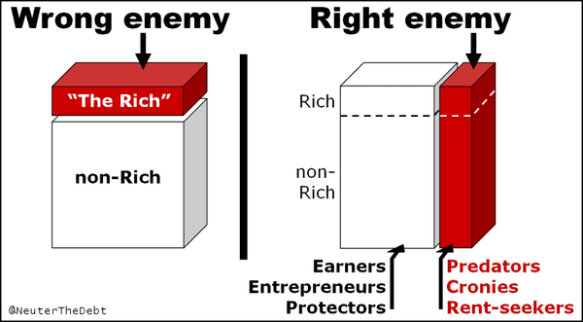
wrong enemy right enemy

From a very insightful post with a very insightful diagram: The Right Kind of Class Warfare: Workers vs. Looters.

What makes this image so helpful is that it’s true. If you look at the “right enemy” part of the image, the rich in the red zone are the cronyists who get Ex-Im subsidies, the Wall Street crowd that fed at the TARP trough, and other well-connected folks (like Warren Buffett) who use government coercion to line their pockets.

It’s the difference between value adding and waste.

[Via Instapundit]

The Obama legacy – international division

There is nothing, either domestic or international, that has not been made worse by the Obama presidency. This is from The New York Post that deals with the international side: A world aflame: Obama aides debunk the boss’s happy talk. There is much more than this, but this is quite good enough:

“Violent extremists are operationally active in about 40 countries. Seven countries are experiencing a collapse of central government authority, 14 others face regime-threatening or violent instability or both, another 59 countries face a significant risk of instability through 2016,” Clapper said.

“There are now more Sunni violent extremist groups, members and safe havens than at any time in history.”

That’s quite an achievement. We can talk about the domestic stuff some other time.

So where now?

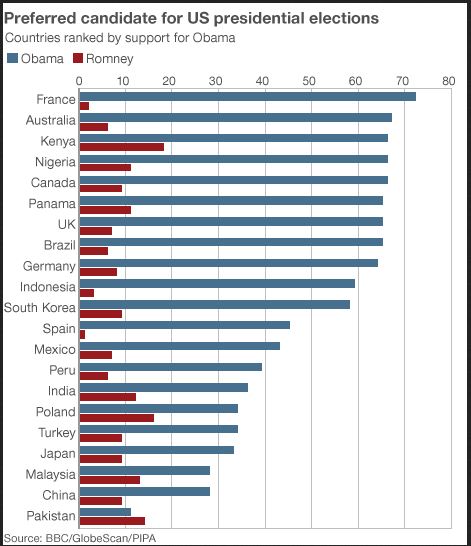
I have often thought of this post, Obama in the lead 68-7 – in Australia. It is the results of a round-the-world survey conducted by the BBC on how different countries would have voted in the American presidential election in 2012. The results were published right at the end of the campaign. And in Australia: Obama 68% – Romney 7%. The data are there at the end. They still look as gruesome as any set of data I have ever seen.

This, mind you, was after Obama had been president for four years. The world was disintegrating, but nowhere near the level it has reached today (see the story above on The Obama Legacy). Yet, I doubt that were the question raised again that there would be much regret among the 68%. Obama would still win an American election in Australia, perhaps he would even still win in the US.

My point. I seem to see political issues in a different way from most Australians. I regret Donald has not got quite the needed polish to go all the way, but no one else can make the difference he could. He ruined himself in his criticisms of George Bush and the Iraq war in the debate on the weekend. He is a New Yorker who inevitably reads The New York Times and watches NBC. Ted Cruz is right that Trump has “New York values”. He has seen how colossal his mistake has been but it’s now, I think, too late. If he wins the nomination, which he still might, although the odds have lengthened a long way, he will no longer have the support of the bien pensants, many of whom would vote for Hillary or Bernie instead.

And while we don’t elect presidents in 2016 to deal with the problems we faced in 2001, the continuity is crucial. He may even have opposed the war in Iraq, and given how things have turned out, he may even have been right to do it. No one contemplating on what to do after 911 could possibly factor a Barack Obama presidency into a Middle East policy from 2009-2017. Everything achieved has been thrown away, and matters made infinitely worse. The world I grew up in is disappearing. Something different is emerging. There will always be an elite – go to the poorest nation on the planet and there you will find an elite living extremely well – but for the rest, neither peace nor wealth nor freedom.

But who knows? Nothing is certain. 2030 is as far from us now as we are from 2001 so maybe things will turn around. I’m sure serfdom didn’t look all that bad to the serfs.


From Around the World Who Would You Vote For?

October 2012

us election in 2012 preferred candidate

It’s enough

The choice of who to support for president has never been more difficult. Trump is wildly different from the norm – another Andrew Jackson. He will be hated by everyone on the left, but he also is not liked or respected by many within the Republican establishment and those whose support he will need.

He may have had what is required but he may also not have the mental discipline, never mind the background knowledge, to do what’s needed. Trump might have been able to do what’s needed but you can’t do it by alienating everyone in your path. A leader brings people together. A businessperson makes everyone do what they want because a decision has been reached. And his sensational thin skin is a massive worry. And now with the death of Antonin Scalia, only one of a number of Supreme Court justices who might end up being chosen in the next 4-8 years, the stakes are extraordinary. You might be willing to compromise on a less adventurous president if it raises the probability that a Republican gets to choose.

With the appointment to the Supreme Court right there in the mix, there will be no doubting in anyone’s mind, that this is not just a decision for the next four years, but for the next 20-30 years. Everything about the future of the US will be in the mix. And while I think the Republican establishment is bizarrely out of touch – Jeb Bush is their chosen vehicle, for heaven’s sake! – I am hopeful that there will be a coming together among the candidates about what must be done.

The major impression I received in listening to Donald Trump at the debate in South Carolina was that he has spent too many years reading The New York Times. It is what Ted Cruz has said, about Trump being infused with “New York values”. I’m not sure it was the best way to put it, but I knew what he meant. There is a smarmy left-liberal condescension towards any other way of thinking that is tearing down the world we have built. We live in the freest, most tolerant society that may ever have been, but that freedom is being ground to dust by a liberal intolerance that if left unstopped will be our ruin. I thought Trump might have done something to stop it, but I am becoming less sure he can. I don’t think anyone else can, so I will just have to wait on events.