Some friendly advice on tax reform

Tony Abbott offers advice to Malcolm Turnbull on tax reform.

“Changing the tax burden from income to spending makes sense but only if overall taxes become lower, simpler and fairer.”

“As a potential reformer, Malcolm Turnbull has the advantage of being relatively unbound by previous commitments but still faces the problem of how to deal with the “no one can be worse off’ mindset that makes serious reform so hard.”

“The real challenge, in Australia as in Britain, is how responsibly to spend less on short-term consumption and more on long-term investment in infrastructure and national security.”

There’s more than just tax at the link as well.

Global warming and free speech

From John Hinderaker at Powerline, estimating that 27% of Democrats are totalitarians:

Rasmussen Reports asked likely U.S. voters whether the government should criminally prosecute those who don’t go along with the global warming scare. This was the precise question:

Should the government investigate and prosecute scientists and others including major corporations who question global warming?

In response, 27% of Democrats called for prosecuting global warming realists. (Remarkably, 11% of Republicans did, too.) Happily, 63% say the debate on global warming is not yet over, while 68% oppose criminal prosecutions. So that 5% difference must represent people who are in favor of freedom of speech.

No wonder that, as Rasmussen also notes, only 20% of Americans say that we enjoy “true freedom of speech,” while 73% “think instead that Americans have to be careful not to say something politically incorrect to avoid getting in trouble.” These are sad times for those who value liberty.

This story is paired at Drudge with this: Antarctic Ice is Growing, Even Hit a ‘Record,’ But Evening News Shows Hype Melting Arctic Instead.

Media outlets predicted an “ice-free” Arctic time and again, and so far have been wrong. But with all the panic about melting glaciers, or sea ice, or ice at the poles the media have reported, one would imagine good news about increasing ice would at least get some attention.

Not from the broadcast networks anyway. In the past year, they’ve ignored data showing increasing ice in Antarctica, presumably because it did not fit perfectly with their climate agenda, instead choosing to hype melting Arctic ice repeatedly.

The media is the message, or the absence of the message. Americans with their round-the-clock news coverage may be among the most poorly informed people on the planet.

The crisis of capitalism is caused by ignorance of history

capitalism is

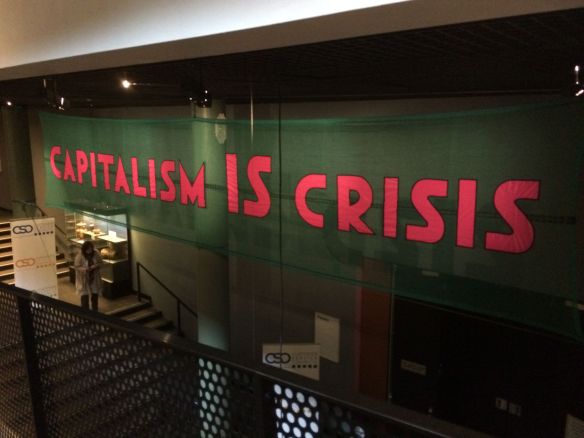
The photo is from The Powerhouse Museum which I took this afternoon where they are having an exhibition on protest. And it was in the museum cafe that I read Maurice Newman’s article on Malcolm Turnbull’s agile nation must avoid politics of envy. The article is about the kinds of thing that people in the second half of their lives are prone to understand, which are why the kinds of things they may have believed in the first half are so stupidly wrong. As he writes:

Why then, in this postmodern world, when we know that free enterprise has so spectacularly raised living standards and prolonged life for all, do we demonise it as uncaring, unfair and outdated?

Free market capitalism, like nature, may favour the resilient, the ambitious and the fleet of foot, but rather than celebrate self-interest and see wealth creation as a positive contribution to all society, we are conditioned by the Left, from school days on, to believe that social goals and the collectivist vision are more important than private choices; that without government intervention, most will be left behind.

This is our world. A top-down social-democratic state where elites are patronised, competition is controlled, where private initiative is stifled, free speech is abridged and where the electorate is increasingly state dependent. Here, big government colludes with big labour and big business to socialise losses at taxpayer expense.

Precious productive capital is wasted on school halls, pink batts, the National Broadband Network, futile subsidies and ordinary political aggrandisement. Loose fiscal and monetary policies give the rich relatively risk-free profits from speculative assets, while winner-take-all returns see a new breed of innovators and disrupters building tax- sheltered fortunes.

The media are filled with people who are the least likely to understand any of it but are most likely in a position to influence the rest of the community about the supposed evils of the market system. For those with few skills of an entrepreneurial nature, making their fortune as critics of the only society that has ever created wealth and freedom may give them a great sense of self-fulfilment and se;f-importance, but there are many societies that have been laid very low when people just like these have taken power. See Venezuela for a recent example.

Economics as physics

J.E. Cairnes back in 1888 stated that there was nothing that an economist could learn by using maths that they could not think through in words. I thought of this looking at a recent post from The Grumpy Economist on Open-Mouth Operations, that is, a discussion of the way comments by the Chairman of the Fed of themselves shift markets. This is the lead-in para to the model:

Our central banks have done nothing but talk for several years now. Interest rates are stuck at zero, and even QE has stopped in its tracks. Yet, people still ascribe big powers to these statements. Ms. Yellen sneezes, someone thinks they hear “December” and markets move.

And these are the maths behind his words.

Use the standard “new-Keynesian” model

xt=Etxt+1−σ(it−Etπt+1)
πt=βEtπt+1+κxt

Add a Taylor rule, and suppose the Fed follows an inflation-target shock with no interest rate change

it=i∗t+ϕπ(πt−π∗t).
i∗t=0
π∗t=δ0λ−t1

Equivalently express the Taylor rule with a “Wicksellian” shock,

it=î t+ϕππt
î t=−δ0ϕπλ−t1.

In both cases,

λ1=(1+β+κσ)+(1+β+κσ)2−4β‾‾‾‾‾‾‾‾‾‾‾‾‾‾‾‾‾√2>1

Yes, this is a special case. The persistence of the shocks is just equal to one of the roots of the model. Here δ0 is just a parameter describing how big the monetary policy shock is.

Now, solve the model by any standard method for the unique locally bounded solution. The answer is

πt=δ0λ−t1,
κxt=δ0(1−βλ−11)λ−t1
it=0
cochrane

This is how policy is now discussed and determined. But do note the equilibrium that comes out of it. Just don’t ask me to explain what you have just read so which is why I will let the author do it:

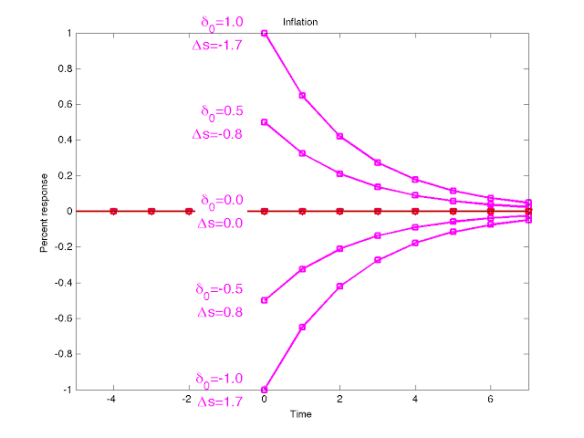
And here is the path of output. In each case δ0 in the graph gives the size of the monetary policy shock. It’s also the size of the inflation jump at time zero induced by the monetary policy shock.

Watch this mom, no hands… Interest rates do not budge throughout the episode. The Fed announces a monetary policy shock, and inflation moves just enough so that the systematic part of monetary policy offsets the shock, and Fed doesn’t end up actually doing anything! We get the traditional results of monetary policy — lower inflation and lower output, for example — based just on talk!

If you’re inclined to this sort of model, you might want to pursue this sort of solution as a model of our current “open-mouth” regime.

This is too far for me to go. It gives up on traditional “monetary” policy. “Monetary” policy is here pure “multiple equilibrium selection” policy. The Fed makes a different set of off-equilibrium threats and we jump to a different one of multiple equilibria. Interest rates are completely irrelevant to the standard effects of monetary policy here.

So I view the calculation as an indication of fundamental problems with the model I wrote down above, a reductio ad absurdum. But others may want to take it seriously. Hence the “thesis topics” tag.

Granted, the standard view of open mouth operations is that Fed statements change expectations of future interest rate paths — actual, observed, equilibrium interest rate paths, not these shocks which are offset by inflation. But sooner or later rational expectations have to kick in — you can’t endlessly promise interest rate changes that never happen. So the open mouth operation is an interesting limit, in which statements about interest rates matter, but the Fed never has to actually do anything about interest rates.

Also granted, I don’t have a better model of why markets move so much on Fed chatter.

The Δs numbers index how much fiscal policy must cooperate in each case. If there is a jump down in inflation, that means greater value of government debt, and fiscal policy must raise surpluses by the indicated percentage. For the fiscal theory of the price level, these paths are then paths that happen when there is a pure change of fiscal expectations, and the Fed does nothing about monetary policy. I find that a much nicer interpretation.

Reserve Bank of New Zealand Governor Donald Brash coined the word “open mouth operations,” observing that he seemed to be able to move interest rates by simply talking, without conducting open market operations. This is a second level of open mouth — here the Fed can move inflation itself just by talking.

So do statements by the Chairman of the Fed affect the inflation rate, and if so how, and if not, why not? But more to the point here, whatever you personally believe, do you need the maths and the model to explain your conclusion?

Wondering where all the productivity has gone

From John Cochrane, where he begins by setting out the problem to be solved:

Sclerotic growth is the overriding economic issue of our time. From 1950 to 2000 the US economy grew at an average rate of 3.5% per year. Since 2000, it has grown at half that rate, 1.7%. From the bottom of the great recession in 2009, usually a time of super-fast catch-up growth, it has only grown at two percent per year. Two percent, or less, is starting to look like the new normal.

Small percentages hide a large reality. The average American is more than three times better off than his or her counterpart in 1950. Real GDP per person has risen from $16,000 in 1952 to over $50,000 today, both measured in 2009 dollars. Many pundits seem to remember the 1950s fondly, but $16,000 per person is a lot less than $50,000!

If the US economy had grown at 2% rather than 3.5% since 1950, income per person by 2000 would have been $23,000 not $50,000. That’s a huge difference. Nowhere in economic policy are we even talking about events that will double, or halve, the average American’s living standards in the next generation.

And then he makes the central point:

Over long periods of time, economic growth comes from one source: productivity, the value of goods and services each worker can produce in a unit of time. . . . Nothing other than productivity matters in the long run.

All good, and probably known to all. But then there is trying to identify the nature of what has been holding productivity back, and here I’m afraid he doesn’t quite go as far as he needs to. He has a list of also-run issues, in which he includes “fiscal or other stimulus programs”. If these are not part of the weed patch he describes, I don’t know what are.

Here is what I think the problem is. Governments think they can direct our resources more productively than businesses can, and what’s worse, that public spending will encourage business and business growth. It is surely not all of it but it is much of it. Public spending has a role to play, but governments are now spending our economies into the poor house. If you want to raise productivity, no answer that does not include cutting back on public spending will work.

The end is Nye

Things like the fact that the planetary temperatures have not risen in almost two decades are virtually unknown among those who think of global warming as a catastrophic problem. It is seldom stated, and nowhere someone of a warmest nature might casually go to read about the issues. How debate can ever be engaged remains a mystery since the exposure to facts such as these, required to temper the debate, never happens.

Which brings me to this today linked at Drudge: Bill Nye demolishes climate deniers: “The single most important thing we can do now is talk about climate change”. I was interested in the article from the headline since if he is to demolish those of a more sceptical nature, he has to actually address the kinds of things they say. Well, once again the article is filled with rhetorical flourish but no facts.

Not knowing who Bill Nye was I assumed that he was some deep intellectual, steeped in climate science. Turns out he is the American version of Tim Flannery.

William Sanford “Bill” Nye (born November 27, 1955), popularly known as Bill Nye the Science Guy, is an American science educator, comedian, television presenter, actor, writer, scientist, and former mechanical engineer, best known as the host of the Disney/PBS children’s science show Bill Nye the Science Guy (1993–1998) and for his many subsequent appearances in popular media as a science educator.

This is how he writes and this is about as informative as the article gets.

On Nov. 10, Bill Nye will release a new book titled “Unstoppable.” As only Bill Nye can, he uses the book to explain the science behind climate change, debunks popular myths, and asks readers to take action in their own lives to create a sustainable future. The book is shot through with optimism, but Nye has no illusions about what lies ahead. The message is simple: Climate change is real; humans are causing it; and we have no choice but to build a better and cleaner world.

With his expertise in mechanical engineering and talking to children, sounds like the ideal person from whom to get the facts.