
As Tim Blair so rightly says: The ABC knows when it is safe to mention religious affiliation.

As Tim Blair so rightly says: The ABC knows when it is safe to mention religious affiliation.
My thanks to Tel for bringing this to my attention. I Want to be a Consumer, a Poem by Patrick Barrington. Henry Hazlitt, in his Failure of the “New Economics”, quotes this poem, which can be viewed as a critique of Keynesian economics. Hazlitt wrote:
The natural consequences of the Keynesian economic philosophy were vividly portrayed by Patrick Barrington (two years before the particular rationalization that apeared in the General Theory) in his poem in Punch [Issue of April 25, 1934]
Some ideas are just in the air. The poem was written two years before Keynes got around to showing how well before his time this young lad was. From a Keynesian point of view, what is really socially wrong with his ambition?
I Want to be a Consumer
“And what do you mean to be?”
The kind old Bishop said
As he took the boy on his ample knee
And patted his curly head.
“We should all of us choose a calling
To help Society’s plan;
Then what do you mean to be, my boy,
When you grow to be a man?”“I want to be a Consumer,”
The bright-haired lad replied
As he gazed up into the Bishop’s face
In innocence open-eyed.
“I’ve never had aims of a selfish sort,
For that, as I know, is wrong.
I want to be a Consumer, Sir,
And help the world along.“I want to be a Consumer
And work both night and day,
For that is the thing that’s needed most,
I’ve heard Economists say,
I won’t just be a Producer,
Like Bobby and James and John;
I want to be a Consumer, Sir,
And help the nation on.”“But what do you want to be?”
The Bishop said again,
“For we all of us have to work,” said he,
“As must, I think, be plain.
Are you thinking of studying medicine
Or taking a Bar exam?”
“Why, no!” the bright-haired lad replied
As he helped himself to jam.“I want to be a Consumer
And live in a useful way;
For that is the thing that’s needed most,
I’ve heard Economists say.
There are too many people working
And too many things are made.
I want to be a Consumer, Sir,
And help to further Trade.“I want to be a Consumer
And do my duty well;
For that is the thing that’s needed most,
I’ve heard Economists tell.
I’ve made up my mind,” the lad was heard,
As he lit a cigar, to say;
“I want to be a Consumer, Sir,
And I want to begin today.”
I met with my publisher today and we briefly discussed a third edition of my Free Market Economics. It’s now on the agenda but distantly since I have pretty well said what I want to say. I bring this up for a series of additional reasons, and let me start with this much appreciated comment on a previous post:
Hi Steve
Off topic here (apologies Cats) but I wanted to congratulate you for finding an opportunity to slip the wonderful word ‘phantasmagorical’ into your book . To find such a word embedded within an economic text was a great little ‘Easter egg‘! I am about half way through and am thoroughly enjoying it. I only studied economics in high school but have always had more than a passing interest in the subject. Jump forward 20+ years and I am bashing my way through an MBA and found your book really relevant for my elective unit on ‘Entrepreneurship’, a great refresher on some of the base principles of the subject and a refreshing perspective on the functions of supply and demand in any economy.
Cheers Nathan
And then, also just today, there was this from a student who is studying from the book as part of an online course I run. He had a question to ask about a coming test, but then wrote this:
For the book, I have to say I really enjoy it and though I really hope you don’t mind in me giving some suggestions as such. Firstly just on the premise on the book i could see it being a love hate for some students just as it continuously goes through as an argument of sorts rather than laying down the facts as they should be, if you know what I mean. Not a dig just meaning that if it were more just this is as it is then we could just focus on that.
The second one is on the explanations for say’s law and the business cycles. I have kind of found for me in learning it I keep trying to apply it to real life as we should and ended up looking through all of the recessions in the past. And actually looking at them it makes the classical views blatantly obvious and correct even in the great depression where there wasn’t a reduction in the demand but that the economy was rapidly changing to the more modern economy with the setting of the public market for stocks. Not sure if I explained that quite right, though what I am getting at is if in the explanations or even in an assignment we were looking at what has caused every recession it would really hammer in the concepts of the book and prove that they in fact are correct and that Keynes is some funded by government full of shit fraud.
Again really enjoying the book now that I have got into it, just more on the output as I really hope it would become universal proof of the correct concept.
I will think about what I can do now that the issue has come up, but I have to say I am very reluctant to mess with the text again. It’s not perfect, but it remains the only anti-Keynesian textbook available anywhere in the world and there’s much else in it besides.

Political correctness does not work in this country, at least not yet. You can also find the cartoon – from The Australian today – on Tim Blair’s blog, where there is also the following comment from the Letters to the Editor in The Daily Telegraph:
After bringing in Muslim refugees and giving them free healthcare, free education, open-ended Centrelink payments, and priority public housing, we now have to pay for de-radicalization programs so they don’t kill us. Why can’t the Muslim community pay for this themselves via the money made from halal certification fees? Malcolm Turnbull is off with the fairies on immigration and national security matters – a slave to political correctness.
We have always been able to Australianise our migrants because we believe in our heart of hearts that we are superior to every other society on earth. Wherever you come from, it’s not as good as here. And not only do we believe it, it may actually be true. So to all those ungrateful migrants who feel so aggrieved that they can shoot police IT workers of Chinese descent dead on the street for some kind of bigoted racist jihadist reason, it won’t work on us, in spite of what our elites might like to pretend. Look at that cartoon, and ask yourself where else it might get published. I cannot think of another place on earth, and as long as we can do it, we will remain all right.
These people don’t get it. They just don’t get it. I want to write, “such idiots they are”, but I am much too polite for that. From Paul Kelly’s column today on Keating and Swan loom large in Bowen’s thinking:
“I am a Keynesian,” Bowen declares proudly. “I would take a Keynesian approach to fiscal management. We can’t rule out the need for a government to stimulate domestic demand sometime over the next decade.” It is an unambiguous statement of belief.
Given Australia’s lower economic growth and doubts about economic recovery, Bowen as treasurer resorting to fiscal stimulus would be a live option. It reminds us that Bowen is a politician formed by the 2008-09 global financial crisis and is a champion of the huge fiscal stimulus put in place by Kevin Rudd and Wayne Swan at that time. . . .
In his book The Money Men, Bowen rejects the main criticisms of the Rudd-Swan stimulus. While admitting the outcome was “imperfect”, Bowen says Swan was tested like no treasurer since Labor’s Ted Theodore during the 1930s and concludes that Swan, in relation to the GFC, “got all of the big calls right”.
The evidence of cloth between the ears never gets more evident than dealing with someone who actually sat in Parliament first through the Costello years and then through the years of economic management under Wayne Swan and thinks that Swan got it right. Those Costello years, when everything was going so well because the world economy was so placid. Like through the Asian Financial Crisis and the Dot-Com bust, you mean. They went well here because, for a change, we didn’t have a Keynesian in charge. How really out of it do you have to be to say this:
As Bowen says, Labor’s $46 billion second stimulus package of February 2009 triggered a debate that dominated “at least the next five years of Australian politics”.
It dominates us now because the deficits and debt will remain a problem for years on end. And now this clown wants to come back into government and add to the problems in the same way that they did the last time we gave them the chance. And if you really want to start to worry, try this on for size:
For Bowen, economic growth is the mission. He wants a competitiveness strategy “sector by sector”, says it is “not the job of Canberra” to determine where the new jobs come from but identifies the sectors that he sees as a priority and the skills deemed to be essential.
Picking last year’s winners is a tried and true strategy of failure, but back it will come if we give these people the chance to turn the Australian economy into the same kind of wreck that Obama has managed in the United States.
Among the many blessings Australia has that keep the economy trundling along in spite of international devastation is our central bank. It runs the most accurate policy of any bank in the world, and has refused to follow the fashion into zero rates of interest found elsewhere. Here’s the latest news: Interest rates: RBA refuses to blink, keeping cash rate at 2pc despite IMF downgrade:
The Reserve Bank has defied mounting global economic gloom, keeping interest rates on hold for the fifth month in a row and expressing confidence in APRA’s efforts to keep a lid on investment lending in the frothy Sydney and Melbourne housing markets.
As the International Monetary Fund downgraded its economic growth forecasts yet again, including those for Australia, Reserve Bank governor Glenn Stevens issued almost a carbon copy of his previous month’s monetary statement, whose tweaks if anything suggested even less desire to reduce the 2 per cent cash rate. . . .
“The available information suggests that moderate expansion in the economy continues,” Mr Stevens said, dumping last month’s qualifier of ‘most of’ and once again pointing to the strength of the jobs market. In the only other major change from last month, Mr Stevens suggested APRA’s efforts to dampen the growth of investor housing lending were “helping to contain risks that may arise from the housing market”.
The bit on the housing market even makes me think that if they were about to shift, rates would be going up. Sounds good. Low interest rates will kill you, as the US economy so clearly demonstrates, or at least it would if only there was am economic theory to explain why that was.
There is a very nice article in today’s Oz by Maurice Newman with the fairly accurate title, Coup takes credibility of politicians to a new low. It’s not so much politicians in general who are being dealt with but Malcolm Turnbull in particular. So it was with great interest that we find this at the end of the article:
Maurice Newman is a company director and former chair of the Australian Stock Exchange. He is the former chairman of the prime minister’s Business Advisory Council. The views expressed here are his own.
That they are the columnist’s own views was something I had always assumed up until now, but apparently wrongly. Clearly, they are not their own views unless we are told so, which with The Oz is something I now take for granted (with the honourable exceptions, other than Maurice, of Nick Cater and Henry Ergas). But to be so blatant about it does truly eat into the credibility of the paper. We are, at least in theory, supposed to assume that these are journalists who will say what they believe, come what may. You know, all that truth to power stuff.
And you know what else, given the editorial line of the paper nowadays, you can see why the column irritated them. He explains what a disaster the change has been, but then goes on to make a much more important point:
The Liberal Party coup has wider ramifications than a simple transaction swapping one leader for another. It is one more blow to the credibility of leaders and the moral compact between the government and the people.
It makes voters less likely to listen to pleas from government for noble sacrifices in the common good.
It suggests, absent a significant turnaround in our terms of trade, the tough decisions and long lead times needed for economic and fiscal recovery are likely to be defeated by the electoral cycle.
They will also be defeated because our new PM doesn’t have a clue what he’s doing. But he is very articulate in saying nothing much at all and taking credit for the things Tony had already put in place. As for the other things he has done, you should read the column to see why The Australian wants to wash its hands of what Maurice Newman has said.
Elite opinion is so off the planet that the evidence that high IQs are a form of stupidity is becoming more evident with each passing day. The latest evidence, this from Donna Laframboise:
The closer one examines the recent climate conference co-sponsored by the UK Supreme Court, the worse it looks. I’ve previously discussed the 45-minute keynote address given by Philippe Sands, in which that law professor urged international courts to “play a role here in finally scotching” non-mainstream climate perspectives.
But the video recording of that speech includes the remarks of three other individuals. Strung together, this is among the most terrifying 90 minutes I’ve ever witnessed. The event at which Sands’ speech was delivered was chaired by sitting UK Supreme Court Justice Lord Robert Carnwath. His opening remarks demonstrate that activist scientists have been joined by activist judges.
It isn’t possible to listen to Lord Carnwath’s remarks and conclude that, where the climate debate is concerned, he’s keeping an open mind. At the 5-minute, 12-second mark on the video he says the climate law conference was his idea.
You can watch the video at the link if you can bear it. Meanwhile, also from the UK, but this time with the focus on the Governor of the Bank of England:
Mark Carney’s warning that investors face “potentially huge” losses from their “stranded” coal, oil and gas assets has riled many in the investment community who believe the Bank of England governor has spoken out of turn. The chief investment officer of a large UK pension fund, who requested anonymity, agreed: “Mr Carney should stick to his mandate. Carbon policy is a matter for politics and government legislation, not the Bank of England.” Other investors also expressed scepticism about the stranded-assets theory, as well as the extent and the immediacy of the risks underlined by Mr Carney. –Madison Marriage and Richard Stovin-Bradford, Financial Times, 5 October 2015
Mark Carney believes that fossil fuels will soon become stranded assets, as the world will fall for the global warming scam and stop using them. Apparently, nobody told the Chinese! According to the IEA, they have been busy buying up all the global oil and gas assets they can get their hands on, and, as of last November, control 7% of worldwide crude oil output. –Paul Homewood, Not A Lot Of People Know That, 4 October 2015
Mark Carney, with wind turbine nailed to his forehead, has decided he doesn’t like hydrocarbons. Coal, gas and oil. He thinks we should probably leave one third of the world’s reserves of hydrocarbons right there where they are, in the ground. Leave it where it is and invest in what are euphemistically called renewables, which contribute 1% of the world’s energy needs. Right-ho, Mark — that’s the entire basis of the western economic system well and truly buggered, then. Hell, who’d have thought it: a banker doing his best to wreck the economy as a consequence of a latterly acquired arrogance. Nah. That’s never happened before, has it. –Rod Liddle, The Sunday Times, 4 October 2015
Geologically, the United States does not stand out in terms of shale resources. A very incomplete global mapping suggests a US shale oil share of no more than 17% of a huge geological wealth, widely geographically spread. Given the mainly non-proprietary shale technology and the many advantages accruing to the producing nations, it is inevitable that the revolution will spread beyond the United States. The global spread of these revolutions and the ensuing price weakness that we envisage for the coming two decades will, on balance, provide a great advantage both to the oil industry and to the world economy at large. The efforts to develop renewables for the purpose of climate stabilisation will become more costly, requiring greater subsidies, in consequence of lower oil prices. –Roberto F. Aguilera and Marian Radetzki, The Conversation, 5 October 2015
The 20 climate scientists and academics who sent a letter to President Barack Obama asking him to prosecute global warming skeptics may be in big trouble. A congressional committee is now looking into the government-backed nonprofit that circulated the letter, demanding they turn over “all e-mail, electronic documents, and data created since January 1, 2009.” The group has one week to respond in writing to the committee’s request. It seems like IGES’s effort to get Obama to prosecute global warming skeptics has completely backfired in the two weeks since their letter to the administration was published online. IGES has since taken down the letter and put up a message claiming the letter was “inadvertently posted” online. –Michael Bastasch, Daily Caller News Foundation, 2 October 2015
We know there is more carbon in the atmosphere, and we know there is a theory that says more carbon in the atmosphere leads to a rise in temperature. The only problem so far is that temperatures are not rising. Obviously a mere detail to people whose lives would never be disrupted by massive increases in the cost of energy, in the same way their lives will never be disturbed by a million refugees across Europe. So when I think of this:
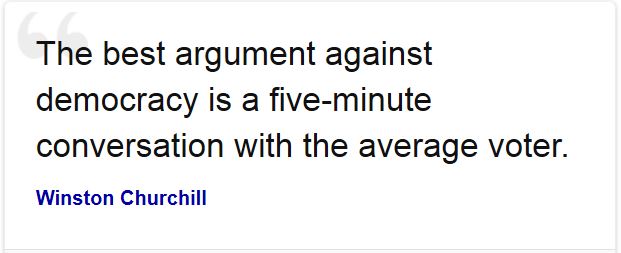
I think that’s all very well, but for someone who has spoken to his fair share of Members of Parliament, my version would be:
The best argument against democracy is a five minute conversation with an elected politician.
Ah yes, the worst system except for all the others that have been tried from time to time. But it is the same kind of elite opinion that today worries about climate change that once upon a time had Neville Chamberlain congratulating himself for achieving Peace in Our Time in 1938. Democracy at least has the benefit of making the majority complicit in their own downfall. Not much of a compensation, but it is something.
Well, there is this:
And then there’s this:
Violence intensifies in Jerusalem, West Bank, raising security concerns…
‘Back on the brink’…
Palestinians barred from Old City…
Netanyahu: ‘In fight to death’…
Three weeks of unrest…
And there is this as well:
Russia Intensifies Syria Bombing…
Assad forsees success…
Washington and Moscow can’t agree on definition of ‘terrorist’…
US Aims to Put More Pressure on ISIS in Syria…
PAPER: Putin sees Obama coolness as weakness…
And then, of course, there is the invasion of Europe:
Germany faces logistical nightmare as refugee inflows hit record
A logistical nightmare! It’s all just about transportation. From the story:
At the center in Berlin, asylum seekers, some of whom are sleeping outside, say they have been waiting as long as 25 days to register. With winter looming, the same frustrating delays are occurring in other cities across Germany.
“The biggest problem at the moment is the initial registration of people and providing them with the basics – that’s not working well in an awful lot of places,” said Rebecca Kilian-Mason, who runs a project in Munich that informs migrants about the asylum process in Germany.
The long waits to register are at the top of a list of problems that German authorities are wrestling with.
I guess once they are all registered the problems will come to an end.
The Leaders’ debates next year will be quite interesting. Here is Labor under the headline, Terror shooting: radical groups ‘prey on teens like pedophiles’:
Bill Shorten has condemned organisations that incite “criminal thinking” in vulnerable young people, comparing them to pedophiles who prey on Australia’s youth.
The Opposition Leader said he had “no time for organisations fermenting dangerous” ideas amid reports the 15-year-old who shot dead a police employee in Sydney on Friday attended the Parramatta Mosque before the murder, including for a service associated with the controversial political group Hizb-ut-Tahrir.
Farhad Khalil Mohammad Jabar is believed to have been radicalised through worshippers he met at the mosque where other teenagers are known to have sympathies for the terrorist group Islamic State.
Asked about the reports and if the government needed to take a new approach to this type of violent behaviour, Mr Shorten said: “If there are organisations in this country preying upon vulnerable young people, filling their heads full of murderous crazy nonsense, then those organisations are breaching their social contract with the Australian people.
Here are the New Libs via Greg Sheridan, who obviously has now also received the memo from central command to be nice to Malcolm:
Malcolm Turnbull has passed his first test as a national security leader after the shocking terrorist murder outside the police centre at Sydney’s Parramatta.
The essence of Turnbull’s wisdom here has been balance.
He has said essentially three things. The first, this is a shocking, cold-blooded murder and our thoughts and prayers are with the victim’s family and the NSW Police Service.
Second, this is an act of terrorism.
Third, no one should attribute guilt by association for this terrible act to the Muslim community or to any other Muslims individually. The need for dialogue with the Muslim community is not only to maintain social cohesion but also to help in efforts to counter the radicalisation of young people. Each element of these messages was necessary. To miss any one would have been to unbalance the response.
Turnbull’s response has won appreciation and support from each of the relevant audiences: the public generally, NSW police, security agencies and leaders of Muslim communities.
Turnbull’s government signalled in its earliest days that it was going to change the tone of the rhetoric it used in relation to terrorism.
No one could doubt Tony Abbott’s abundant goodwill in this area, but his rhetoric had become a little clunky, the constant repetition of the phrase “the death cult” was off-putting and some Muslim community leaders felt he had been a bit rough with them, in particular
in his remark he wished more Muslim leaders would say Islam was a religion of peace and mean it.In any event, numbers of otherwise moderate and mainstream Muslim leaders felt alienated and some degree of co-operation had declined.
UPDATE: From Tim Blair. If I didn’t know this was never something to make jokes about, I would assume this was satire of a very dark kind.
Malcolm Turnbull’s more conciliatory approach to the Muslim community doesn’t seem to be working:
The teenage gunman who executed a NSW Police Force employee has been lauded as a “hero of the Islamic people” on a tribute page set up on social media …
A Facebook page has since been established in the North Parramatta teen’s memory, labelling him the “hero of Parramatta”.
“Hero of the Islamic peoples he will be gratly (sic),” one post read.
“Death to the evil police state of Australia who killed this young child all he is guilty of was being muslim!!”
A photo of Farhad’s face with a screen grab of footage captured outside the police HQ of him holding his gun above his head is accompanied by the statement: “Inshallah we will kill all the infidels”.
Another post states: “It is no secret that Australia seeks to destroy islam and there is no choice for followers of allah but to defend themselves.”
I’m not sure, but this might qualify as some of that divisive rhetoric Mark Kenny is always crying about. And check the line from Nick Kaldas:
Asked about the page, NSW Police Deputy Commissioner Nick Kaldas said it was disappointing.
“Just as disappointing as the right-wing extremist material,” he said.
Sure, Nick. Because right-wing extremists always rejoice online when one of them murders a police employee.
 Law of Markets