
Conspicuous consumption in the twenty-first century

From The New York Times, what wealth really allows you to do today:

WHEN our family moved from the West Village to the Upper East Side in 2004, seeking proximity to Central Park, my in-laws and a good public school, I thought it unlikely that the neighborhood would hold any big surprises. For many years I had immersed myself — through interviews, reviews of the anthropological literature and participant-observation — in the lives of women from the Amazon basin to sororities at a Big Ten school. I thought I knew from foreign.

Then I met the women I came to call the Glam SAHMs, for glamorous stay-at-home-moms, of my new habitat. My culture shock was immediate and comprehensive. In a country where women now outpace men in college completion, continue to increase their participation in the labor force and make gains toward equal pay, it was a shock to discover that the most elite stratum of all is a glittering, moneyed backwater.

A social researcher works where she lands and resists the notion that any group is inherently more or less worthy of study than another. I stuck to the facts. The women I met, mainly at playgrounds, play groups and the nursery schools where I took my sons, were mostly 30-somethings with advanced degrees from prestigious universities and business schools. They were married to rich, powerful men, many of whom ran hedge or private equity funds; they often had three or four children under the age of 10; they lived west of Lexington Avenue, north of 63rd Street and south of 94th Street; and they did not work outside the home.

Instead they toiled in what the sociologist Sharon Hays calls “intensive mothering,” exhaustively enriching their children’s lives by virtually every measure, then advocating for them anxiously and sometimes ruthlessly in the linked high-stakes games of social jockeying and school admissions.

If a woman wants to show she’s made it, quit work and raise your children! No one else can afford it, certainly not amongst the educated classes. But if you can, you will be in a zone of your own.

This one’s easy – was she right or was Cormann right?

I don’t watch TV so I don’t have to put up with any of it. Helps me keep a perfect calm in the midst of life. But there’s the interview above, and here is her comment below:

Alberici said she doesn’t “understand the hoo-ha” about her post-budget interview with Finance Minister Mathias Cormann in which she accused the government of making up “nonsense” figures that “you continue to trot out”.

“I was just trying to bring facts to the table – that’s what we are supposed to do. I don’t think doing a challenging interview is biased. I think the opposite: we should be challenging everyone who is in front of us.”

The moment that matters is around 3:30. If she was right, then she has a point. If she was wrong, then she should apologise. In any case, she should be civil to a Minister of the Crown. Watching it for the first time, I have to say it was a perfectly normal interview and I thought Cormann answered everything as well as one could hope. But arguing about budget facts is unfair, since no one watching will know one way or the other.

But the question remains: who was right about the figures?

THE ANSWER: The answer that has most satisfied my curiosity was provided by Ray. A fine piece of investigative journalism, unlike the sort of common garden invective dished up by the ABC.

Cormann quoted a figure of $667 billion. Alberici said that was made up and the correct figure was $370 billion. However, the only reference to $370 billion I can find in PEFO is the projected face value of Commonwealth securities as at 2016-17. The $667 billion reference from Cormann relates to the projected face value of Commonwealth securities in 2023-24. Since PEFO contained no estimate for this out to 2023-24, Alberici has no basis to her claim that Cormann was wrong.

By the way if we really want to compare apples with apples, MYEFOs projection for the face value of Commonwealth securities in 2016-17 was $440 billion.

The Economist still thinks our economic problems are due to a shortfall of spending!

economics hides its head

Like so many others, I have the answers to the dilemma economic theory is now in. My answers centre around the classical economics that was the core of theory before Keynes brought ruin to the heart of economics with his General Theory. Clear as a bell to me the havoc this has caused, but there are other views as well, some of whom, according to The Economist, are put forward by other economists as part of their blogs. Here’s how I can tell that most of the bloggers and economists they focus on are absolutely wrong:

America is suffering from a shortfall of spending. Both market monetarism and the neo-chartalists are right about that. They disagree about whether the best response is monetary or fiscal. The market monetarists argue that fiscal stimulus should be redundant, because a central bank can always revive spending—if it sets its mind to it. If the Fed’s efforts have disappointed, it is not because market monetarism is wrong, but because the Fed is not sufficiently committed to the cause. [my bolding]

Of course, both monetary and fiscal are important: the imperative is to raise interest rates and cut spending. But I don’t think that’s what they mean.

See how fortunate you are to be able to come to this blog and find out what is wrong and what to do. The problem is that both central banks and government spending are diverting our very scarce productive resources into a series of wasteful outcomes that are making us progressively less wealthy. The gross stupidity of thinking that the cause of our currently slow rates of activity and high levels of unemployment is a shortfall of spending shows that the curse of Keynes is going nowhere soon.

[An article from 2011 sent to me from a friend for comment. Economics is not about to change is my only answer.]

Running on MT

Watching Malcolm Turnbull defend the ABC on Bolt is the final straw. Who on our side of politics does he represent?

He is defending the ABC in its vicious and lying attacks on The Coalition! The ABC is not called to account! The ABC is publicly funded. This is not competition! It’s not there based on ratings success.

If that is the best he can do, he has lost us all.

And after the break: Q: Have you ever been a conservative?

A: Yes, BUT. Conservatism is a process. It is an approach. It is not being reactionary. Conservatism seeks to reform in an organic way. Wishes to have a strong link to the shore even as we set out to sea.

Q: Climate change? Four problems with the consensus.

A: I’m not doing pick-a-box. My position on GLOBAL WARMING. Greenhouse gases affect the climate. Many think this will be a problem. There is doubt about the rate. Any sensible personal has to have scepticism. We should take a prudent cautious approach, to reduce greenhouse gases.

Q: Freedom of speech.

A: Plenty of scope already in the Act for debate. There was a general consensus to remove the words humiliate etc. The proposals that the government produced went beyond that. The government went further than it should have. Need to get the right balance.

Q: How different is the govt today from when you tried to topple Abbott.

A: I don’t accept the premise of the question. We now have a good budget, and a united government.

Irrational voting

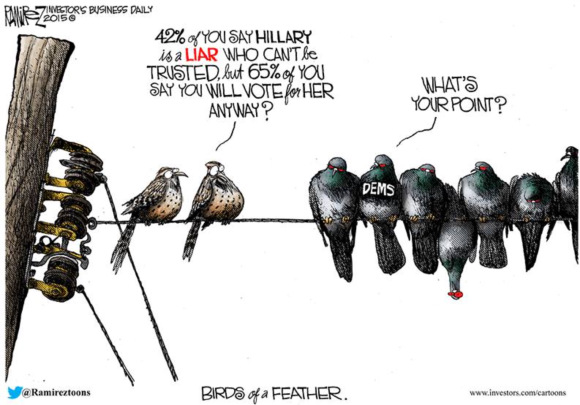
democrat birds

The cartoon makes the point I am not quite able to in words. What cannot be explained is this: that it makes no difference to a voter on the left that their own country might end up like Greece of Venezuela. Voting for the left is an emotion largely based on hatred and not hope because it cannot be in any way based on a rational desire for a better future.

Australia’s supply side revolution

I don’t mean to be pedantic – well I guess I do mean to be pedantic – but the problem with bracket creep has nothing to do with whether the economy will recover. The increases in personal taxes are the necessary requirement to pay for all of the expenditures loaded on the economy by Labor. As the story says, Employees lose $25bn to creep as Labor blamed for blocking savings. Everyone will have to chip in to pay for Labor’s waste, and so, those annual personal tax cuts that Peter Costello used to deliver, are for the future. But here is where I wish to differ:

Treasury secretary John Fraser­ warned last night that fiscal drag was “a worry” that needed to be addressed and higher taxes would hurt growth.

The one thing that won’t be hurt by a gently rising personal tax burden is growth. The pervasive Keynesian mindset where the economy is looked at from the demand side, and that it is consumer demand that drives 60% of the economy, and et cetera, is just plain wrong. Just keep reducing public service waste, get that budget back into surplus, do everything you can to make the private sector grow, and it will all take care of itself. And under no circumstances let “aggregate demand” enter into any part of the policy matrix. It is value

The budget – even better one day later

As I was picking up the paper this morning, my wife said to me, it’s just like reading The Age. You may be sure she did not intend that as an encouraging sign of the times. I fear I have to agree, at least to some extent. But there were areas of redemption. The truest words on the budget commentary were by Mark Latham:

It’s all about dickheads talking about stuff they know nothing about — that’s what it’s about.

Certainly when I read (well, glanced through) the diatribe from Niki Sava, it was discouraging. Seriously, she is moving into the spot vacated by Michelle Grattan. It did take the government, and not just Joe Hockey, a year to work out that the only way to get the deficit down is to grow the private sector around it. And they finally removed the Keynesian head of Treasury and brought in John Fraser which probably has made a world of difference. I don’t know why she focuses on personalities, but with her Malcolm Turnbull fandom, nothing will satisfy her blood lusts, it seems, not even a really together budget that works economically and politically.

More to my taste was the article by the CEO of the Council of Small Business of Australia, Hockey’s ‘small-business budget’ perfect for the sector. Here is someone who know that perfection nowadays almost entirely consists of “didn’t make things worse, and perhaps made them a bit better”. I’ll give you his last two paras and you can read the rest for yourself:

The depth of announcements in the budget shows the government understands it is the little changes that make a difference. The small-business person’s capacity to start up, operate and, if desired, expand their business has been enhanced. The whole business life cycle seems to have been covered.

Overall this has been a great budget for small business and for the economy.

This is not some side-line observer but a representative of the people who are going to make the difference in how the economy goes. There is a terms-of-trade shift putting money into the hands of business. Keynesian theory also pretends that it is doing the same, except that to get the money, businesses must hand over the things they produced to people who are busy digging holes so they can be refilled. The net is not all that large for any firm nor is there any net addition to the economy. What the government has done is inject after-tax cash flow straight into the hands of producers. If you go to my second edition, right there on page 359-361 is the list of what a government should do to revive and economy. Number one reads: “priority should be to lower taxes, especially on business.”

As for the coverage by the ABC, I have only Andrew Bolt’s word for it since I never watch myself, but if his observations are anything like the reality, and I have no reason to doubt it, there are huge savings to be made on the budget bottom line that are begging to be made. If there is anyone at Cabinet level still protecting this hopeless bunch of leftists from a day of reckoning, they should be taken out, have their epaulettes removed, and sent off to be ambassador somewhere properly remote.

Nice budget

It’s none of my business, really, but I quite like the budget. I teach Tuesday nights and don’t get home till too late so only get a vague sense on the night. Today the stories are filtered through the media so I have to decide whose judgements I will trust. Fact is, I don’t trust any of them, but this was my favourite. From Ross Gittens:

This is the budget of a badly rattled government that has put self preservation ahead of economic responsibility.

So what does this economic guru think is missing?

The biggest miss is increased spending on infrastructure, mainly because the Reserve Bank’s interest rate cuts are becoming ever less effective in getting the economy moving. Increased infrastructure spending would not affect the main medium-term objective of eliminating the recurrent budget deficit.

Such Keynesian mind-swill! The economy will turn around, ever so slowly. But to be surprised that lower interest rates provide no momentum to an economy is merely to demonstrate a lack of understanding how an economy works. And then to think that more infrastructure spending – NBN? pink batts? BER? – is needed makes me wonder whether it is ever possible to learn from the failings of the past.

To be surprised that the budget is a political document designed to get a government re-elected is kind of odd, a perspective shared by Paul Kelly, Budget 2015: Real aim is to save the Coalition. I’m all for budgets that edge the economy towards improvement. We are getting closer to the next election, and personally, I don’t want our economic problems solved before then. Costello left behind an economy of such golden prospects that it required all the ingenuity of Rudd-Gillard-Swan to ruin it. But they did. Why fix it right away so that the Shorten-Plibersek hammers can be applied. Let them fight the next election about how they would fix what is wrong, specially if they try to complain about the deficits they created and would not allow to be fixed.

Everything about the budget was aimed towards value adding. Almost no freebies for the non-working, non-productive. Almost everything is designed to encourage businesses to produce and invest, and for individuals to work and earn. The deficits can wait for after 2016.

And I just might mention this story from The Age which I also think is a portend in the right direction: Wages grow at slowest pace since ABS began quarterly records. It’s still 2.3% so not nothing, but also not rising as we would like. But it requires productivity to rise for real wages to rise. That is being nurtured. A very well structured budget that deserves the success that I am hopeful it will have.

Salvaging what we can

There are many mad voters in the US which I define as anyone who voted for Obama twice. But this new blog by Roger Simon, Diary of a Mad Voter, is focused on the next presidential election, which doesn’t happen until November 2016. We will be voting before that, but there is not the same kind of obsessive interest this far out. But we are blessed with a Parliamentary system and do not elect a president.

The post I opened when I got there was by Richard Dreyfuss, yes THAT Richard Dreyfuss. It is about Election Coming: Nobody Knows Anything. Translation, the American voter is so dumbed down by the education system that they are largely too poorly informed to vote in any sensible way.

Our values are not transmitted genetically; they must be taught. They’re not. We’re asked to make choices between political parties that have ceased all rational intentions to communicate their stand on issues with any clarity. We live in an hypnotic trance of inaction because we aren’t taught how to run the nation, that we as a people are the highest sovereign power, that we can and should hold villains accountable.

Voting doesn’t make you a better citizen, comprehending the issues makes you better. Voting without that makes us all suckers.

With Kindergarten versions of fairness now the standard, is it any wonder. Anyway, it is a blogsite you might wish to visit if viewing the American election is of any interest to you.

BTW this was picked up at Powerline. where it is written, “Roger says, that the 2016 election is “THE MOST IMPORTANT ELECTION EVER!” It’s not. We already had that one in 2012. The next one is just a salvage operation, but repair, I think, is impossible.

Knowing the price of everything and the value of nothing

picasso

This has sold for $179 million. What I have never understood is that if I buy a perfect print of this same painting and hang it in my house, or better, get a hand-painted copy, and pay $179 for it, what the person who now bought the painting gets for the million times more they paid for the original than I get for the copy. And there must have been at least one other person who was willing to go to $178 million for the price to have gone that high.