How not to reform economics

Even though I end up disagreeing with what he wrote, Tim Thornton had a quite interesting article in The Age the other day which I have just written a comment on for Quadrant Online. His article was on “The Problem in the Way we Teach Economics” which led to my own response, The Real Problem In Teaching Economics. But Tim’s article is not really about what we teach but about the nature of textbook economic theory, and going on from there, deals with the kinds of economists our way of teaching economics produces. He lists three problems:

Firstly, there is generally no required study of economic history or the history of economic thought. . . .

Secondly, contemporary economics students will rarely encounter any of the schools that compete with the neoclassical school. . . .

Thirdly, the curriculum fails to incorporate crucial insights offered by other disciplines such as politics, philosophy, history, sociology and psychology.

Fair enough. But what Tim wants to do, if he cannot get satisfaction from the mainstream, is start up an alternate school from which a new generation of economists can be grown. And given that he wants to call his new discipline “political economy”, there is little doubt from whence he is coming. As I write at QoL:

Typically, those who would like to root out our modern neo-classical inheritance do so for some quasi-Marxist reason. They are seeking answers to different questions. Their interest is in explaining the distribution of power within a society. This is, of course, politics or sociology, but it is not economics, since even if you knew the answer to any of the questions a political scientist or sociologist might ask, you still wouldn’t understand how goods ended up being produced, what economic structures give you the greatest output, how the community’s command over goods and services could be increased, what to do in recessions, or even what causes recessions in the first place. Instead, what would be taught is some variant on the unfairness of the system and how it needs to change to ensure those who have the least wealth, which typically means those who have contributed the least to our communal flow of goods and services, can get a larger share of the pie.

There is all too much so-called economics around at the moment which presupposes capitalist growth and economic prosperity from which it seeks to extract some kind of rent on behalf of some nominated favourite group. But if they do not understand as a matter of first principles that the only way to run an economy is to have private entrepreneurs running their individual businesses, with as little government interference as possible in what they do or how much they earn, they have no genuine solutions to any actually existing economic problem. So far as understanding how an economy works, it is not only hard to see any value in shifting in the kinds of directions they propose, it is quite easy to see quite a bit of harm.

Das Kapital in the Twenty-First Century

The issue of inequality of wealth is the last refuge of the left. All of the other issues raised through the years – the immiseration of the working class, the crisis of capitalism, world revolution etc – have come to nothing. There is not a single issue raised by the left that has ever had any historical validity, Inequality is the last baton to beat the drum with and they are beating it as hard as they can.

Capital in the Twenty-First Century by Thomas Piketty written in French and now translated into English has weight of pages to compensate for the weightlessness of the argument. The politics of envy are an old story.

Cass Sunstein discusses the book under the quite sensible heading, What’s so wrong with economic inequality? What’s wrong, indeed?

Inequality of wealth is almost irrelevant to the core issue of production and income. Take the example of someone building and then owning an apartment building with 100 apartments put out to rent. If you want to look at it in terms of inequality of wealth, one person owns 100% of the capital and the, let us say 100 renters, have no capital. But the 100 renters also have a place to live, and if there are other apartments available to hold down rents, where’s the problem? As Sunstein writes:

Thomas Piketty’s improbable best-seller, Capital in the Twenty-First Century, has put the question of economic inequality into sharp relief. As just about everyone now knows, Piketty contends that over the next century, inequality is likely to grow. In response, he outlines a series of policies designed to reduce wealth at the very top of society, including a progressive income tax and a global wealth tax.

But Piketty says surprisingly little about why economic inequality, as such, is a problem. He places a lot of reliance on his epigraph, which comes from France’s Declaration of the Rights of Man and the Citizen: “Social distinctions may be founded only upon the general good.” To say the least, that is a highly controversial proposition. With respect to economic disparities, nothing of the kind can be found in the US Constitution, or the Universal Declaration of Human Rights, or even the International Covenant on Economic, Social and Cultural Rights.

The entrepreneurial drive is like any human trait, unequally distributed across the population. But like many other social abilities, it is good for us all that some few amongst us have them. That some who have such abilities get rich as a result is no different than the wealth that can come to actors, athletes, writers and others. But in this case, the benefits to the rest of us are so immense, our gratitude should be boundless. Alas, the politics and economics of envy never rests.

Fixing economics

There is an article by Tim Thornton in today’s Age with the title I might have written myself, The problem with the way we educate economists. He thinks the problem is neo-classical economics which is the standard mainstream taught to everyone who seeks to become an economist. In saying he doesn’t like the way we teach economics, he is really saying he doesn’t like the standard theory found today or more particularly, the quality of the economics profession itself. These are the three problems with the way we teach he lists which are problems with the people who make economic policy:

Firstly, there is generally no required study of economic history or the history of economic thought. This produces graduates with dangerous levels of historical amnesia in regard to the world and to the discipline they assume they understand.

Secondly, contemporary economics students will rarely encounter any of the schools that compete with the neoclassical school: institutional, post-Keynesian, behavioural, Marxian, Austrian, feminist or ecological. These economics schools, which come from all points of the intellectual and ideological compass, make crucial contributions to building up our understanding of a complex and ever-changing economic and social world.

Thirdly, the curriculum fails to incorporate crucial insights offered by other disciplines such as politics, philosophy, history, sociology and psychology.

With any discipline what you teach depends on the question you want to answer. If you are interested in knowing how goods and services end up produced, incomes earned and output distributed, neo-classical theory is pretty reasonable. I say this even having major differences with the mainstream. The course I teach and the book I wrote cover all three of issues raised. I embed my course in history and the history of economic thought. I contrast modern theory with its classical alternative so no one comes away thinking there is only one answer to any question. I introduce politics, philosophy and history, although I must admit seeing little value in either sociology or psychology in answering any of the questions economists have traditionally asked.

Typically, those who would like to root out our modern neo-classical inheritance do so for some quasi-Marxist reason. They are seeking answers to different questions. Their interest is in explaining the distribution of power within a society. This is, of course, politics or sociology but it is not economics since even if you knew the answers to any of the questions a political scientist or sociologist might ask, you still wouldn’t understand how goods ended up being produced, what economic structures would give you the greatest output, how the community’s command over goods and services could be increased, what to do in recessions, or even what causes recessions in the first place. Instead what would be taught is some variant on the unfairness of the system and how it needs to change to ensure those who have the least wealth, which typically means those who have contributed the least to our communal flow of goods and services, can get a larger share of the pie.

Economics emerged as a separate study over two hundred years ago when our societies were extremely poor as they had been since the beginning of time. Now we, who live in economies where markets predominate, are astonishingly wealthy by any and every standard that an economist two hundred years ago might have listed as an aim and ambition. And because of the innovation machine that has been set in place by these same economic structures, we have a reasonable expectation that our wealth will continue to grow.

If someone has a better answer to the questions economists wish to answer, then they must convince other economists first. To take your ball and bat and go off somewhere else may make it easier to find someone to agree with what you say, but then you are talking into an echo chamber of your own construction. There is lots wrong with economics – lots – but to ask for a separate discipline, or encourage a schism within economic theory because you have a different view, is not the way these issues will ever be resolved.

But where I can overwhelming agree is that the economics establishment has built an edifice as strong and formidable as the one built by mediaeval theologians. The answers it gives to many questions seem wrong to me and many others. I hate to show disrespect to Her Majesty, but when she asked after the GFC why no one had forecast the recession, she was asking a question for which there will never be a solution. Recessions happen and it is precisely because they are unexpected that they turn out so badly.

What economists can, however, do is explain why that is, and try to provide answers on how to recession-proof our economies as best we can and hasten recovery when they turn down. Neo-classical theory, being drenched in Keynesian structures, will unfortunately never be able to find the answer to either question which is why a genuine review of economic theory and policy is so urgently required. But because a bunch of twenty year olds are dissatisfied with the answers that modern economic theory has devised is the worst possible reason for looking out for new answers to old questions, which in their case really turns out to be looking for old answers to different questions.

Is that a good thing or a bad thing?

This is from Laura Tingle as part of her opinion piece on the budget in today’s AFR:

In the short term, the lack of fiscal consolidation, underpinned by increased taxation, makes the Abbott government look like a bunch of girls.

The consensus at lunch was this was meant to be a derogatory comment. If so, Australia is the last English-speaking country in the world where this would be allowed to happen. And they call Abbott a misogynist.

Miss me yet? – well it depends on who you mean

george bush miss me yet

Notice they don’t use a picture of Kevin in our local “Miss Me Yet?” meme. But the absurdity of these people, not only in their lack of originality but in where they take their imagery from, is astounding. Personally, I don’t miss the boats, the debt, the waste, the shrillness or the policies. On the other hand, I do miss George Bush.

julia gillard miss me yet

UPDATE: Now if ever there were a natural insect repellent, this is it. Uncovered by Sinclair, this can only be a parody:

kevin rudd miss me yet

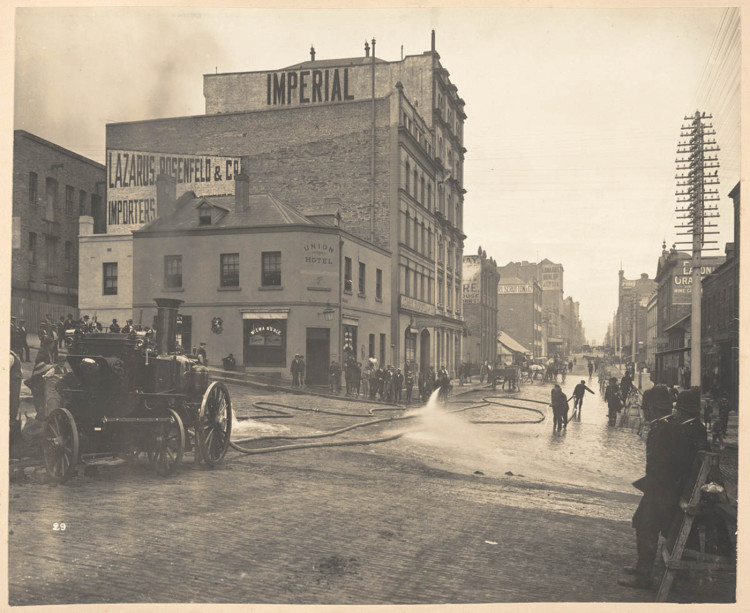
Bubonic plague in Sydney – in 1900

sydney bubonic plague

Did you know we had ever had bubonic plague in Australia? This is the story with pictures of how Sydney was cured of the plague in 1900. There are others pictures besides the one above. The text:

“When bubonic plague struck Sydney in 1900, George McCredie was appointed by the Government to take charge of all quarantine activities in the Sydney area, beginning work on March 23, 1900. At the time of his appointment, McCredie was an architect and consulting engineer with offices in the Mutual Life of New York Building in Martin Place. McCredie’s appointment was much criticised in Parliament, though it was agreed later that his work was successful.”

Politically a very nice piece of work

Economically the budget is hastening slowly. The trend is right and really is a matter of taste. I wouldn’t expect any serious revival before 2015 but this has hardly been the savaging everyone was talking about. After 2015 it sets us up for a quite good recovery. As with everything in economics, there are so many unknowns of the known and unknown variety that nothing can be certain. But it puts us in a good position to catch any passing wind.

Politically, however, it looks even better. I teach of a Tuesday night so don’t get home till late and had to catch up by watching ABC News 24. And what struck me was the extent to which the critics were pretty subdued. No real heavyweight venom and anger, just the usual negativity about trying to repair what everyone knows needs repairing. We are the lucky country in the sense that the harder we work the luckier we get. Just as in 1931 the Lyon Government cut deeply into public spending allowing Australia to be the first economy in the world to emerge from the Great Depression, so the cuts and crafting of expenditure this time round will allow us to put ourselves on a very solid foundation for growth.

Even the supposed nasties, listening to some woman worrying whether she might be able to find the $7 to get to the doctor came across as a pretty weak and whiny complaint. The co-payment is designed to make you think twice in a way that a freebie doesn’t. For 98% of the country, if your illness isn’t worth paying $7 for the medical advice you get, you either have your priorities wrong or you have been wasting a lot of our precious medical resources because you’ve treating them as a free good. Well, it might have been free to you but not to the rest of us.

Same with cutting Newstart for the under-30s. Luckily again we are a community that doesn’t look benignly on living off the earnings of others although there are many still trying to expand this constituency. But what is more important is that it will mightily discourage many from a wastrel style of life. Falling into a welfare trap young and early is a disaster. Maybe it will save a bit of money but more importantly it may save a few lives from being lost and wasted.

We’ll see over the next few days and months how the politics plays out in the real world. In the meantime I think it is a job well done.

Scandal, what scandal?

Paul Caron, who has been following the dead cat IRS scandal, has an article in USA Today on The media ignore IRS scandal. He therefore writes:

Today’s news media are largely ignoring the IRS scandal, and it is impossible to have confidence in the current investigations by the FBI, Justice Department, and House committee. I am not suggesting that the current scandal in the end will rise to the level of Watergate. But the allegations are serious, and fair-minded Americans of both parties should agree that a thorough investigation needs to be undertaken to either debunk them or confirm them.

Step one should be to give Lois Lerner full immunity from prosecution in exchange for her testimony. And then let the chips fall where they may.

Rise to the level of Watergate! This is so far beyond Watergate that even to suggest a comparison is to downgrade the significance of what went on. Whatever else Nixon did or did not do, at no stage was it ever suggested that he had even been aware of what was being done never mind having been involved.

With Lerner and the IRS it is completely different. The probability is not small that this is an Obama operation and originated in the White House. Lerner knows the truth but will never speak, and even if she did the media would never report what she said. Caron’s work is for the historians, not for political comment by anyone with a sentimental attachment to the left. The fact that it even showed up in USA Today is all the evidence you need that no one on the left thinks it will ever come to anything at all.

The world’s most articulate conservative philosopher

Roger Scruton was in Australia this week discussing the nature of politics from a conservative position. Here he is with Andrew Bolt. What I found interesting was his discussion of the nature of the left and its perennial opposition which fills its carriers with an emotional overload that prevents rational thought on their behalf and therefore rational discussion. As the left defines itself by what it hates and not, other than in the vaguest terms, by what it is for, it must work to shut out debate since past the invective, there is nothing concrete it seeks or has to say. I only wish Roger had been given more time.

Repeat a lie often enough . . .

michael mann gw hoax

Since facts don’t matter in the global warming debate, this won’t matter either. But this is from a post at Powerline titled, MICHAEL MANN IS A LIAR AND A CHEAT. HERE’S WHY. See the diagram? This is the text that goes with it:

The figure on the left is a blow-up of the far-right portion of the dramatic hockey stick diagram as it was featured in the IPCC’s Third Assessment Report. It purports to show steeply rising temperatures in the latter portion of the 20th century. The green line represents Keith Briffa’s tree ring data. Note how it discreetly disappears behind the other lines. The graphic on the right shows Briffa’s data as it actually existed. The later decades of Briffa’s data, showing a sharp decline in temperature after 1960, were simply cut out in the diagram as published by the IPCC.

There is clearly no fighting it any more. I’ll just have to go and see if I can get a grant.