Obstruction, intimidation and harassment

You should dwell on this para from John Hinderaker at Powerline for a very long time and then read the article to truly appreciate the kind of world we are in. He puts the word “if” at the front, but if you read the article, there is no if about it. This is the sentence:

The Obama administration hacked into a reporter’s computers, used them to spy on her, and even prepared to frame her for a potential criminal prosecution by planting classified documents.

“If this were a Republican administration,” he further notes, “every reporter in Washington would be on the story, as would various law enforcement agencies.” There would literally be no end to it, a Nixon plus McCarthy moment never to be forgotten. Indeed, this is such a moment, and one that ought to be but won’t.

As for who we discussing, we are, of course, talking about Sharyl Attkisson since there is literally no other reporter from the mainstream American media to compare and about whom the American government was so enraged. But after the IRS, there is virtually nothing a Democrat President can do that will get him into serious trouble with the media, and therefore with the electorate at large. For journalists, however, things are entirely different. The risks of stepping out of line are enormous. Only someone with the highest of profiles would be even relatively immune and she got the sack, so in reality, no one is immune. There’s a lot of years of not being on CBS ahead of her, an outcome virtually no one else with the same kind of profile would be willing to endure.

I will have to read her book, Stonewalled: My Fight for Truth Against the Forces of Obstruction, Intimidation, and Harassment in Obama’s Washington although I suspect it will do no more than confirm all of the beliefs about the American media and government I already have. But if you haven’t understood the nature of the American Republic in the second decade of the twenty-first century, this may give us a glimpse.

Government must get out of the way

Keynesian economic theory has turned out to be a device for the rich to rob the poor, for the unproductive to raid the incomes of those who work. We are supposedly all to be made better off through massive diversion of the wealth of our nations into the pockets of the crony capitalist friends of our ruling elites and union leaders who fleece their members in the name of protecting them from the employers who gave them their jobs.

Rupert Murdoch has spoken on this to the G20, the first person not from a government to be allowed to make such a presentation. Paul Kelly discusses Murdoch’s speech under the heading, Equality at risk in the West, says Rupert Murdoch. It’s a damned sight more than just equality that is at risk, but our very prosperity. We are being made poor across the broad expanse of our communities because governments are now the chief agents for dispensing purchasing power. Obama was right: you didn’t earn it. The government earned it, and you will only be allowed to keep what it decides you should keep. This is part of what Murdoch said:

“In America, the most highly paid 1 per cent now pay 46 per cent of all income tax.” . . . “In Britain, the top 1 per cent pay 28 per cent of all income tax. That is a massive shift from what our society looked like 30 years ago. We should all be concerned about this polarisation which was never the intent of policy but is certainty a consequence.

“Quantitative easing has increased the price of assets, such as stocks and real estate, and that has helped first and foremost those who already have assets. Meanwhile, the lack of any real wage increase for middle-income workers means growing societal divisions and resentment.”

Quantitative easing is a disaster but you will not find out why by reading any economics book that I know of, other than mine. The last two chapters deal with what had once been stock standard economics before the General Theory. Even Keynes dealt with the money rate of interest (the price of credit) and the natural rate of interest (the price of actual resources, such as bricks and mortar), but that was in his 1930 Treatise on Money, which he wrote before he was sidetracked by Say’s Law. We are ruining our economies in the belief that we are actually doing them good by higher levels of public spending and lower interest rates to encourage investment. But we are ruining them, which is a fact that is obvious to everyone. The only thing invisible is why. But what Murdoch proposed is absolutely right:

The significance of his nine-page speech is his argument about the limits to both monetary and fiscal policy and the imperative for a new approach based upon the need “for government to get out of the way”. Mr Murdoch called for: labour market reform; lower and more competitive corporate taxes; a crackdown on multinationals — naming Google — for not paying taxes where they make their profits; a rethink on excessive bank regulation, warning “you would have to be mad to join the board of a bank these days”; and recognition that high taxes and over-regulation were damaging economic growth and the public interest.

But if you start from Y=C+I+G you cannot make any sense of what he suggests. Read Chapters 16 and 17 of my Free Market Economics second edition if you would like to understand the classical explanation for what is happening right before your eyes and why these kinds of reforms are needed. I do find it odd that this is the only book I know of, at least one that has been written since the 1930s, that can explain what was once obvious to every economist in the world. But odd or not, that is how it seems to be.

If the government spends the money then you can’t

When the government does the spending the rest of us are pushed out of the way. Governments cannot create demand, they can only divert it into the production of their own preferences instead of ours which are sometimes, but not always, the same. The notion that their soaking up our resources somehow magically adds to the sum total available to everyone is the most monstrous of all of the monstrous untruths now found in modern economic theory. Here is an article about the United States that would have a sharp resonance across the world. 7 things the middle class can’t afford anymore is its title. I will only reproduce the first of them. You can then read the whole thing for yourself.

Vacations

A vacation is an extra expense that many middle-earners cannot afford without sacrificing something else. A Statista survey found that this year 54% of people gave up purchasing big ticket items like TVs or electronics so they can go on a vacation. Others made sacrifices like reducing or eliminating their trips to the movies (47%), reducing or eliminating trips out to restaurants (43%), or avoiding purchasing small ticket items like new clothing (43%).

Keynesian theory pretends that if the government spends more of your money, you will end up better off. Are people really that stupid to believe such a thing?

Dealing with the inflexible grip of an intolerant orthodoxy

This was a note posted to the Societies for the History of Economics three days ago.

The Guardian, Tuesday 21 October 2014

Ha-Joon Chang powerfully argues the case that it was “an economic fairytale” which “led Britain to stagnation” (Opinion, 20 October). It may be added that our universities bear a heavy responsibility for this situation. Certainly, it cannot be denied that the fairytale paradigm (“supply-and-demand”, competition in the market, and all the rest of it) can be applied to any economic issue. The point, however, is that the currently dominant adherents of this approach deny that any other approach can even claim to be economics at all; indeed, adherents of other schools of thought have very largely been purged from our university economics departments.

Proponents of the fairytale justify this stranglehold by claiming that all former insights into the economy that have stood the test of time have now been incorporated into their own – narrowly quantitative – “modelling” framework: thus, Keynes’s discussions of uncertainty are reduced to “models” of expectations, Hayek’s alternative to neoclassicism into models of “price messages”, Marx’s heritage into models of inequality, Ricardo’s into “rent-seeking”, and so on. Consequently, so the argument goes, there is no longer any basis for the claim that there are different schools of thought in economics. There is only one.

It is the inflexible grip of this intolerant orthodoxy on university economics departments which has so signally distanced academic economics from engagement in discussion and debate outside the academic arena, much of which is directed towards questioning its fairytales. It is, by the same token, very encouraging that students who reject their approach have in the past year or more been reintroducing into university economics departments the kind of vibrant debate which ought to lie at the heart of academic life.

Dr Hugh Goodacre

Member of the academic board, University College London

I could not have agreed more so this was the reply I posted today:

I left Hugh Goodacre’s interesting post alone for the last few days to see if anyone else were interested. Apparently not, but I am. He made two points. First that the monopoly position of the economic mainstream, which he described as “this intolerant orthodoxy”, needs to be confronted so that other approaches to thinking about economic theory are brought into the curriculum. And then second, he notes that there has been the start of a kind of uprising amongst economic students who believe they have been deprived of the kind of broader education they would prefer but do not know how university departments can be encouraged to teach it.

I am in complete agreement with the need to bring these various other traditions into mainstream debate and am also working with the student movement, the so-called “Post-Crash Economics Society”, which coincidentally just last week had its first meeting in Australia.

There are many more ways to approach economic questions than those found in the confines of the mainstream. There has also been such a failure of the economic theory to provide much guidance in getting our economies out of the problems we are now in, that I find it a scandal how little effort has been made to have a post mortem on what went wrong. And when I think of what it is that went wrong, I am not referring to the frequently raised question about why was no one able to foresee the GFC, but the more significant question, which is, why are the policies that have been introduced to restore our economies to health not working?

The Post-Crash Economics approach is one way of going about it. But given my first experience here I have doubts about whether this is much of an answer even though the right questions were being asked.

The main speaker had come all the way from Manchester to discuss what they had in mind. And while there were various moments when his own underlying agenda was all-too-obvious to me as a long-ago member of the left, his final slide had the words “It’s time to challenge the orthodoxy” and showed a woman with a “power to the people” fist in the air.

I therefore asked the first of the questions from the floor, which was more of a comment than a question. And what I said was something like this

“If you would like to set up a group that widens the study of economics and introduces the full range of the various schools of thought to the education of economics students, then I am with you. But if you are going to just use this grouping as another version of the ratbag left, then you will do nothing other than create one more meaningless structure which someone such as myself will have nothing to do with. Your presentation was not neutral. You are a person of the left, which is all right since many people are. But you will only succeed if what you do really is neutral between all of the various groups that find neo-classical economics wrong in important respects. Economics, however, is not an easy subject that someone without formal training can choose amongst theoretical perspectives without serious study. If this is just one more self-indulgent anti-capitalist rant, then this will go nowhere. You cannot ‘democratise’ the study of economics as you described your ambition as if economics can be some kind of all-in enterprise where everyone’s opinion counts for one and no one’s counts for more than one. If you are genuinely interested in broadening the perspectives students receive, then, but only then, will you have the support of those of us from a more market-oriented perspective, or indeed, from anyone with an interest in the fullest development of economic theory.”

To be quite blunt about it, economic students are in no position to suggest how economic theory ought to be taught or what the content of their courses ought to be. And even while I agree with them that there is a large problem with mainstream economic theory, and I am pleased to find they are curious about other approaches, I cannot see how they can have much to say about which economic theories are the most appropriate. It is an issue to be decided within departments of economics and amongst economists themselves. They are absolutely right to seek a wider set of perspectives but I am not sure they are going about it in the right sort of way.

My own version of what these students have sought was proposed in my Defending the History of Economic Thought (Elgar 2013). In my view, the ideal place for debates among the various economic traditions is within the study of the history of economic thought. This is where it should be. Such discussions should be found on our websites, in our journals and as an important part of our conferences. Every one of these heterodox traditions has a history of its own that is an essential element in understanding these theories. Whether Austrian or Marxist or anything else between, each focuses on its own historical development as a way of understanding its own core concepts. It is, sadly, only the mainstream that ignores its history, which is why HET has almost disappeared from within most schools of economics.

I not only think this is part of the means to save the history of economic thought from extinction, but it would also be a valuable addition to the education of economists. The most important ability an historian of economic thought must have may be an ability to make sense of the views of others. It is why HET should be a forum for discussing the widest range of perspectives so that we can all learn new things from each other.

The sighting of a unicorn – an honest reporter in the mainstream media in the US

They describe it as an “exclusive” but that’s just the problem. No one else wants the story anyway: Ex-CBS reporter’s book reveals how liberal media protects Obama. This is about the truly intrepid Sharyl Attkisson who shows by her example of normal investigative reporting how corrupt almost all of the mainstream media in the United States is. She was sacked, of course.

When the longtime CBS reporter asked for details about reinforcements sent to the Benghazi compound during the Sept. 11, 2012 terrorist attack, White House national security spokesman Tommy Vietor replied, “I give up, Sharyl . . . I’ll work with more reasonable folks that follow up, I guess.”

Another White House flack, Eric Schultz, didn’t like being pressed for answers about the Fast and Furious scandal in which American agents directed guns into the arms of Mexican drug lords. “Goddammit, Sharyl!” he screamed at her. “The Washington Post is reasonable, the LA Times is reasonable, The New York Times is reasonable. You’re the only one who’s not reasonable!”

The American media is as corrupt as the Soviet press. On no issue of political significance can one expect honest reporting. It is almost entirely no more than covering up the horrors of what Democrats do while distorting and amplifying whatever can be portrayed in a negative way if undertaken by a Republican.

You can see the immense value of an honest and open press in the way the United States is being ruined by its absence.

QE – the case against

Scott Johnson at Powerline has put up a post in which he quotes a mate of his which is In Defense of QE. It is a defence put together by a “professional investor” using “investor” in its modern sense as someone who takes people’s money and invests it in some form of monetary instrument, not someone who actually builds productive assets. No doubt QE has made him a tonne of money. Shame about everyone else.

I will make only two points since this gets into such esoteric argument that no one can follow any of it.

Firstly, a long part of the supposed defence is a defence of central banks and the role of the Fed during the height of the GFC. Well when it comes to that, the actions taken by the Fed during the GFC seemed essential to me at the time and on thinking things over ever since, I have had no reason to think otherwise. It was a very fast moving story but all told, you could not let the conflagrations in financial markets just burn themselves out on their own. QE had nothing whatever to do with the Troubled Asset Relief Program, the TARP. With QE we are not talking about troubled assets or dealing with an emergency. It is just straight out inflation.

Second, inflation has now come to mean rises in prices when once it meant printing money. The Keynesians switched the terminology to movements in prices in the 1930s so that their policies would no longer be immediately described as inflation (discussed in the 2nd ed of my Free Market Economics [FME2] pages 406-408). But let’s not quibble about this. What ought to be understood instead is that the effect of inflating the money supply to fund public spending has a number of possible effects of which higher prices is only one. Without militant unions and continuous labour market pressures to push wages up, inflation in the form of price increases is subdued. And whatever else may be the case at the moment pretty well everywhere, only those in very protected environments are in the mood to be pushing for significantly higher wages that would put their jobs at risk.

The real issue is that the way in which the re-direction of expenditure to the public sector is and will continue to manifest itself in a crumbling capital stock (see FME2: p410). The economy of the United States is falling to bits. It will take a longish time since it has a massive asset base but it is being eroded fast enough, which is evident in the median income data and elsewhere. The data are from the Federal Reserve.

median income us

QE is just part of the wreckage that the shift of aggregate expenditure from private investment to government waste is causing. I don’t normally quote from the World Socialist Website, but these are again data from the Federal Reserve which, based on the actions it has taken, is probably itself now a member of the Socialist International:

The yearly income of a typical US household dropped by a massive 12 percent, or $6,400, in the six years between 2007 and 2013. This is just one of the findings of the 2013 Federal Reserve Survey of Consumer Finances released Thursday, which documents a sharp decline in working class living standards and a further concentration of wealth in the hands of the rich and the super-rich.

The US economy, along with most other economies, is falling apart and there is hardly an economist in the world uninfected by the Keynesian virus and therefore hardly an economist able to understand what is going on. If for no other reason than just to get this other perspective, let me again recommend my FME2, “a must read for serious economists” as one reviewer described it, and that was the first edition. This one is better.

Don’t worry, I won’t let anybody tell me

It’s not even that she is so stupefyingly ignorant that is so remarkable but that it is apparently a winner for her to say it. This is the story of the video above and the title of the post it comes from exactly restates what the next Democrat to run for president intends to argue: ‘DON’T LET ANYBODY TELL YOU’ THAT ‘BUSINESSES CREATE JOBS’.

There may be some way for an interpretation of the most destructive piece of arithmetic in history – Y=C+I+G – to enter more vacuous territory, but it’s hard to see how. For her, her husband apparently and all too many on her side of the fence, it is government spending, not productive businesses, that causes economies to grow and individuals to be employed. (To understand the reference to arithmetic, you need to go to the video.)

You think the American economy will recover? With people as out of it as she is at the helm, the US economy will never recover, not ever. And if we give her the benefit of the doubt and assume she actually knows better but her supporters do not, what comfort is there in that? Personally though, I think she is saying what she believes. What then for living standards a decade from now?

Vote early, vote often

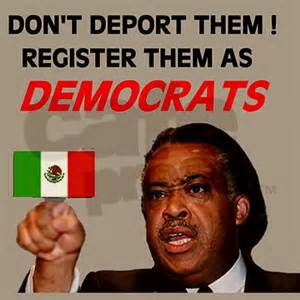
obama reister for the votre

With the first Tuesday following the first Monday in an even numbered year only a week or so away, I thought I would draw attention to the impending elections in the US. No matter what happens, Obama will still be president, and no matter what the election outcome is, he will continue to do his best to ruin the United States. As part of his program, we have the following, which should mean it would not make much sense to put your hopes on an election landslide to fix things up.

Putting non-citizens on the voters list is just one of the many ways the Democrats in the United States subvert their own democracy. Since they absolutely without question know that their own views on absolutely everything are the only views with any merit whatsoever, it is essential to ensure that no other views are ever allowed to affect policy. And of course, it’s also nice to have political power and the fantastic wealth it attracts to people who for the most part are otherwise without seriously marketable talents.

I actually cared about the outcome of the American presidential election in 2012 since I thought of it as the crucial political moment of our time. Obama won – in no small part because of fraud – and I now see the US as a train wreck. All of this fraud is to be expected. Here is the text that goes with the picture:

Obama program puts noncitizens on voter rolls « Watchdog.org:

“With early voting starting Thursday, North Carolina’s election board found 154 ineligible voters on its poll lists — and officials are examining thousands more questionable registrations.

The illegal immigrants landed on the state’s voter rolls, courtesy of the Obama administration’s Deferred Action for Childhood Arrivals program.

The State Board of Elections said late Tuesday that more than 9,000 additional voters’ names are being checked for legal status.

They do not expect to finish checking before early voting starts Thursday.

“We don’t know what we don’t know,” special counsel Brian LiVecchi told Watchdog.org.

Nearly 10,000 names on the rolls are tagged by the state Department of Motor Vehicles as “legally present,” but the Winston-Salem Journal reported that doesn’t mean all 10,000 are ineligible to vote.

When immigrants are certified under DACA deportation proceedings are frozen.”

Obama may still want to be a citizen of the world and take the US along with him, but he will still live in a gated community for the rest of his life to keep the riff raff out.

Interestingly, this has come from Captain Capitalism with these words:

This, more than any other reason, is why I have given up caring about the future of the US. . . . When you let people who aren’t citizen vote, you do not have a country. You have a resource for the world’s parasites to plunder.

I can see he and I are on the same page on this one.

UPDATE: He may not have invented it, and may not even have intended it, but I am going to give John Constantine credit for the perfect phrase to explain why Labor encourages the arrival of boat people. As he wrote in the comments:

Nothing to see here.

It is vital that vote people enclaves must be inserted into the last remaining pockets of ‘old australia’ to achieve sustainable diversity of socialist voting patterns.

Some henry ford of socialism has figured out how to mass produce socialist votes, and the blueprints have been passed around every power crazed control freak in post-western civilisation.

Boat people are vote people for the left, just as they are in the US. If they voted reliably Republican or for the Libs, you can be sure our borders would be more secure than the Berlin Wall.

FURTHER UPDATE: Look, even the Washington Post is getting into the act. Could non-citizens decide the November election? it asks. And here is part of the answer it gives:

Because non-citizens tended to favor Democrats (Obama won more than 80 percent of the votes of non-citizens in the 2008 CCES sample), we find that this participation was large enough to plausibly account for Democratic victories in a few close elections. Non-citizen votes could have given Senate Democrats the pivotal 60th vote needed to overcome filibusters in order to pass health-care reform and other Obama administration priorities in the 111th Congress. Sen. Al Franken (D-Minn.) won election in 2008 with a victory margin of 312 votes. Votes cast by just 0.65 percent of Minnesota non-citizens could account for this margin. It is also possible that non-citizen votes were responsible for Obama’s 2008 victory in North Carolina. Obama won the state by 14,177 votes, so a turnout by 5.1 percent of North Carolina’s adult non-citizens would have provided this victory margin.

How surprised are you by any of that, I wonder.

It’s not easy being non-green

I went along to hear ex-Greenpeace founder Patrick Moore last night and a very rewarding evening it was. A fellow Canadian and from our west coast so I may even have travelled in the same circles during the dropout stage of my life in the early 70s. I certainly knew whereof he spoke. I encourage you to go along, and also catch up with him on Andrew Bolt tomorrow. He has a roadshow presentation which you can hear for yourself, so I will stick to the Q&A which was as interesting as the rest. And if you are of the opinion you have heard it all before, you may have but I hadn’t so it may be worth your while. He has also not yet been scheduled for an interview by the Trotskyists at the ABC.

First my own question, which is something that worries me a very great deal. Moore presented a long line of statistics and other evidence, some I was familiar with and some I wasn’t, in large part pointing to the fraudulence of the global warming scam but also dealing with other areas of the environmental movement and the massive damage it is causing. So my question was to point out that anyone who has the inclination to follow the evidence and look at the data has already caught on and understands there is nothing to concern us. What, therefore, do you think, I asked, about green policies really being a form of religious observance, not science based, and therefore unreachable by the use of rational argument. To which he replied:

“I have no answer.”

I think that is the same answer I have and it is the essence of the problem. There is always some stray fact or random event that will keep people who desperately want to believe the worst about our way of life from straying from the fold. There are no crucial tests they set themselves. There is no actual standard, such as seeing whether or not temperatures have actually risen, which you would think ought to be fundamental. To a true fundamentalist there is no evidence actually required. The old cartoonist standard of the old man with the “we are doomed” sign is the mainstream. We live in an age of faith and nothing is allowed to disturb that faith.

The other answer to a question I found interesting was about why the environmental movement has been able to maintain such a strong position in spite of the massive harm it does and the absence of any serious factual basis for their claims. This was his answer:

There is a great convergence of our elites, each of which sees advantage to themselves in promoting and going along with the environmentalists:

1) the greens
2) politicians
3) the media
4) the grant-seeking academic community
5) businesses who want to look green as a promotional activity
6) most religions

That is a formidable combination that, quite frankly, I don’t see any prospect of defeating. In more authoritarian regimes green politics is a nullity but here in the West, I can see it is one more reason to believe we are at the end of time. It is only the fantastic cost to individuals that may eventually slow but never stop the damage being done. When your electricity bill is $1000 a quarter, there may be some reconsideration. In the meantime, I might go and get myself one of those “we are doomed” signs for myself.

If you would like to see Patrick, this is where you still can while he is in Australia. Also on Andrew Bolt tomorrow, at 10:00 am. A very good speaker and comes with the authority of someone who has been there and knows where all the bodies are buried.

Where you can still see Patrick Moore in Australia

MELBOURNE
27 Oct. 12 for 12:30 The Australian Club 110 William St 2-course lunch $110 p.p. (dress code)

CANBERRA
30 Oct.

1st Session 2-3pm afternoon tea 3-30 pm,
2nd session 3:30- 4:30 pm

Hughes Community Centre Wisdom Street, Hughes
$20 donation ($10 for students) requested plus $2 for afternoon tea payable at the door

PERTH
1 Nov.
1st meeting 4 – 5pm (GM crops) C3 Church, 94 Waratah Ave. Dalkeith.
2nd meeting 5:30 – 7pm (Climate), C3 Church, 94 Waratah Ave. Dalkeith
a $20 donation ($10 for students) is requested to cover costs – covers both sessions.

HOBART
3 Nov. TO BE ADVISED.
Please register your interest in the Hobart event with Garth Paltridge (paltridge@iinet.net.au)

BRISBANE
Nov. 5th 7 for 7:30, Irish Club 175 Elizabeth St. A $20 donation at the door is requested to cover costs.

NOOSA
Nov. 6th 5 for 5:30, TheJ, 60 Noosa Dr, Noosa Heads
To book for this event, just click on:
http://sa2.seatadvisor.com/sabo/servlets/EventSearch?presenter=AUNOOSHI&event=mse0611

a $20 donation will buy a ticket.