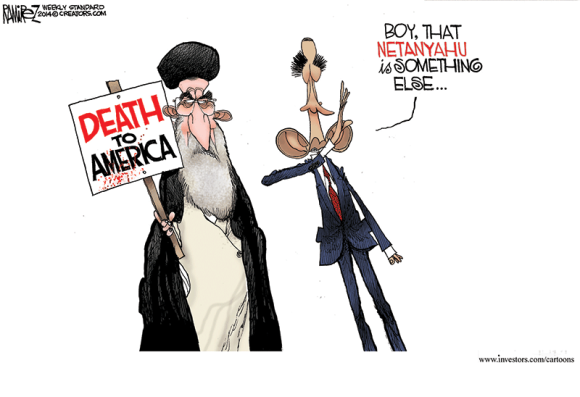
The damage a president can do especially if that’s his aim

obama netanyahu

From Scott Johnson at Powerline, HOW TO UNDERSTAND OBAMA’S IRAN DIPLOMACY.

I think the easiest way to understand Obama’s diplomacy is this. Assume that Obama believes Iran should have nuclear weapons and would like to facilitate the mullahs’ nuclear weapons program. This assumption is the Occam’s Razor that clarifies what might otherwise be obscure. The assumption may not be correct, but it should prove a handy guide to coming attractions.

It is the same for every policy. If you think of Obama’s aim as harming the white American middle class, and doing as much damage as possible to American foreign policy interests, you will never go wrong in guessing what he will try to achieve. There are plenty of obstacles so he cannot do anything he wants, but he does as much as he can. The American people elected their bitterest enemy to the White House, and as obvious as it is, no one in public life will say so loudly and clearly. Is it respect for the presidency, uncertainty about Obama’s actual motives or fear of exposing just how damaging a presidential system can be?

Defending the defensible

Here some lunatic defends General Pinochet in public. Well we all know what sort of person he must be. But what caught my eye were these two comments. The first one about the present:

But just to see how bad things have gotten in Chile: The Communist Party is back in power, and the Justice system keeps in jail veteran soldiers of the fight against the insurgents. To do this, the “Justice” system simply ignores an Amnesty Law form 1978 still valid and which covered both military and insurgents. And it also created out of thin air the category of “permanent hijacking”, for the disappeared during the regime. According to this, the old men languishing in jail still keep those disappeared who knows where. To these soldiers no benefit is given: they will stay in jail until they die. And there is a movement to put them in prison wih the general population, strip them of their ranks and their pensions. The revenge of the left is relentless. Right now, a judge is investigating the murder, in an encounter with police and secret service agents, of the head of the terrorist organization MIR in October 1974. He is accusing the agents of murder. It would be like bringing murder charges against the Navy Team that killed Osama Bin Laden. The main erson accused of so “dastardly” deed of ridding the wortld of this scum, is an officer of the army who has Russian roots, Miguel Krasnoff. Meanwhile, the head of the Communist Party, who plotted an assasination attempt against Pinochet in which several of his gurads were killed, and for which he is very proud, was recently cleared of any charges when a group of the widows of such guards brought forward an accusation. The judges applied of course the statutes of limitation, something the brave men who fought the communist takeover are being denied.

And then a reminder about the past:

What people don’t know: the socialist Allende won with a minority of votes, because the majority vote was split between the two conservative candidates. (There was no second round at that time.) Allende illegally took private industries for his own people to control, ruining the country’s economy. People even lacked food, thus the “pots and pans” march of middle-class women (which feminists hate, and never mention). Demonstrators in the cities were viciously attacked by communist gangs. Shopkeepers were attacked, the people terrorized to pacify them – the usual preparations for a communist takeover. When the communists (most of them non-Whites) were sentenced and imprisoned, Allende illegally let them out in the streets again. Thousands of times. The communist party trained guerrilla warfare in Cuba, and Cuban advisors, guns, ammo and explosives were smuggled in to Chile. It is known that people in the top of the government facilitated this – perhaps Allende himself. Finally the Senate and the Supreme Court formally asked the military to remove the president, listing his many crimes in a long letter. General Pinochet carried out their request. The communist takeover was stopped. (Sometimes brutally? Yes, it’s South America. And the communists had terrorized the people for years.) Allende committed suicide with his Soviet-made Kalashnikov. Pinochet let a Nobel Prize-winning economist fix the economy. Under Pinochet, Chile prospered and continued to do so after him. He promised to only rule for a while and then step aside for democracy – which is exactly what he did. Most Chileans LOVE Pinochet. Something the media hide from Westerners. The media and other leftists wanted Chile to become another communist dictatorship. The Chileans disagreed.

Around the same time we had our own take down of the Prime Minister via the Governor-General. All very constitutional here but the downside wasn’t quite in Allende territory either. And if you are interested in the kind of destructive potential an Allende has, just have a look at Venezuela right now.

Picked up at Captain Capitalism

Step into my parlour said the spider to the fly and let me give you some advice

From Brett Stevens at Amerika:

Liberalism wishes total death on all conservatives. We are what stands in their way but, even worse, we do not validate their viewpoint. That means that we can potentially puncture the bubble of illusion in which they exist, which they want us to subsidize through socialism lite in the form of subsidies.

With that it mind, conservatives would have to be mentally broken — and many are — to trust anything the leftist establishment tells us “in our best interests.” This is advice from an enemy, and any sane person expects that the enemy will give us advice that is convenient for that enemy, or in other words, leads to our downfall and the victory of the enemy. Their words are poison disguised as “helpfulness,” or what they call a “concern troll” on the internet.

The actuality of the mid-term elections is that conservatives won by plugging their pragmatic platform: reduce government, restore social order and values, keep the military strong and reverse course from the socialist paradise of the Obamanauts. In other words, eternal conservative values geared toward the founding group and majority of Americans.

Of course the left wants us to disregard this knowledge, and many conservatives do, too. It is easier to win elections by waving the WE’RE NOT DEMOCRATS flag and collecting votes. Easier = higher margins, greater reliability. But if conservatives do not get a handle on the ongoing American disaster soon, they will be eliminated.

[Via Captain Capitalism]

Steven Kates’s Free Market Economics 2nd ed

I was particularly pleased by Old woman of the north, blogstrop and danger mouse who saw Mill’s genius in my previous post on Mill’s Principles of Political Economy. I could not agree more with OWOTN where she wrote “What beautiful, clear English! The thought processes flow.” And so they do. And Mr Bear, Ted if I may, I just mention the book because I do think it would be an aid to governments who are sinking our economic ship. I merely translate Mill into language that is easier to read in the twenty-first century. This is my attempt to say what Mill said in that same passage. Nowhere as poetic, nowhere as deep, but hopefully getting to the same point. These are the opening paras of Chapter 3.

Value added

Possibly the most difficult area to understand about economics is one that you would think would be amongst the easiest and most commonly understood. This is the area of value and value added.

If economics were going to provide an understanding of anything, it would have to be, you would think, an understanding of what value is and where it comes from. And while economists do have such theories, they are relatively obscure and are almost never discussed at the introductory level. Value in economics is a very difficult idea.

Yet for all that, it is not possible to have a clear understanding of either economics or economic policy unless one has a reasonably clear idea about what value is and how it is created. And unless one has this reasonably clear idea about the nature of value, it is almost impossible to make judgements about almost anything done in an economy, from its very organization to the finer details of individual decisions.

That the aim of economic activity is to create value is obvious and straightforward, for all the difficulty in knowing just what value actually is. Something has value to the extent that a person is better off with it than without it. In economics we frequently say that a good or service has value if it is able to provide utility. Economic activity is aimed at providing individuals with increased levels of personal utility.

But it is also true that in almost all cases to produce something of value it is first necessary to use up some of our resources that also have value. Nothing comes from nothing. And this is where the notion of value needs to be further refined. A tonne of steel also has value, but not as a final good providing utility. It has value only as a productive input that can be used to produce the goods and services that do provide that utility. The value of such inputs is derived from the value of the final goods and services they can be used to produce. Which brings us to the crucial issue of value added.

To create value in the form of the final goods and services that provide utility is the central purpose of economic activity. In the process of creating such value, some part of the resources that exist must be used up in the process. Value added underscores what is too often forgotten, that to add value one must also at the same time destroy value. The word ‘added’ is there to remind us that we have also had to subtract the resources used up in producing whatever has now been brought into existence. Value added is thus the net result of using up various resources which already have value, to create other products that have even more value.

It is only if the value of the products newly produced is greater than the value of the resources used up that value adding has occurred. Economic growth is the way we normally discuss value adding activities. They are one and the same. The value of output must exceed the value of the inputs used up if economic growth across an economy is to occur.

My advice is to read Mill if you can. But if you would like a modern version, then you will need to read this.

John Stuart Mill’s Principles of Political Economy

I have long had a view that John Stuart Mill’s Principles of Political Economy is the best economics book ever written. But I have now also come to the view that no one is ever going to contradict me because virtually no one can any longer read the book. I have just been back over the book on a project on Mill I am just beginning and turned to Book I Chapter II which is “On Labour”. I say to you in all honesty that it is a fascinating chapter from which there is much to learn, including how little there is that is truly new that is not in Mill. But here is the opening para of the chapter from which the one thing I guarantee you will learn is how hard the book must be to read.

§ 1. The labour which terminates in the production of an article fitted for some human use, is either employed directly about the thing, or in previous operations destined to facilitate, perhaps essential to the possibility of, the subsequent ones. In making bread, for example, the labour employed about the thing itself is that of the baker; but the labour of the miller, though employed directly in the production not of bread but of flour, is equally part of the aggregate sum of labour by which the bread is produced; as is also the labour of the sower and of the reaper. Some may think that all these persons ought to be considered as employing their labour directly about the thing; the corn, the flour, and the bread being one substance in three different states. Without disputing about this question of mere language, there is still the ploughman, who prepared the ground for the seed, and whose labour never came in contact with the substance in any of its states; and the plough-maker, whose share in the result was still more remote. All these persons ultimately derive the remuneration of their labour from the bread, or its price: the plough-maker as much as the rest; for since ploughs are of no use except for tilling the soil, no one would make or use ploughs for any other reason than because the increased returns, thereby obtained from the ground, afforded a source from which an adequate equivalent could be assigned for the labour of the plough-maker. If the produce is to be used or consumed in the form of bread, it is from the bread that this equivalent must come. The bread must suffice to remunerate all these labourers, and several others; such as the carpenters and bricklayers who erected the farm-buildings; the hedgers and ditchers who made the fences necessary for the protection of the crop; the miners and smelters who extracted or prepared the iron of which the plough and other implements [30] were made. These, however, and the plough-maker, do not depend for their remuneration upon the bread made from the produce of a single harvest, but upon that made from the produce of all the harvests which are successively gathered until the plough, or the buildings and fences, are worn out. We must add yet another kind of labour; that of transporting the produce from the place of its production to the place of its destined use: the labour of carrying the corn to market, and from market to the miller’s, the flour from the miller’s to the baker’s, and the bread from the baker’s to the place of its final consumption. This labour is sometimes very considerable: flour is [1848] transported to England from beyond the Atlantic, corn from the heart of Russia; and in addition to the labourers immediately employed, the waggoners and sailors, there are also costly instruments, such as ships, in the construction of which much labour has been expended: that labour, however, not depending for its whole remuneration upon the bread, but for a part only; ships being usually, during the course of their existence, employed in the transport of many different kinds of commodities.

He does wear you out. I have visions of Mill, who wrote this thousand page book in about eighteen months while holding a full-time job in the East India Company, sitting there in his free moments with his pen, ink and paper, scratching out the text as he tried to distill his thoughts into something coherent. The man with the highest IQ in the nineteenth century, his book was the byword for economic theory for the following fifty years and then some. My copy is a discarded text from the 1920s that was still being used at the University of Melbourne. If you would like to see Mill up to date, you can read the 2nd ed of my Free Market Economics and when you see the book (unless you read it electronically) you will understand why the cover shows a water mill as its main motif.

To which from further comments I must add this:

John Stuart Mill,
By a mighty effort of will,
Overcame his natural bonhomie
And wrote “Principles of Political Economy.”

Preserving the right to defend ourselves against our enemies

On November 25, 1994 Isaiah Berlin was given an honorary degree of Doctor of Laws at the University of Toronto for which he prepared what he called a “short credo”. Read it all. It is about is protecting ourselves from the enemies of our civilisation and the kinds of things we may need to do. Some of these enemies possess the potential to wield immense power in combination with a conviction that they are not only irrefutably right but that this certainty gives them the right to do whatever it takes to prevail. So far as they are concerned, the future of mankind is dependent on understanding whatever it is they believe. They will therefore do whatever it takes to make their own views ascendant. Recognise the type? Any current examples around? Free and unfettered speech for them and those who sympathise?

Here is part of what Isaiah Berlin had to say at the end of a long life thinking about these and other similar questions. He was thinking about a European menace that had come with The Enlightenment (so-called) which led to many a totalitarian ideology. Today it is a more ancient enemy of free thought that is the problem. And to tell the truth, with ISIS and its offshoots, it is hard to see that they are trying to do me or anyone else any good. Berlin may thus be even farther away from explaining the nature of the problem we face than he could have known. I don’t quite see the benefit to the people whose heads they cut off nor to anyone else. This is part of what Berlin wrote:

If you are truly convinced that there is some solution to all human problems, that one can conceive an ideal society which men can reach if only they do what is necessary to attain it, then you and your followers must believe that no price can be too high to pay in order to open the gates of such a paradise. Only the stupid and malevolent will resist once certain simple truths are put to them. Those who resist must be persuaded; if they cannot be persuaded, laws must be passed to restrain them; if that does not work, then coercion, if need be violence, will inevitably have to be used — if necessary, terror, slaughter. Lenin believed this after reading Das Kapital, and consistently taught that if a just, peaceful, happy, free, virtuous society could be created by the means he advocated, then the end justified any methods that needed to be used, literally any.

Nothing about our current marauders reminds me in any way of people who are looking for “a just, peaceful, happy, free, virtuous society”. They merely look like the return of Tamerlane and Genghis Khan. The overlay of bringing any kind of virtue to the world is not credible. They could not possibly even believe it themselves. That our own crew of leftist misfits and psychopaths give them cover is part of what Berlin was originally referring to when his thoughts only ranged as far as Lenin and Pol Pot. ISIS is a different world. So what should be done? How are we to protect ourselves from such evil? Here’s his advice:

I am afraid I have no dramatic answer to offer: only that if these ultimate human values by which we live are to be pursued, then compromises, trade-offs, arrangements have to be made if the worst is not to happen. So much liberty for so much equality, so much individual self-expression for so much security, so much justice for so much compassion. My point is that some values clash: the ends pursued by human beings are all generated by our common nature, but their pursuit has to be to some degree controlled — liberty and the pursuit of happiness, I repeat, may not be fully compatible with each other, nor are liberty, equality, and fraternity.

So we must weigh and measure, bargain, compromise, and prevent the crushing of one form of life by its rivals. I know only too well that this is not a flag under which idealistic and enthusiastic young men and women may wish to march — it seems too tame, too reasonable, too bourgeois, it does not engage the generous emotions. But you must believe me, one cannot have everything one wants — not only in practice, but even in theory. The denial of this, the search for a single, overarching ideal because it is the one and only true one for humanity, invariably leads to coercion. And then to destruction.

We are able to talk to each other because we are, for the most part, bourgeoise and therefore prone to compromise while recognising the need to trade off parts of one desired outcome for others which compete and get in the way of each other. This is the world we live in, will always live in. There are people who would impose their wills on us if they could and literally by the sword and armed might. If you think you can compromise with such savagery you are wrong. They must be fought every inch of the way. Speaking for myself, I will not put our civilisation, my civilisation, at supreme risk to preserve some individual principle such as the right to say whatever I want whenever I want no matter what harm it may do to myself, my family, my friends, my country and my way of life. Berlin thought he saw a better world coming but he hadn’t seen what we have.

I am glad that you to whom I speak will see the twenty-first century, which I feel sure can be only a better time for mankind than my terrible century has been. I congratulate you on your good fortune; I regret that I shall not see this brighter future, which I am convinced is coming.

Well if such a future is coming, it is not coming yet. In the meantime, we must do what we can to preserve this way of life that if snuffed out as so many wish to do will not soon return. It is up to us, we who are alive today, to defend the freedoms we inherited, which, as always, requires us to balance each of our rights against others of our rights to preserve what we have. If our enemies prevail, no one will be talking about preserving our rights for a very long time to come.

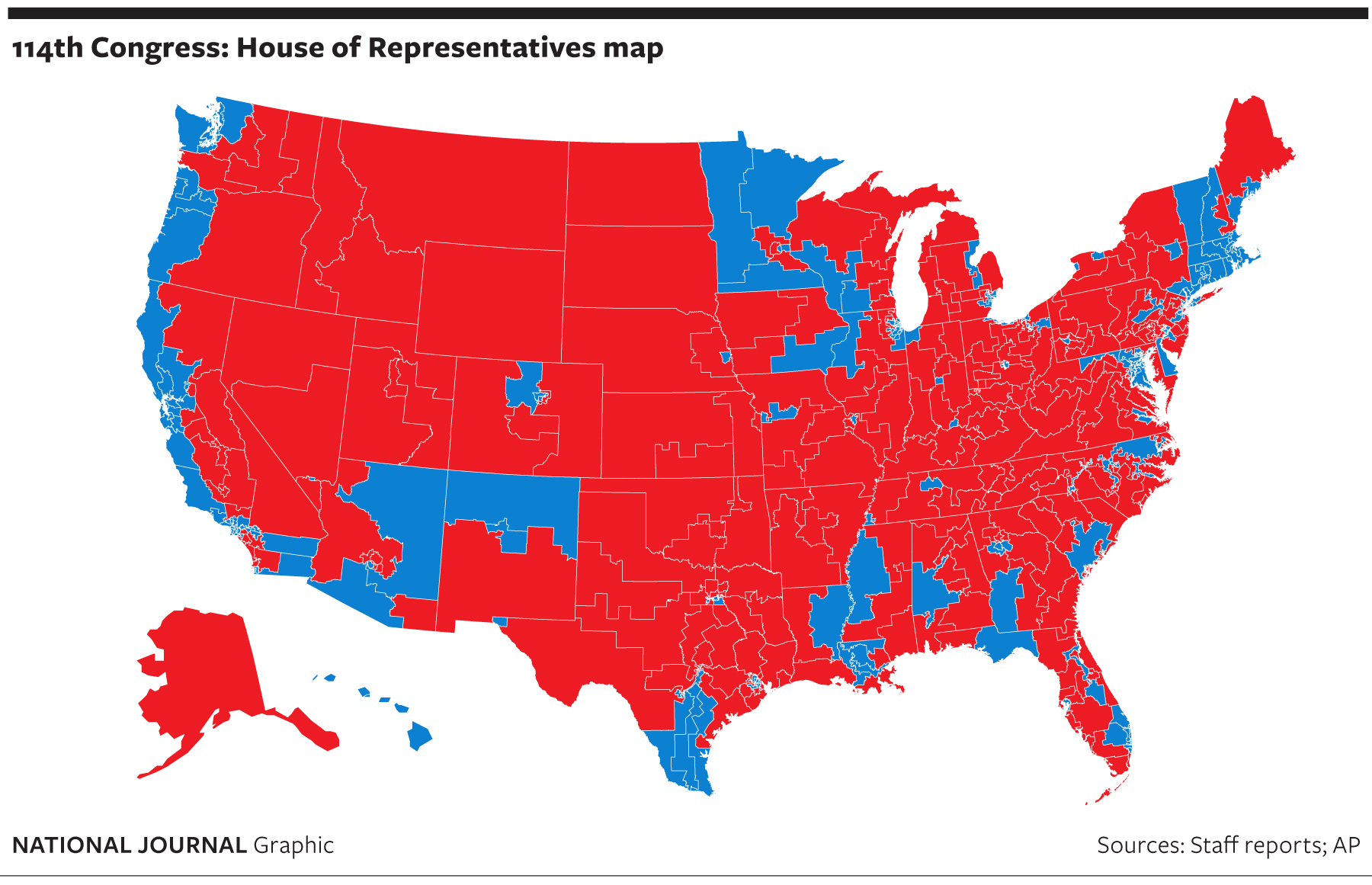
Map of House Districts in the 114th Congress

obama map of congressional districts

Here’s the lower chamber of the 114th Congress, in vivid color.

And I think Rush Limbaugh is absolutely right:

The results do not mean that voters want Republicans to govern. The election does also not mean that the country’s become conservative. It can’t be said that there was an ideological component to the mandate, because the Republicans did not run on ideology. The Republicans ran everywhere to stop Obama, and that’s what the mandate is. Now, whether they want to accept the mandate or not, that’s another question. . . .

The country’s depressed because of Democrats. The country is out of work because of Democrats. The country is feeling aimless because of Democrats. The country is not optimistic about its future because of Democrats! There is no way the vote yesterday was a signal to work with them. They have had six years of unstoppable destruction, and the American people — and I, by the way — want it stopped.

John Stuart Mill on the role of the state in the prevention of harm to others

This is John Stuart Mill on the basic principle of a free society found in his On Liberty:

“The object of this Essay is to assert one very simple principle, as entitled to govern absolutely the dealings of society with the individual in the way of compulsion and control, whether the means used be physical force in the form of legal penalties, or the moral coercion of public opinion. That principle is, that the sole end for which mankind are warranted, individually or collectively, in interfering with the liberty of action of any of their number, is self-protection. That the only purpose for which power can be rightfully exercised over any member of a civilised community, against his will, is to prevent harm to others.” [My bolding]

I have an article at Quadrant Online on The Right and Will to Defend Ourselves. What do I think of the state taking strong measures to protect us from the harm that others wish to do. I am all for it. There is no single simple overriding principle that is the final arbiter in what actions a state may take to protect me from the harm others wish to do. Here is Isaiah Berlin, whom I quote in the article, discussing the same thing:

If these ultimate human values by which we live are to be pursued, then compromises, trade-offs, arrangements have to be made if the worst is not to happen. So much liberty for so much equality, so much individual self-expression for so much security, so much justice for so much compassion.

My point is that some values clash: the ends pursued by human beings are all generated by our common nature, but their pursuit has to be to some degree controlled — liberty and the pursuit of happiness, I repeat, may not be fully compatible with each other, nor are liberty, equality, and fraternity.

Berlin not only understood Mill perfectly well, that would be where he would have found his own principle first stated. Minority opinion is one thing which must be protected to the ends of the earth; the call to murder one’s fellow citizens is quite another thing altogether.