
From The Campus Review. This is an exact reprint.
Survey results highlight philosophical debate about universities’ purpose
The report, by QS and student recruitment agency the Institute of Student Employers, found that employers thought students deficient in 12 of the 15 skills surveyed.
Having also gleaned insights from 16,000 students, the report authors noted that students and employers held different views on which skills were most valuable. While students believed creativity and data analysis were key, employers preferred problem-solving, teamwork and communication skills.
The results also varied by business size, as well as location. For example, large companies prized leadership over technical skills, and North American employers were relatively satisfied with their graduate employees – especially compared with Latin American ones.
Global Overview of Core Skills: Importance v Satisfaction
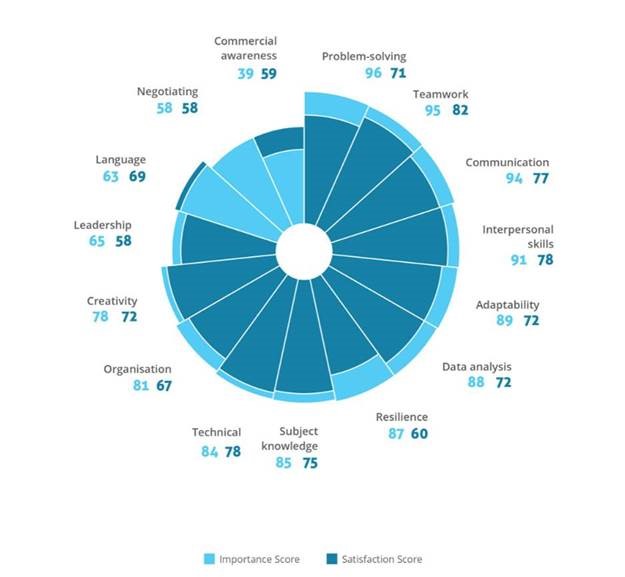
Photo: QS/Institute of Student Employers
Dasha Karzunina, Market Insights Manager at QS, said the report verifies widely-held beliefs about students’ skills gaps. This implies that a purpose of university education is to prepare students for employment. Undoubtedly many – if not all universities would affirm this. Yet some people argue that preparing students for employment is the job of vocational providers, not universities.
These, however, are lone voices. Students want graduate jobs, so universities, swayed by market forces, attempt to ready students for them. Examples include the growing emphasis universities place on inculcating soft, transferable skills in students to suit the rapidly shifting employment landscape, and the increasing prominence of experiential learning and industry placements across degrees.
To further prepare students for careers, universities could introduce measures that enhance their resilience – their largest skill ‘gap’. For instance, universities could consider improving resilience as part of the student experience, even as an educational outcome.
 Law of Markets