
Auchy-lès-Hesdin

New Lanark
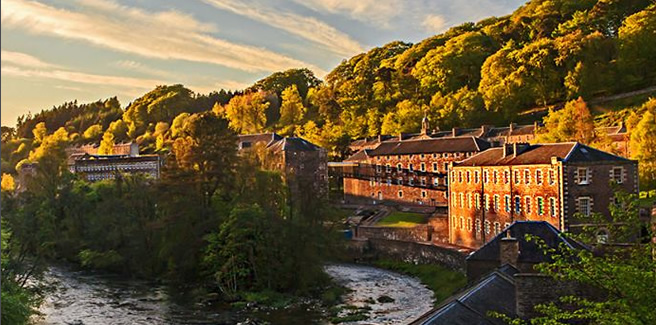
I fear, based on the thread of commentary that followed my earlier posting on the Societies for the History of Economics discussion thread, that the astonishing uniqueness and historical significance of J.-B. Say’s textile mill at Auchy-lès-Hesdin is not fully appreciated. I have now therefore put up a follow-up posting. I fear from the comments there may not be an appreciation of what is found at the site nor the will to see it preserved if it can be done. J.-B. Say was one of the greatest economists of all time, mentioned in virtually every history of economics text ever written. He was not only amongst the first economists to insist on the importance of the entrepreneur in the study of economics, he was himself an entrepreneur and we have almost intact the remains of the factory he commenced. The textile mill he built at Auchy-lès-Hesdin in 1805 remains along with the house he had commissioned. It was while he was living at Auchy that he completed the second edition of his Treatise and it was there that he provided the first ever textbook treatment of what we now call Say’s Law. There is nothing like it on the face of the earth. The nearest approximation are the buildings at New Lanark, where Robert Owen, who was not an economist, tried his own experiments in entrepreneurship, and the Thünen Museum in Germany.
These three sites are exceptional in their interest, but only one at the moment remains unattended and in near ruins. Please do look at the three websites below to see the comparison:
This is the note I have received from M. Zéphyr Tiliette, the archivist at Auchy, based on my posting:
We have to remain modest but we agree with you : Auchy-lès-Hesdin is a very special place given its history and particularly the association of the presence of Jean-Baptiste Say, an already great figure and a famous economist, and the industrial revolution he introduced in this remote place of the north of France. Strictly speaking, he went not there into exile but he certainly enjoyed more freedom there about 200 km away from Paris and distant from the Napoleon’s government. He also prepared in Auchy the 2d edition of his « Traité d’Economie Politique » published in 1814 ; as he wrote, he had some time for that in 1811 / 1812.
Locally, it is still easy to imagine how was the site 200 years ago when Jean-Baptiste Say lived there with his family : the abbey church, park limits, surrounding walls, river, waterfall, are practically unchanged. Most of the industrial buildings have been rebuilt, their equipment continually modernized and the hydraulic power device has been rearranged in order to continue to generate some electric power additional to the main steam and electric power systems. It is under maintenance presently.
The massive « Château Blanc » was built shortly after the Jean-Baptiste Say‘s departure by the Grivel family. Our economist lived right in the same area, probably in the best abbey’s appartments, likely as his partner Grivel. Auchy « a kind of Versailles for economists » as you say !! Thank you very much for Auchy !! But a lot of things would be to be done to approach this designation. Nevertheless, the presence and the work of J-B Say there corresponds to an event very significant by many aspects related to an example of industrial revolution in a rustic place at that time. This would deserve an historical research including regional human consequences and may be the other factory of the « Say C° » in Abbeville (35 km away ) ( of the brother Louis Say ), also in relation with other industrial developments nearby.
The future of the existing industrial buildings of Auchy is a concern, of course. But I entirely agree with you : the site deserves a significant place of memory devoted to J-B Say, to his history, his work, the economy science and so on, a kind of « museum for the history of economic thought » as you write. May be such a concept could collect a part of « archives » related to studies on J-B Say carried out at the Lyon 2 University as Pr. André Tiran, the Say expert, mentioned at Auchy on August 30th. It also could be combined with a valuable, historical documentation about the regional history and with antique library pieces for instance concerning « The Âge of Enlightenment », the XVIIIth century, J-B Say being a heir of it. We also could emphasize the great interest of J-B Say in the people’s education.
Such a project has to be discussed ; it is not yet finalized. Cognizant people and officials should be met. Auchy needs money for that.
Surely it would be an attractive place to visit « midway between Azincourt and Crécy » !! as you say.
This is not some graveside or an office in an economics department of some other flotsam and jetsam from the vast history of economics. This is a living, existing embodiment on a vast grounds within an industrial estate that was the work of one of the greatest economists who ever lived who also built a factory at the very start of the industrial revolution. This is not, moreover, a pin factory. This was a cotton mill built at the very dawn of a new age. You can stand on the site and see across the last two centuries.
This is something that historians of economics should be interested in. It is something that all economists should be interested in. It is something anyone with an interest in history should be interested in. It is here now, and there are many possibilities for the site including demolition in some fit of distraction. As M. Tiliette states, the restoration is in need of money, but it is not a vast ocean of money. And until you wander the park surrounding the buildings you will not see why I have described this place as the Versailles of Economics. If you are close, you should go and look. There is nothing else like it and it will be to our shame if we let this place go to ruins when it could just as easily become a World Heritage site in the same way as New Lanark.
 Law of Markets