
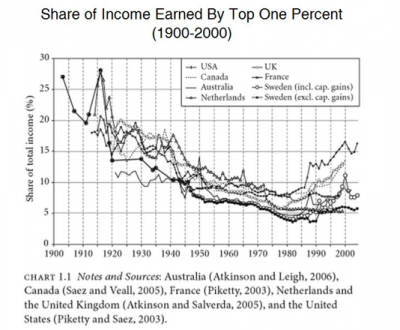
Alan Meltzer has written an article he has titled, The United States of Envy about the distribution of income across the past century. Here’s his main point:
Taxing the rich to redistribute did not produce growth. On the contrary, growth reduced the share earned by the highest earners.
Rapid growth comes from investment in new and better productive assets taking place more rapidly than existing assets are eaten away by use and decay. More saving and less consumption is what is required and nothing else will do. But here’s the catch. If investment projects are actually going to create value and raise living standards, they will have to be chosen by individual entrepreneurs – not governments who know only how to squander. Therefore, these individual entrepreneurs, to the extent they are actually successful, become wealthy. There is no way to succeed at some entrepreneurial innovation without becoming wealthy, and there is no means to organise an economy that will encourage entrepreneurial innovation without offering wealth to those who succeed. Hence envy.
But the envy is not just at wealth. No one cares about the wealth of movie stars or sports stars. They are amongst the wealthiest people in every society. But they do things that people admire and wish they could do themselves and tend to be young or at least glamorous. People who run businesses, however, are old and boring, hardworking and stodgy. Numbers people who may hire but will also fire. They focus on costs and sell what they produce at a profit. Their value system, whatever charitable work they may do and philanthropy they may spread, is still essentially Protestant work ethic irrespective of their actual religious beliefs.
But suppose it is drive, intelligence, personal ambition, an eye for detail, a grand vision and other such characteristics that matter and make all the difference. These traits are unevenly distributed across every population and thus not everyone has them to the same extent. Some people are lazy, not very bright, unambitious, slothful and without ideas, any single one of which will keep you from excelling. Well whose fault is that and why should these people be made to suffer for it? Why should the unequal distribution, not of wealth and income but of personal characteristics, determine not just your financial position but actual status in life?
So when we talk about the distribution of income we are really talking about the distribution of personal characteristics, with a tremendous amount of resentment directed towards those who actually do succeed. But what social policy has now done is to finance the lazy, the less intelligent, the unambitious, slothful and those without ideas with just enough of the earth’s worldly goods to keep them alive. But it has also vastly undermined those who might have been more ambitious, more creative, more productive with the result that individuals in great numbers fall into the abyss of non-achievement. And once in such condition, there is almost no means to pull oneself upwards. And so the envy and with it the socialism of the modern day whose greatest enemy is commercial and financial success driven by the resentment of those who can do more than they can and who are far more likely to lead lives of integrity and self-fulfilment.
 Law of Markets