
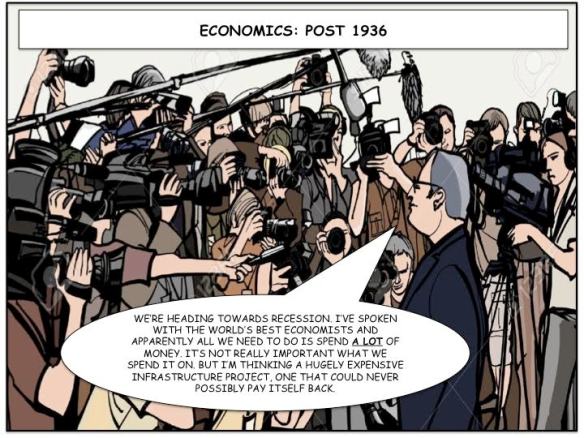
It’s my birthday, and my younger son has given me a present. You can see whose house he was brought up in. And while it may spoil the joke a bit by adding some commentary, you never know in this day and age what others will and will not see. The first picture is straightforward, however. You hear the equivalent said all the time in every economy.
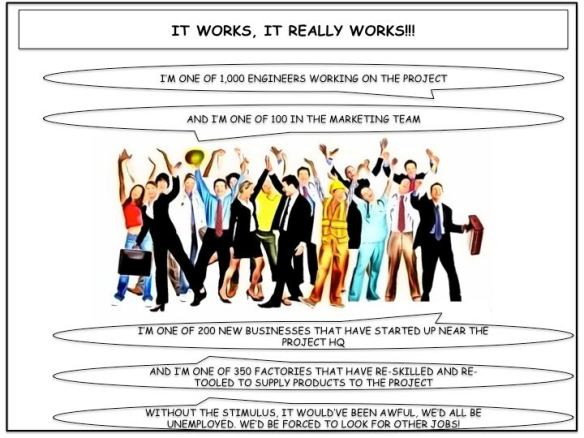
The second is the subtle one. The government has chosen projects that will never repay their costs which means that the economy, so far as these expenditures go, will end up less well off at the end than it was before. Other projects, almost invariably from the private sector, will usually make up for this loss. But non-value-adding projects pull an economy backwards. If you are getting fewer units of output back compared with the number of units used up in production, living standards must contract. But as the picture shows, lots of people are employed. They are just not employed in projects that create net wealth, which includes those employed in industries supplying inputs.
Because Keynesian economics is all aggregates, the structural problems created by this expenditure is invisible both in theory and in relation to the actual circumstances of the economy. People are, to all appearances, working and producing. The problem remains that what is produced has less value than the resources used up. One day, as the debts pile up and deficits grow, the expenditure must be withdrawn with the result that the entire structure of production must then be reconfigured in a way that allows productivity to grow. That reconfiguration is infinitely more painful than things would have been had you let the economy adjust in the first place.
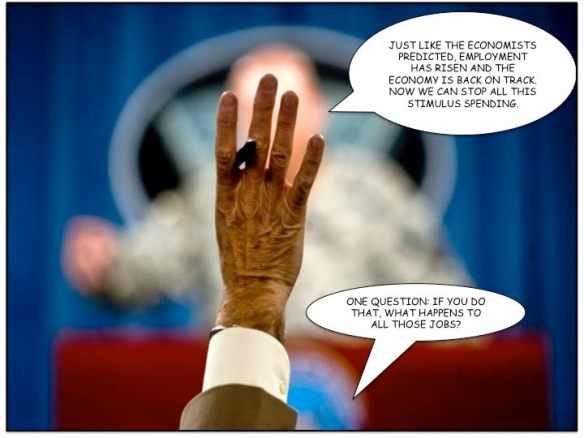
My son is neither an economist nor a graphic designer. The message is nevertheless sound and coherent with the presentation clarity itself.
And the world is changing. I have just been sent this from The Spectator: The one thing most people think they know about economics is wrong with the subheading, “Keynesian deficit spending makes sense – but over and over again it has not worked”. My What’s Wrong with Keynesian Economics? was sent off for production on Friday. Most people, especially economists, do indeed still think Keynesian theory “makes sense”, they just cannot work out why it never works. If they actually understood how an economy does work, they would understand why Keynesian theory is complete nonsense.
And because the manuscript has now gone off, I am heading off and away for my version of lying by the beach. Blogging may therefore be more intermittent than usual.
 Law of Markets